Ceremony and student festival set for Sunday in Kodaira
Campus slogans praising Kim Jong-un sit alongside claims of educational heritage
Chosun University in Japan, marking its 70th anniversary this year, will hold a commemorative festival Sunday. The event celebrates the history of ethnic Korean education among Koreans living in Japan, but slogans praising North Korea's leader displayed on campus point to the school's enduring political ties to Pyongyang.
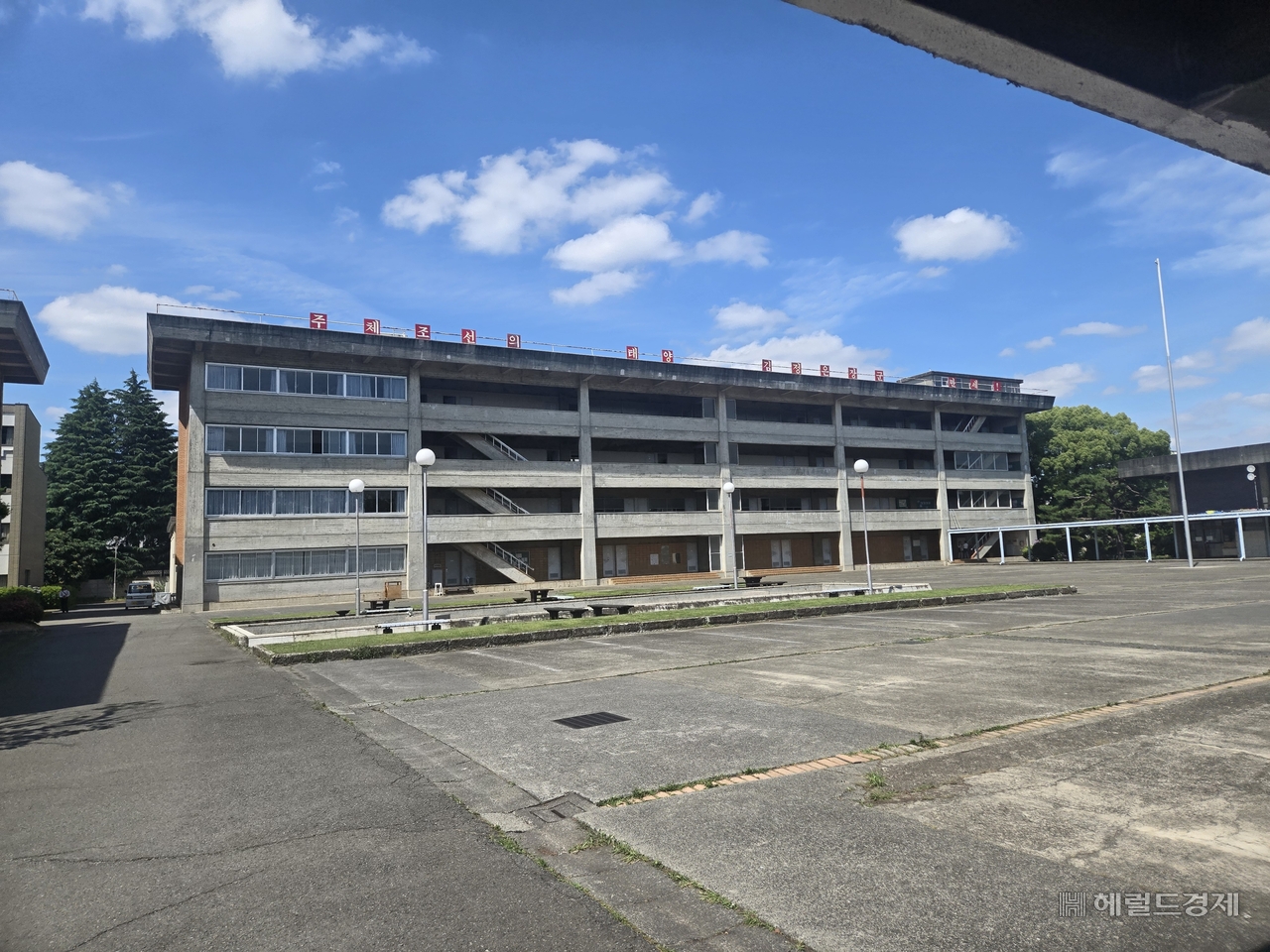
A photograph of the campus of Chosun University in Kodaira, Tokyo, shows the phrase "Long live General Kim Jong-un, the sun of Juche Korea!" installed on the rooftop of a building. The slogan runs along the top of the structure in white lettering on a red background.
The organizing committee for the university's 70th anniversary announced on social media that it will hold a ceremony, student festival and alumni gathering Sunday at a special venue on campus. The event carries the slogan "70 years of pride, confidence toward 100!"
A morning ceremony will be followed by a student festival on the athletic field, with a welcome and appreciation performance, a commemorative performance and a grand finale chorus scheduled for the afternoon. A photo exhibition tracing the school's history, a dormitory tour and alumni networking events are also planned.
Chosun University was founded in Tokyo on April 10, 1956, as an ethnic education institution affiliated with the General Association of Korean Residents in Japan, known as Chongryon. It is a separate institution from Chosun University in Gwangju, South Korea, and is classified under Japanese law as a "miscellaneous school" rather than a standard university.
The school's ties to North Korea — a subject of ongoing controversy in Japan — are also evident in an institutional history introduced by a university official. In a March 29, 2025, contribution to the Choson Sinbo, Ri Byong-hwi, a vice director and professor in the university's academic affairs department, said North Korea's degree and academic title committee conferred professorships and associate professorships on 10 faculty members, including the then-president and vice president, in 1965. Ri added that the then-head of academic affairs was awarded a North Korean doctoral degree in 1972 — a record indicating that Pyongyang played a role in certifying the academic ranks and degrees of the school's faculty.
The piece also documented instances of North Korea's leadership directing the school's educational priorities. According to the article, Kim Il-sung met with a university delegation in November 1976 and called for greater emphasis on foreign-language education and the training of technical personnel in fields such as electronic science. Ri also linked the expansion of academic departments in the 1960s to North Korea's socialist construction drive and the political agenda of the ethnic Korean movement in Japan at the time — an account that reflects how the school's educational development was shaped by its political relationship with Pyongyang.
The central challenge going forward is how the university can preserve its identity as an institution of ethnic Korean education while securing genuine independence in its curriculum and governance. Key questions include how the school explains North Korea's influence on current educational content and decision-making, and whether students are guaranteed an environment in which they can learn and express diverse perspectives. Distinguishing between the educational mission of preserving language and culture and outright support for a specific political system is also essential if Chosun University is to build broader trust within Japanese society.
sjkim@heraldcorp.com