'Treatment must continue outside the hospital' — home care medicine moves beyond expanding coverage toward quality reform; discussions range from broadening eligibility to younger patients to building outcome-based evaluation frameworks and strengthening care continuity from discharge to home
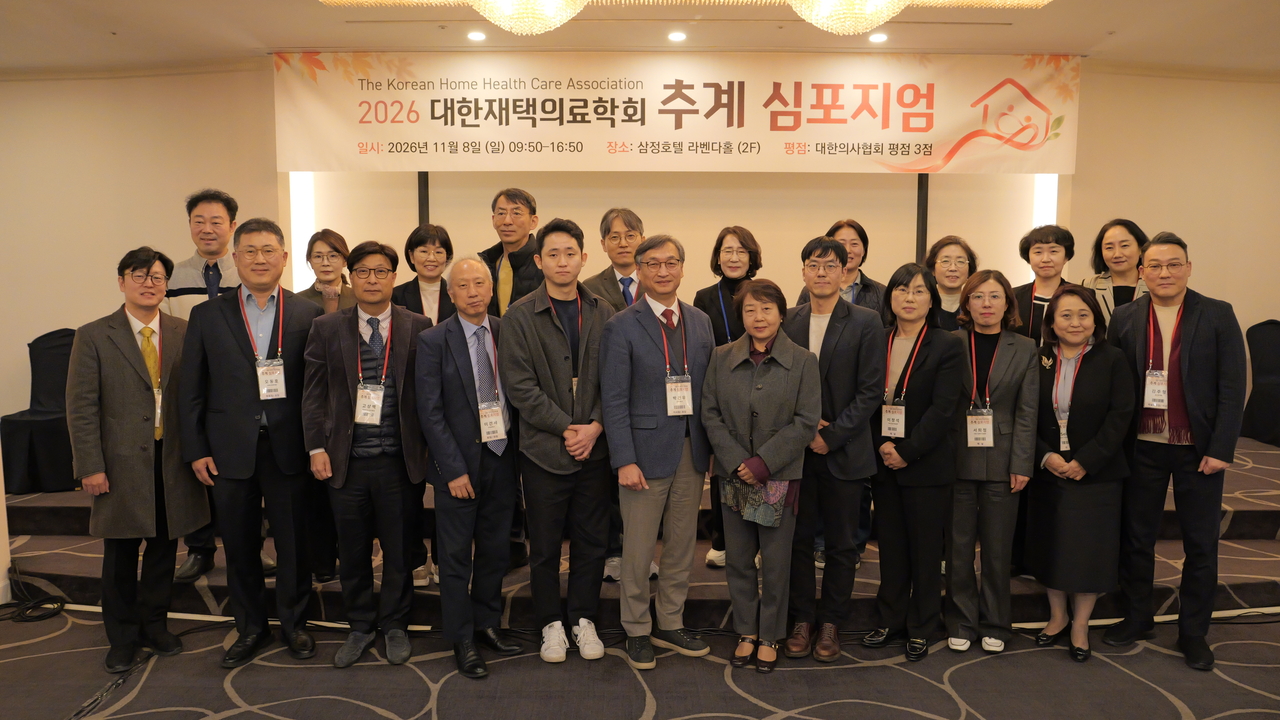
As medical services extend from hospitals into the home, home care medicine policy is reaching a new turning point. Calls are growing to move beyond simply increasing the number of patients eligible for home visits and the institutions providing them, and instead to ensure that patients can receive safe, continuous treatment at home by securing quality care and service continuity. A key challenge raised at the conference was the need to move away from a system focused on elderly long-term care recipients and expand support to all age groups requiring medical care.
The Korean Academy of Home Care Medicine held its 2026 fall academic conference Sunday at Hotel Samjeong in Gangnam-gu, Seoul, under the theme "Expanding to the Home, Setting the Standard: The Growth and Quality of Home Care Medicine."
The conference was organized to pursue both the quantitative expansion and qualitative improvement of home care medicine at the same time. Experts from medicine, nursing, caregiving and health information fields took part, drawing on the experiences of patients and their families to discuss a broad range of topics — including frameworks for evaluating medical services, clinical management, post-discharge care coordination, health information sharing and the use of telemedicine.
Discussion centered particularly on the need to move away from measuring home care outcomes by the number of visits or service delivery figures, and instead focus on substantive treatment results — including patients' health status, maintenance of daily life, and reductions in preventable hospitalizations and emergency room visits.
Redefining quality benchmarks: outcomes over visit counts
The first session, chaired by Board Chairman Park Geon-woo, examined the role of home care medicine and its evaluation criteria, starting from the realities of care as experienced by patients and their families.
Cho Ki-hyun, an author and representative of the young caregivers community N-inbun, and Hong Jong-won, director of Geongangeui Jip Clinic, shared the difficulties and experiences that family caregivers and visiting physicians face in the field, drawing on their co-authored book "When We Call Our Relationship Care."
Kim Ju-hyung, academic director of the Korean Academy of Home Care Medicine, Lee Jeong-seok, director of the Long-Term Care Research Center at the National Health Insurance Service, and Seo Hui-jeong, director of the Service Innovation Center at the Korea Institute for Healthcare Accreditation, then joined the discussion on institutional measures to objectively evaluate and guarantee the quality of home care medicine.
Kim said quantitative indicators alone — such as the number of home visits and inter-institutional referrals — are insufficient to adequately assess the actual level of medical services provided.
Kim proposed that evaluations should incorporate the appropriateness of treatment records, follow-up measures based on test results, medication management for patients taking multiple drugs simultaneously, and whether preventable hospitalizations and emergency room visits have occurred.
Participants also called for strengthening the role of specialized home nursing and home rehabilitation institutions and building a cooperative framework with medical facilities. Emphasis was placed on developing a community-level coordination model that allows small clinics to participate in home care medicine, along with a division of roles that lets physicians focus on clinical care.
From nutrition and dementia management to post-discharge care: strengthening treatment continuity
The clinical session, chaired by Vice President Oh Dong-ho, addressed health management challenges frequently encountered in home care settings for patients with serious and chronic conditions.
Lee Chung-hyung, the academy's education director and director of Seoul Bom United Clinic, explained the importance of home-based nutritional management, saying assessments should go beyond weight changes and food intake to comprehensively evaluate swallowing function, the patient's living environment and the family's caregiving capacity.
Lee Sang-beom, the academy's administrative director and director of Seoul Sinnae Clinic, presented the need for tailored management of Alzheimer's patients that accounts for drug tolerability in elderly and underweight patients, gradual dose adjustment, polypharmacy and medication adherence.
The nursing session, chaired by Vice President Tak Yeong-ran, focused on continuity of treatment from hospital to home as its central agenda.
Kim Yun-ok, team leader at Asan Medical Center's Integrated Care Support Center, introduced "WithONE," an integrated care program for high-risk elderly patients. The program screens for frailty and functional decline from the early stages of hospitalization and connects patients to home nursing, home care medicine and community resources through multidisciplinary intervention and integrated discharge planning.
Lee Yun-gyeong, a director at Bayada Home Health Care, drew on the organization's international home care accreditation experience to propose standardized guidelines covering patient safety, data protection, emergency response, caregiver education, and the communication of treatment and medication information.
Japan's care system was also introduced. Seiko Adachi, vice president of Japan's Shinko Social Welfare Foundation and representative of Home Instead Japan, explained the role of care managers in linking medical and long-term care services, and said responsibilities by profession and information-sharing frameworks must be clearly defined.
Bridging information gaps: digital technology and telemedicine in home care
Participants said that for home care medicine to take root as a sustainable healthcare system, the information gaps between medical institutions must be resolved and a digital infrastructure usable in the field must be established.
In the final session, chaired by President Lee Geon-se, Byeon Ji-hye of BITComputer and Kim Jeong-yun, development team leader at Wangjin Research Institute, shared their experiences building electronic medical record systems tailored to home visit care.
They explained the need for a system that reduces duplicate documentation in home visit settings and allows physicians, nurses and other professionals to share patient information smoothly.
Participants said that linking existing hospital EMR systems with home visit records would require standardizing common data fields, medical terminology, codes, information exchange formats and inter-institutional referral and response procedures.
Jang Min-cheol, head of the PHR project division at the Korea Health Information Service, introduced the "Health Information Highway" and the medical MyData initiative, explaining a framework for securely linking and using medical information based on patients' own consent.
Yoo Gyeong-ho, chairman of the Korean Society of Telemedicine, proposed a collaborative model that connects the on-site judgments of community primary care physicians and nursing staff to specialist consultations and hospital treatment, and then feeds post-emergency treatment outcomes back to local medical teams.
The discussions focused on the idea that digital technology in home care medicine must go beyond a tool for administrative convenience and serve as a foundation supporting care continuity and patient safety.
'Beyond long-term care recipients': expanding home care medicine to all ages
A central theme of the conference was expanding the scope of home care medicine.
President Lee said the field must move away from its existing approach centered on elderly long-term care recipients and connect services based on medical need to younger patients, those under 65, and people who have not been certified for long-term care or have not applied for it.
Lee also said it is important to actively identify people who are missing out on needed services because they are unaware that home visit care and home nursing programs exist.
Participants called for broadening the range of service providers as well. They said a structure is needed in which not only community home visit clinics but also hospitals, tertiary hospitals and home nursing centers cooperate according to the patient's condition and stage of treatment.
Emphasis was placed on the need for uninterrupted coordination between medical institutions and community care services to stably support patients' health management and daily life after discharge.
Building safety and quality management frameworks to accompany the expansion of services was also identified as a key challenge — including inter-institutional medical information linkage, personal data protection, safety for patients and visiting staff, and the establishment of standardized training and service standards.
The academy said it plans to broaden the base of participation among diverse medical institutions and professionals, review overseas home care medicine experiences — including Japan's — for applicability to the domestic environment, and strengthen cooperation among the government, relevant agencies and frontline service providers.
The conference was significant in that it shifted the direction of home care medicine policy from "how many services are provided" to "how safely and continuously those who need care actually receive it."
"The outcomes of home care medicine must be measured not only by the number of institutions and visits, but by whether people who need the service are actually receiving it and able to maintain their daily lives," President Lee said. "Ensuring that quantitative expansion is matched by minimum service capacity and shared standards is an important task for the academy."
7toy7@heraldcorp.com