Korea Automobile & Mobility Industry Association holds forum on retirement age extension
Average age of leaving primary job is 53; mandatory retirement accounts for just 13.2%
Large firms raise concerns over youth hiring slowdown and promotion bottlenecks
Experts call for employer-choice reemployment over blanket retirement age hike
As discussions continue over raising the statutory retirement age from 60 to 65, South Korea's automotive industry has called for any such reform to weigh the impact on youth employment and corporate labor costs. Industry representatives argue that a flexible continued-employment system tailored to each company's circumstances would be more effective than a blanket retirement age extension, given that the average age at which workers leave their longest-held jobs is just 53.
The Korea Automobile & Mobility Industry Association (KAIA) held its 48th Automobile & Mobility Industry Development Forum on Tuesday at the Korea Automobile Building in Seocho-gu, Seoul, under the theme "Retirement Age Extension and Youth Employment: A Path to Coexistence."
KAIA Chairman Jeong Dae-jin said expanding employment for older workers is necessary, but warned that "a uniform retirement age extension that does not sufficiently account for workforce demand by industry, companies' capacity to hire young workers, and the burden of labor costs could undermine corporate competitiveness."
Forum participants said that to assess the real-world effectiveness of raising the retirement age, it is essential to examine when and why workers actually leave their jobs.
According to a supplementary survey on older workers conducted by the Ministry of Statistics this past May — presented at the forum by Jeong Hye-yun, an associate research fellow at the National Assembly Futures Institute — 69.5 percent of people aged 55 to 79 had already left their longest-held job. The average age at which they departed was 53, seven years earlier than the current statutory retirement age.
The leading reasons for leaving were business slowdown or closure (24.9 percent), deteriorating health (22.1 percent) and family caregiving (15.2 percent). Mandatory retirement accounted for just 13.2 percent, ranking fourth. By contrast, the average age to which older workers said they hoped to remain employed was 73.6.
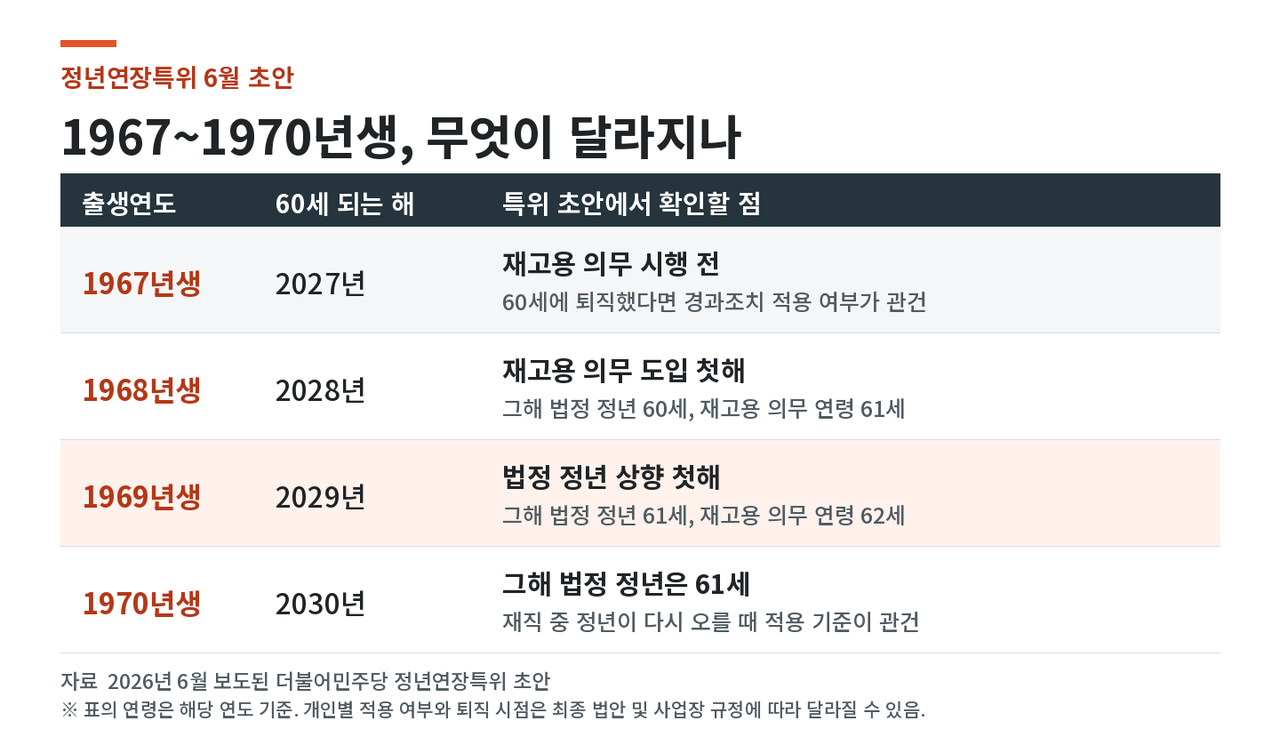
"Raising the retirement age does not guarantee employment for all middle-aged and older workers," Jeong Hye-yun said. "The average age at which people leave their longest-held job is 53, and mandatory retirement accounts for only 13.2 percent of departures — so the priority should be reducing pre-retirement attrition, not simply pushing back the retirement cutoff."
Concerns were also raised about the potential for a retirement age extension to suppress youth hiring. Among those who do retire at the mandatory age, 33.6 percent come from companies with 1,000 or more employees, indicating that jobs where workers actually stay until retirement are concentrated disproportionately at large firms.
Large companies in particular often calibrate new hiring around vacancies created by mandatory retirements, analysts noted, meaning that longer tenures for existing staff could directly reduce the number of young workers brought on. Delayed departures among senior employees could also slow promotions and job rotations for junior staff.
"Large companies sometimes base new hiring on vacancies from mandatory retirements, so extending the retirement age — by keeping high-wage workers longer and delaying those vacancies — could constrain their capacity to hire young people," Jeong Hye-yun said. "Particularly under Korea's seniority-based wage system, this could simultaneously drive up labor costs and create bottlenecks in promotions and assignments."
Debate over retirement age extension and reemployment is already under way within the automotive sector.
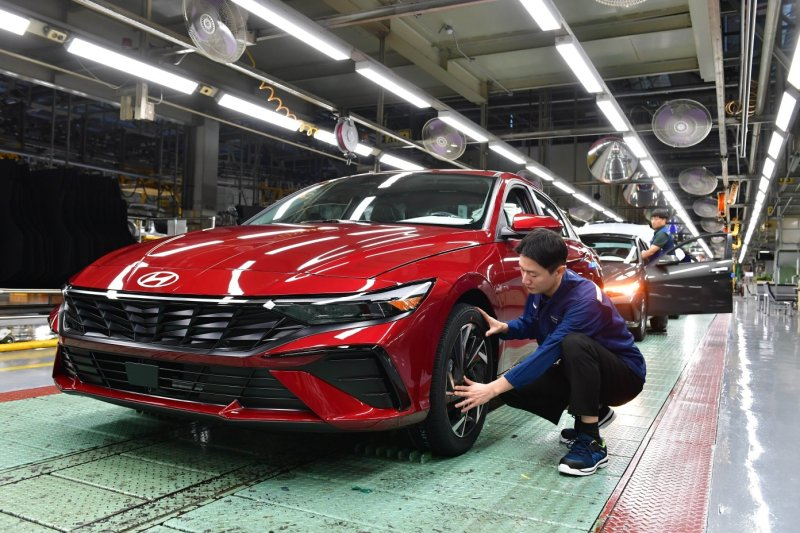
Hyundai Motor agreed in this year's wage negotiations to extend the retirement age to 65 if relevant legislation is amended. The company has committed to hiring 500 new technical workers between 2027 and 2028, but the union estimates that 3,428 employees are due to retire during the same period.
At General Motors' Korean operations, about 80 percent of the 4,455 employees scheduled to retire between 2025 and 2034 are in production roles. The company has agreed to rehire retiring workers on fixed-term contracts to retain skilled labor.
The wage structure adds another layer of complexity. In South Korea, workers with 30 or more years of tenure earn 2.95 times the wages of those with less than one year — a gap wider than in Japan (2.27 times) or Germany (1.80 times). Under a system where pay rises with seniority, extending the retirement age could significantly increase labor costs for employers.
The youth employment picture is also difficult. The employment rate for people aged 15 to 29 stood at 44.0 percent in September, down 1.1 percentage points from the same month a year earlier, with the number of employed young people falling by 147,000.
Japan's continued-employment system was put forward at the forum as a possible model. Japan has kept its statutory retirement age at 60 while requiring companies to secure employment for workers up to age 65. Most firms have implemented this by rehiring retirees on renewed contracts and adjusting wages and working conditions accordingly.
Jeon Young-su, a professor at Hanyang University's Graduate School of International Studies, said that because Japan's labor market conditions — including labor shortages and high youth employment rates — differ significantly from South Korea's, "rather than directly transplanting Japan's retirement extension model, we need to design a system suited to our own industrial structure and employment conditions."
Jeong Hye-yun similarly recommended guaranteeing employment up to age 65 while allowing companies to choose between extending the retirement age or rehiring retirees based on their own circumstances, and called for a long-term shift toward a job- and role-based wage system.
Discussants also called for separate support measures for small and medium-sized enterprises and young workers. Park Wan-su, publisher of Chamyeo wa Hyeoksin, said: "The reality of our labor market is that young people cannot find jobs while middle-aged workers cannot make it to retirement age. We need to design support policies for small and medium-sized enterprises alongside any retirement age extension, so that its benefits do not accrue only to those who already enjoy employment security."
KAIA Chairman Jeong said the industry must "discuss employment arrangements suited to the conditions of each industry and company, so that extending the retirement age does not constrain job opportunities for the next generation — and build a sustainable employment structure in which the skills of older workers and the capabilities of young workers complement each other."
kwater@heraldcorp.com