MedPacto demonstrates effect of anticancer drug candidate MP010, findings published in Cancer Cell
A Korean biotech company has become the first in the world to demonstrate that immune memory can prevent cancer — not only stopping recurrence but also blocking tumors that have not yet developed.
MedPacto announced Tuesday that it confirmed this effect through preclinical research on MP010, its next-generation anticancer drug candidate.
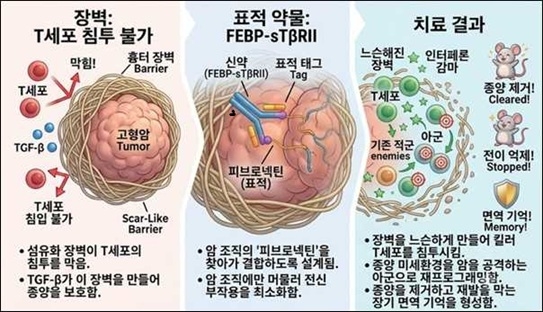
MP010 selectively binds to extra domain-B fibronectin (EDB-FN), a protein overexpressed in the tumor microenvironment (TME) of various solid cancers. At the same time, it targets TGF-β, a signaling molecule that enables cancer cells to evade the immune system and spread.
Unlike conventional systemic TGF-β inhibition approaches, MP010 selectively targets the area surrounding the tumor, minimizing effects on the rest of the body while delivering a potent anticancer effect, the company said. The research also demonstrated that by inducing long-term immune memory, the drug can guard against both the recurrence of treated cancers and the development of entirely different cancer types.
MedPacto said that when MP010 was administered to animal models of three types of treatment-resistant malignant pancreatic cancer, cure rates of 75.0 to 87.5 percent and a long-term survival rate of 87.5 percent were observed. "In particular, when the same cancer cells were transplanted into animal models that had been completely cured of pancreatic cancer, no tumors developed in any of the subjects," the company said.
The company added that when cells from a different type of pancreatic cancer, lung cancer or bladder cancer were transplanted, more than 80 percent of subjects showed no tumor development.
A paper summarizing the findings was selected as the front cover article of the November issue of Cancer Cell, one of the world's most prestigious oncology journals. Cancer Cell carries an impact factor of 56.1, placing it on par with Nature and Science.
Kim Sung-jin, chairman of MedPacto and the lead researcher, said cancer cells secrete TGF-β to neutralize the immune system and reshape their surrounding environment to favor tumor growth and protection. "This research confirmed that suppressing TGF-β around the tumor can achieve complete remission and produce lasting immune effects," Kim said.
The findings are significant as the first research to show that even if the "seed" — the cancer cell — carries diverse genetic mutations, changing the surrounding "soil" can enable treatment and prevent recurrence.
MedPacto Chief Executive Woo Jeong-won said the study demonstrates the potential for TGF-β inhibitors to be developed into broad-spectrum anticancer drugs through new possibilities in immune memory research. "We expect MP010 to lead a new medical paradigm in which the power of immunity can defend against cancers that have yet to develop," Woo said.
MedPacto is completing toxicity studies in preparation for an investigational new drug (IND) application, with plans to conduct clinical trials in South Korea and the United States targeting IND approval in early next year.
freiheit@heraldcorp.com