Korea Housing Institute's November apartment move-in outlook
Greater Seoul move-in index falls 8.6 points on rate-hike fears
National index rebounds for first time in 4 months; Sejong, other regions improve
November move-ins forecast at about 11,000 units, down 49% from a year ago
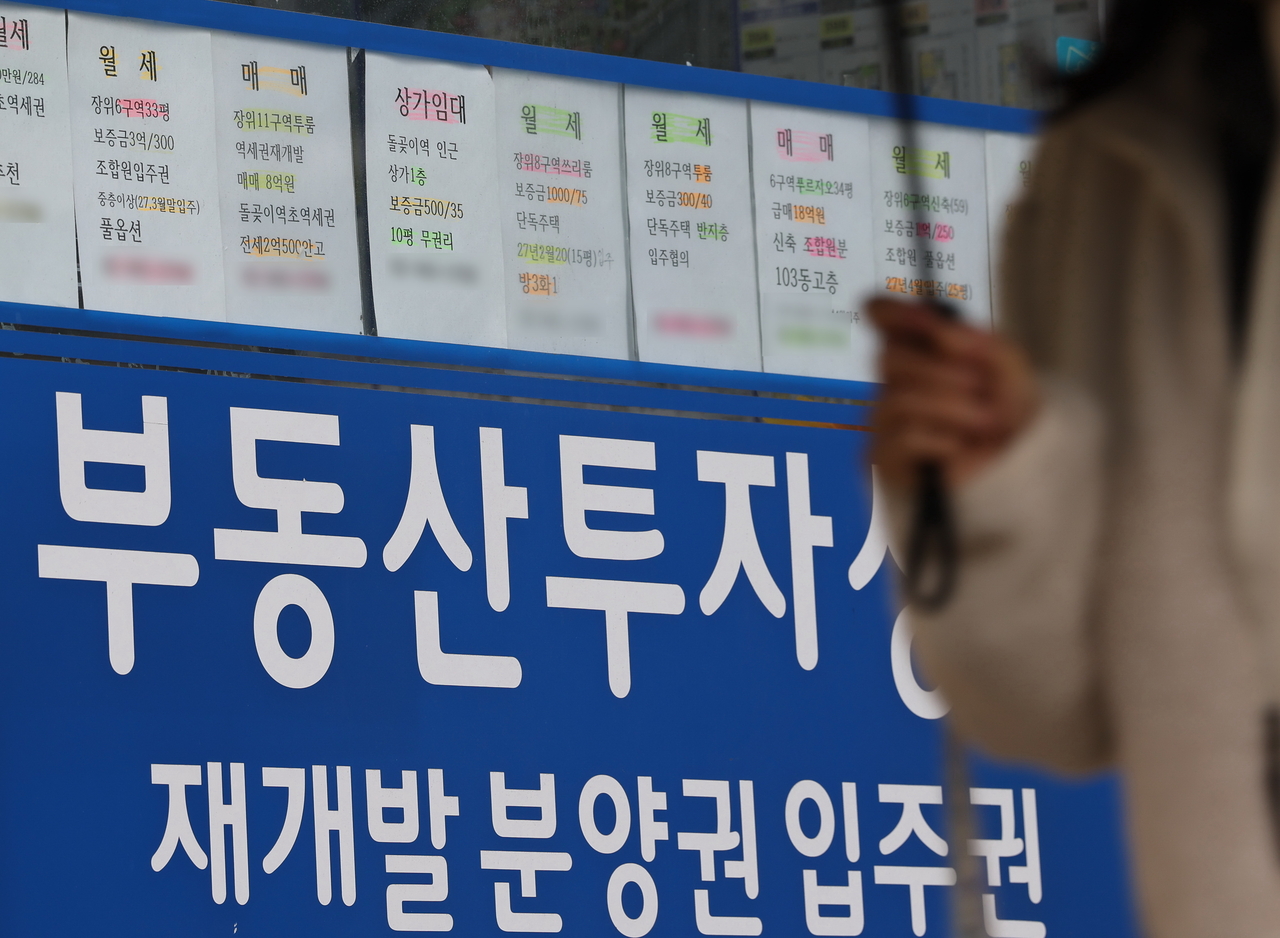
The apartment move-in outlook for Greater Seoul reversed course within a month, weighed down by concerns over rising mortgage interest burdens amid the possibility of further rate hikes. The national index, by contrast, rebounded for the first time in four months, avoiding a broad decline.
According to a survey of housing developers released Tuesday by the Korea Housing Institute, the national apartment move-in outlook index for November came in at 85.3, up 2.7 points from the previous month.
The Greater Seoul index, however, fell 8.6 points to 89.6. The metropolitan index had surged to 98.2 in October from 81.0 in September, only to reverse within a month. All three areas within the region posted declines: Seoul (94.2, down 14.1 points), Gyeonggi Province (88.5, down 8.7 points) and Incheon (86.2, down 3.0 points).
"Although the Bank of Korea held its benchmark interest rate on Oct. 22, it left open the possibility of additional hikes following two consecutive increases in July and August, heightening concerns about loan interest burdens," a Korea Housing Institute official said. "The move-in outlook, which had risen sharply last month, appears to have corrected."
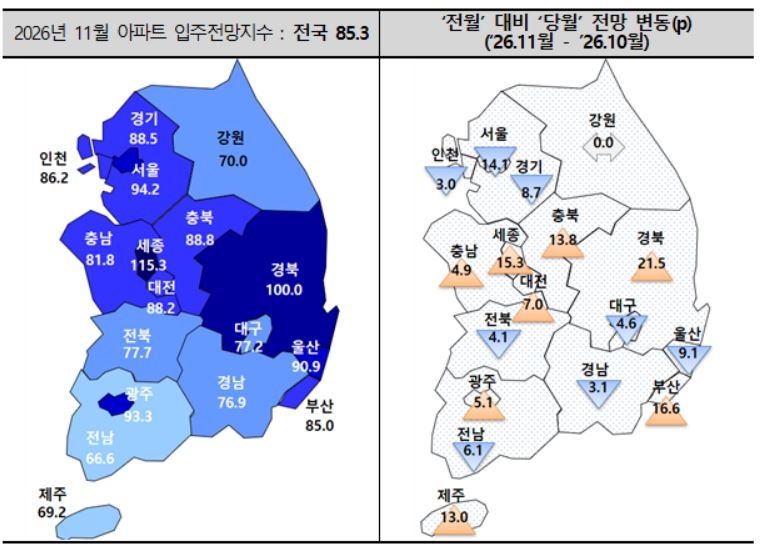
Metropolitan cities and provincial areas, meanwhile, each saw their indexes rise 5.0 points — to 91.6 and 78.9, respectively. As a result, the gap between Greater Seoul and the rest of the country, which had widened to 18.9 points last month, narrowed to 5.3 points this month.
Among metropolitan cities, move-in outlook indexes rose in Busan (85.0, up 16.6 points), Sejong (115.3, up 15.3 points), Daejeon (88.2, up 7.0 points) and Gwangju (93.3, up 5.1 points).
The gains in Daejeon and Sejong reflect expectations of new demand following the government's announcement last month of plans to relocate 44 central government agencies from Greater Seoul to Sejong.
In provincial areas, indexes climbed in North Gyeongsang Province (100.0, up 21.5 points), North Chungcheong Province (88.8, up 13.8 points), Jeju (69.2, up 13.0 points) and South Chungcheong Province (81.8, up 4.9 points).
The national apartment occupancy rate for October fell 3.2 percentage points from the previous month to 65.0 percent.
Greater Seoul's occupancy rate rose 1.4 percentage points to 81.2 percent, while the four major non-metropolitan cities plus Gwangju and Sejong dropped 9.3 percentage points to 51.5 percent. Other regions edged up 0.9 percentage points to 70.3 percent.
In Greater Seoul, conditions for moving into newly built apartments have improved somewhat as jeonse prices continue to rise amid a shortage of jeonse listings. Occupancy rates climbed in both Seoul (87.6 percent, up 2.8 percentage points) and the Incheon-Gyeonggi area (78.1 percent, up 0.8 percentage points).
Among reasons cited for not moving in, failure to secure a balance-payment loan was the most common at 45.8 percent, followed by delays in selling an existing home (25.0 percent), failure to find a tenant (12.5 percent) and delays in selling pre-sale rights (2.1 percent).
About 11,000 apartments nationwide are scheduled for move-in in November, a projected 30 percent drop from the previous month and roughly 49 percent fewer than the same month last year. "In Seoul in particular, pre-sales amount to just 488 units," a Korea Housing Institute official said. "While high mortgage rates are limiting individual buyers' borrowing capacity, the drop in move-in volume could ease the burden of securing tenants and give banks more room to supply balance-payment loans — so some positive aspects may emerge."
Meanwhile, demand driven by the jeonse shortage — combined with enthusiasm for homeownership — continues to fuel strong interest in so-called "lottery" unsold units offering competitive pricing in the Greater Seoul pre-sale market. An unranked subscription held Nov. 2 for a single 84-square-meter Type A unit at Unjeong Jungang Station Woolim The Centum in Paju's Unjeong new town drew 2,564 applicants, while a single Type B unit attracted 2,417 — both exceeding a competition ratio of 2,000 to 1.
hope@heraldcorp.com