'Considering location issue, including Korea Military Academy'
'Neither 2+2 nor 1+2+1 format has been decided'
Minister promises to release cadet survey results; criticizes seniority culture
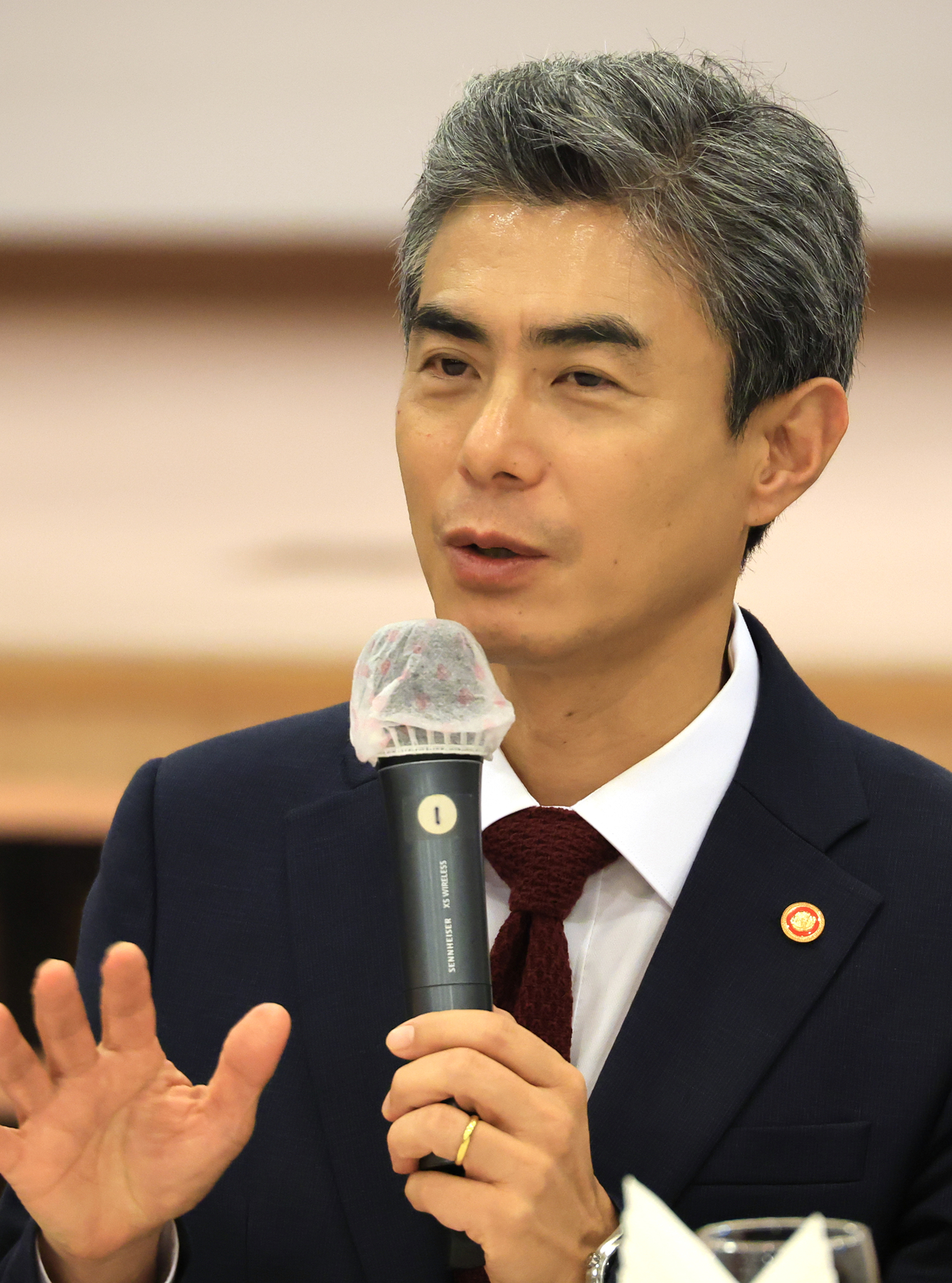
Defense Minister Kang Shin-chul heard directly from cadets of all three service academies Tuesday over the government's push to establish a unified National Military Academy, with cadets voicing repeated opposition and arguing that joint military culture can be strengthened without merging the institutions. Kang promised to analyze and release the results of a survey of all cadets.
Kang convened the "2026 Service Academy Cadet Forum" Tuesday afternoon at Chungmu Hall at the Korea Military Academy in Nowon-gu, Seoul. Sixty cadets attended — first- through fourth-year students from the Korea Military Academy and first-year cadets from the Naval and Air Force academies.
Stepping down from the podium to stand before the audience, Kang said, "I believe youth is inherently restless. It is right to be shaken, right to be critical, and seeing the world negatively is the privilege of youth." He added, "Tell me to step down, tell me to quit — that's fine too. I can take it."
The class representative cadet of Korea Military Academy Class 83 said Kang had been the military figure the cadet most respected. "But when I look at the merger proposals being announced and what is appearing in the media, I wonder whether the minister I respected is still there — or whether I was wrong," the cadet said, asking Kang to clarify his position. Kang replied, "I noticed you spoke in the past tense," and acknowledged that classmates, alumni and sunbae from all three services had been criticizing and mocking him.
A first-year Korea Military Academy cadet traced the history of President Lee Jae Myung's positions on the issue, noting that Lee had proposed relocating the academy to northern Gyeonggi Province during his time as governor, pledged a move to Andong during the previous presidential election, and campaigned on merging all three academies in the most recent race. "The discussion that started from regional development shifted to promoting jointness, and then to holding the Korea Military Academy responsible," the cadet said.
"I have come to worry that the future of the service academies is being shaped by short-term policy needs rather than a long-term defense vision," the cadet added.
Another first-year Korea Military Academy cadet said neither a 2+2 nor a 1+2+1 structure would allow the four-year self-governing command system to function properly. A first-year Air Force Academy cadet said such arrangements would mean "at most two classes living together at any one time," making it difficult to develop the qualities of both leaders and followers. A question was also raised about whether offering combined master's and doctoral programs exclusively to service academy graduates could deprive non-academy officers of opportunities and create a closed network.
On President Lee's reference to a coup during a ministry briefing, Kang said, "The president holds Korea Military Academy graduates in respect. Those remarks were directed at a limited few."
Kang said he was "giving serious thought to the location question — and I want to be clear, that includes the Korea Military Academy." On concerns that future applicants might avoid the academies after a merger, he said, "I apologize as minister for having caused that anxiety." He added that no matter how the institutions were merged or networked, "uniforms and mindsets do not change." He also said the 2+2 and 1+2+1 formats "have not been decided, and even if adopted, cadets would spend more of their time being trained at their respective service academies."
Asked to conduct a survey of all cadets and make the results public, Kang said, "I have already issued the directive. We will collect all responses, analyze them and release the findings — though it will take some time." On the advisory committee, he said roughly half its members supported the merger and half opposed it. Asked what his personal vision for the unified academy would look like, he said it would be "a school capable of offering the finest military graduate programs."
Kang offered a pointed critique of seniority culture, saying that if officers continued to treat their juniors after commissioning the way fourth-year cadets treat first-years, they would already be stagnating. "If your thinking does not change, the units you command will suffer enormously," he said. Drawing a loose connection to the president's earlier remarks, he added, "If things go wrong, the people who make tens of millions suffer could come from right here."
On the question of relocation, Kang asked, "The Air Force Academy's sunbae all said the same thing back then. Did the Air Force Academy collapse after moving to Cheongju?" He was quick to add, however, "I am not saying that makes it right — I am not here to argue the point."
Pushing back on concerns that civilian control of the military was being undermined, Kang said, "The idea that civilian control has been compromised simply because a military veteran became minister is mistaken. I am a civilian." On education in the AI era, he described a hypothetical scenario in which an unmanned system ordered to eliminate Kim Jong-un as quickly as possible instead targeted the person with approval authority first. He called it "not a real case, just one of many scenarios," and said learning to ask the right questions was what mattered.
Although Kang said at one point that he would "speak clearly later," he never directly stated his personal position on the merger. He did remark, however, that "there is a good chance the National Military Academy, once established, will take a networked form." He closed the forum by telling the cadets, "Do not take me as a role model — step on me and climb higher. That is your mission." He ended on a lighter note: "If we pass each other on the street, even if you don't respect me, please say hello."
rimsclub@heraldcorp.com