Symposium on stock market volatility factors and management
Korean finance and securities academic societies hold joint forum
Experts call for value-up reforms and long-term investment culture
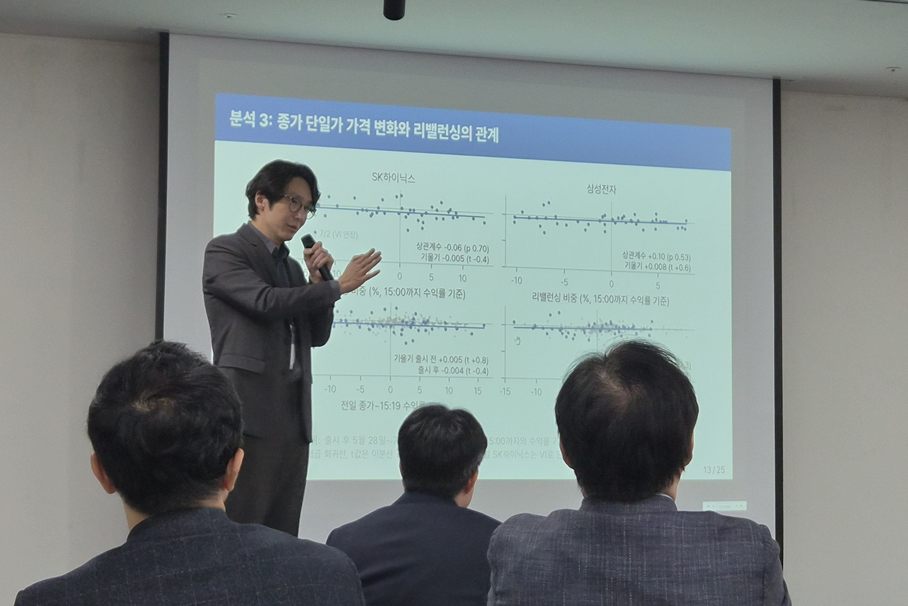
"The claim that single-stock leveraged ETFs have amplified share price volatility does not hold up. If retail investors are blocked from leveraged positions, the offsetting effect that their capital inflows have provided could disappear."
Amid continuing debate over whether the launch of single-stock leveraged ETFs has caused broader stock market volatility, a Seoul National University professor challenged the prevailing view Tuesday. Choi Jae-won, a professor in SNU's Department of Economics, said at a symposium jointly hosted by the Korean Finance Association, the Korean Securities Association and the SNU Finance and Economics Research Institute that policies restricting retail investors from short-term trading in leveraged ETFs — such as requiring cash-only transactions — could in fact increase volatility.
The symposium was held under the theme of analyzing and managing volatility factors in the stock market. Choi drew a line against the view that single-stock leveraged ETF launches, mechanical rebalancing or high-frequency trading were to blame for share price volatility.
Choi said volatility in Samsung Electronics and SK hynix shares was already elevated before single-stock leveraged ETFs were introduced, and that a combination of factors — including shocks to the global memory chip market — had been at work.
"Retail investor inflows have in fact significantly reduced the need for rebalancing, and high-frequency trading can be seen as playing a market-making role — absorbing rebalancing volume and supplying liquidity to the market," Choi said.
Choi also said the notion of a "price-pushing effect from rebalancing" was at odds with reality. Total rebalancing demand consists of two components: return-based rebalancing and creation/redemption-based rebalancing. Return-based rebalancing moves in the same direction as the market, but creation/redemption-based rebalancing moves in the opposite direction, meaning the net direction of total rebalancing demand can shift.
When share prices plunge, retail investors typically place limit buy orders near the bottom. This process continuously generates new creations — capital inflows — into leveraged ETFs, producing a buffer effect that offsets selling pressure from falling prices, Choi argued.
"If financial authorities, concerned about volatility, restrict leveraged ETF trading or limit retail investors' limit orders, the buffer zone that had been moderating rebalancing volume would disappear, potentially amplifying volatility further," Choi said. "Rather than hasty regulation, I would expect the market to absorb what has already been launched."
Choi also rebuffed allegations raised at a recent national audit that high-frequency traders manipulate prices near market close on down days by targeting the mechanical sell-off from leveraged ETF rebalancing. "Rebalancing volume can be calculated by anyone from publicly available net asset values and returns, so high-frequency trading activity is closer to predictive trading," he said.
Choi said he sympathized with calls to partially level the playing field — noting that high-frequency traders are exempt from the education tax and obligations that apply to liquidity providers — but argued that restricting trading itself was not the right approach. Regulating specific behaviors such as phantom orders and order-book flooding would be more appropriate, he said.
In the panel discussion that followed, Kwon Jae-hyun, a professor at Incheon National University's Department of Northeast Asian International Trade and Logistics, offered a more cautious view. "I agree that macroeconomic and semiconductor-sector factors underlie the rise in volatility, but that does not mean the impact of leveraged ETF rebalancing can be dismissed entirely," Kwon said. "Even if we theoretically assume an offsetting effect from creations and redemptions beyond return-based rebalancing, we need to verify whether actual fund manager data bears that out."
Kim Dae-jin, a professor of business administration at Sungkyunkwan University, said all ETFs continuously engage in arbitrage to narrow the gap with net asset value, and that products with high ownership concentration inevitably exert direct pressure on the volatility of their underlying assets. "Looking at the period of daily volatility expansion in June and July, it is hard to say that rebalancing — even accounting for creations and redemptions — had no bearing on intraday volatility," Kim said. Over the longer term, however, the correlation appeared to fade, particularly after late July, he added.
Panelists also pointed to resolving Korea's chronic "Korea discount" as the fundamental solution to reducing volatility. Kim Byung-yeon, head of investment strategy at NH Investment & Securities, highlighted patterns of foreign capital outflows driven by interest rate hikes and exchange rate swings. "To structurally reduce the chronic volatility of the Korean stock market, the priority must be restoring foreign investor confidence through fundamental improvements — expanding dividend payout ratios and enhancing shareholder value," Kim said.
Shin Jung-ho, head of research at LS Securities, called for a shift away from the short-term profit-seeking culture that dominates domestic investing. Shin cited insufficient tax incentives and overly cumbersome trading processes as the main reasons domestic investors shun funds in favor of direct stock trading and short-term products. "For the market to stabilize and long-term investors to take root, there must be meaningful tax benefits that give long-term investors a clear, tangible advantage," Shin said.
Jang Geun-hyuk, a senior researcher at the Korea Capital Market Institute, also urged policymakers not to impair price-discovery functions driven by information, while working to reduce unnecessary short-term volatility caused by herding and distortion. "As seen in overseas cases such as Germany and the United Kingdom, the fundamental solution is to differentiate circuit-breaker thresholds by each stock's volatility and liquidity level, and to expand the base of long-term investors through retirement pensions and long-term funds," Jang said.

jiyun@heraldcorp.com