Ruling party pushes to raise deduction for non-resident single-home owners from 1.2 billion to 1.4 billion won
Higher deduction would cut property tax bills in Mapo, Yongsan and Seongdong
Experts say short-term impact is modest but long-term gap could widen significantly
A widening rift between the government and the Democratic Party of Korea over the basic deduction threshold for the comprehensive real estate tax on non-resident single-home owners is complicating the calculations of owners of mid-to-high-end apartments in Seoul. Depending on whether the deduction is set at the government's original proposal of 900 million won ($670,000), raised to 1.2 billion won, or lifted to 1.4 billion won — the same level applied to owner-occupiers — annual property tax bills could swing by millions of won.
Government and ruling party clash repeatedly over comprehensive real estate tax deduction
The National Assembly's Finance Committee is set to convene a tax subcommittee next week to discuss unifying the comprehensive real estate tax deduction for all single-home owners at 1.4 billion won, regardless of whether they live in the property, according to political sources Wednesday. The move follows growing calls from Democratic Party lawmakers representing Seoul constituencies to revise the government's real estate tax reform package. The Democratic Party had already called for raising the deduction for non-resident single-home owners to 1.4 billion won at a senior party-government consultative meeting.
"Discussions on revising the comprehensive real estate tax for single-home owners are scheduled to begin next week," a Democratic Party official said, and went on to say that "there is strong sentiment among lawmakers that the basic deduction should be unified for all single-home owners, so applying the 1.4 billion won deduction to non-resident single-home owners is expected to become a key agenda item in talks between negotiators from both parties."

The government is holding firm to its existing position. In September, it submitted to the National Assembly a tax reform proposal that would raise the comprehensive real estate tax deduction for owner-occupying single-home owners from 1.2 billion won to 1.4 billion won, while keeping the deduction for non-resident single-home owners at 1.2 billion won. The original plan had called for lowering the deduction for non-resident single-home owners to 900 million won, but the government stepped back in response to public backlash.
Deputy Prime Minister and Finance Minister Lee Hyeong-il reiterated the case for the government's proposal Wednesday via X, formerly Twitter. "The core of this real estate tax reform is establishing a housing market centered on actual residence," Lee said. "For homeownership opportunities to go as much as possible to people who genuinely want to live in a home, given the limited housing supply, this government principle must be upheld."
Lee added: "We have decided to raise the comprehensive real estate tax threshold to 1.4 billion won so that homes valued at up to around 2 billion won are not taxed, while keeping the basic deduction at the current 1.2 billion won." The statement effectively drew a line against the ruling party's push for a further increase in the deduction.
Experts: immediate tax-cut effect modest, but long-term impact will grow
The ongoing disagreement between the government and the ruling party is fueling uncertainty in the market over next year's property tax bills. While a higher deduction could reduce the tax burden if the ruling party gets its way, homeowners are unable to decide whether to sell or buy additional properties because the final direction of the reform has yet to be determined.
Simulations show that the annual property tax bill for major Seoul apartments can differ by up to several million won depending on the comprehensive real estate tax deduction applied.
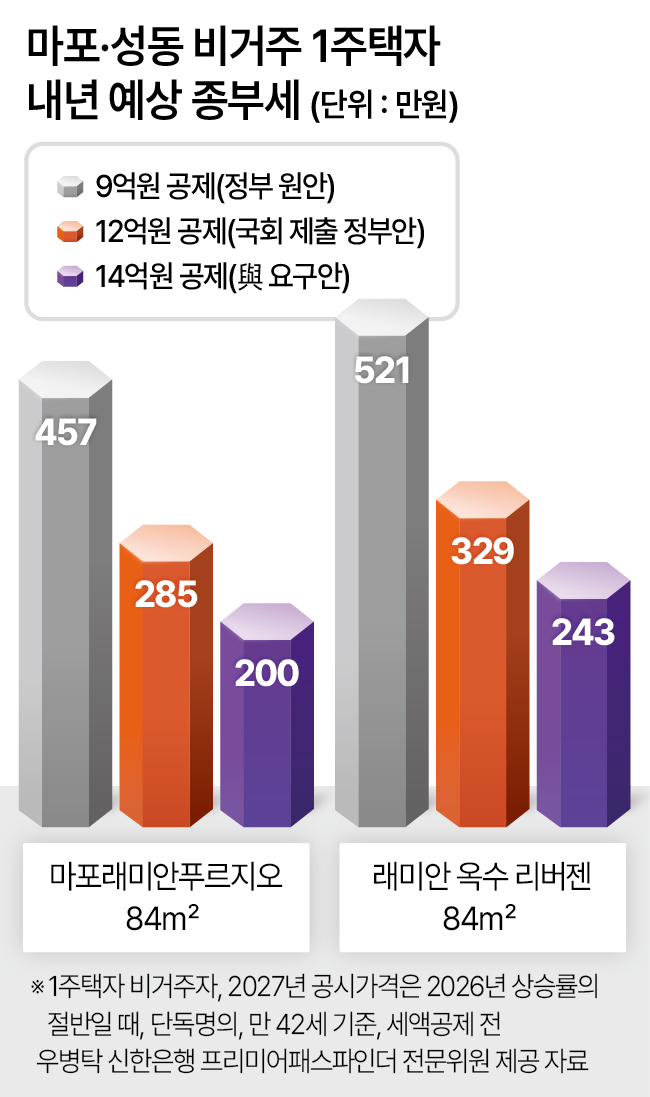
According to simulations by Woo Byeong-tak, a specialist at Shinhan Bank's Premier Pathfinder unit, a 42-year-old owner who has held an 84-square-meter unit at Mapo Raemian Purgio in Ahyeon-dong, Mapo-gu, Seoul for eight years would face a comprehensive real estate tax bill (including the special rural development tax) of about 4.57 million won if the basic deduction is set at 900 million won. The bill falls to 2.85 million won at a 1.2 billion won deduction and to 2 million won at 1.4 billion won.
The total property tax bill — including the property tax component — also varies significantly. Under sole ownership, non-residency and no tax-credit conditions, the total bill comes to about 7.77 million won ($5,790) with a 900 million won deduction, dropping to 6.05 million won at 1.2 billion won and to 5.21 million won at 1.4 billion won. Raising the deduction from 900 million won to 1.4 billion won would cut the annual property tax burden by about 2.57 million won. The projections apply half of the 2026 official price increase rate to next year's assessed values.
A similar pattern emerged for an 84-square-meter unit at Raemian Oksu Rivergen in Oksu-dong, Seongdong-gu. Under the same conditions, the comprehensive real estate tax is estimated at 5.21 million won with a 900 million won deduction, 3.29 million won at 1.2 billion won, and 2.43 million won at 1.4 billion won. Total property tax bills follow the same downward trend, coming in at 8.64 million won, 6.71 million won and 5.85 million won, respectively.
By contrast, the immediate tax relief from a higher deduction is more limited for ultra-high-end apartments in the Gangnam area. Because the property tax burden cap applies to these homes, the difference in deduction levels is not fully reflected in the actual tax owed.
For example, a 53-year-old owner who has held an 84-square-meter unit at Banpo Xi in Seocho-gu, Seoul for six years would face a comprehensive real estate tax bill of about 25.81 million won under a 900 million won deduction. However, if the deduction rises to either 1.2 billion won or 1.4 billion won, the tax bill comes to 19.04 million won in both cases. The tax burden cap — which limits the bill to 150 percent of the previous year's tax — prevents the difference in deduction levels from being reflected in the amount owed right away.
Analysts say this convergence will not persist indefinitely, however. After 2028, when the moderating effect of the tax burden cap weakens, the tax-cut benefit from a higher deduction could become more pronounced even for high-end Gangnam properties.
"Even if the deduction is raised from 1.2 billion won to 1.4 billion won, the immediate impact on the market will not be particularly large," Woo said. "For owners of apartments priced at around 2 billion won, the difference in property tax would be about 500,000 won, which is unlikely to prompt anyone to rush out and buy a home."
However, Woo added that "in 2027, the change in tax burden may be limited regardless of whether one lives in Gangnam or Seocho, but from 2028, 2029 and beyond, a 200 million won difference in the deduction could have a significant effect on the comprehensive real estate tax," and said "it is necessary to look not only at the short-term tax burden but also at long-term changes."
hss@heraldcorp.com