Lee Jun-seok, Cho Jung-hun host 'Greater Seoul Housing Innovation Forum' seminar
'Uniform loan limits delay sales of existing homes'
Short-term land transaction permits, tax relief among proposals
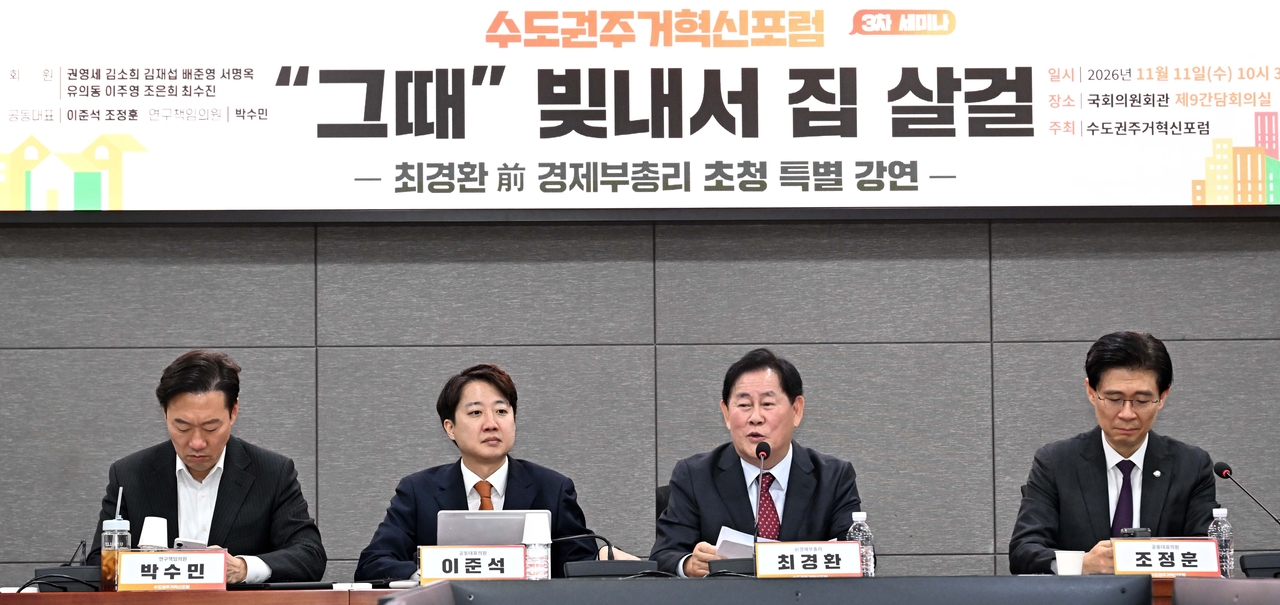
Former Deputy Prime Minister Choi Kyung-hwan criticized the Lee Jae Myung government's mortgage lending regulations Wednesday, urging the abolition of absolute loan caps. Choi argued that blanket restrictions on borrowing — applied even to owner-occupiers with sufficient income and collateral — are suppressing housing transactions and upward residential mobility.
Choi made the remarks at a seminar organized by the Greater Seoul Housing Innovation Forum, a National Assembly research group, under the title "I Should Have Borrowed and Bought a Home Back Then." The forum is co-chaired by People Power Party lawmaker Cho Jung-hun and Reform Party lawmaker Lee Jun-seok.
Choi championed the so-called "Choinomics" agenda during the Park Geun-hye administration — including deregulation of loan-to-value ratio and debt-to-income ratio limits — and said the current government's lending and transaction controls are weakening the housing ladder.
He cited data showing that apartment sales transactions in Seoul fell to 3,915 in September, a 42.4 percent drop from the same month a year earlier. "When lending and transaction regulations delay buying and selling decisions, upward residential mobility and home upgrades become harder to achieve," he said.
According to the Ministry of Land, Infrastructure and Transport, jeonse and monthly rent transactions in Seoul also fell to 59,790 in the same month, down 14.6 percent year on year. "Amid a sharp drop in transactions and a shortage of listings, apartment prices have surged," Choi said. "In the sales market, lending restrictions have reduced the turnover of existing homes, while in the rental market, tighter owner-occupancy requirements have cut the absolute volume of available supply."
As an alternative, Choi proposed scrapping the absolute cap on mortgage loans. He argued that applying the same loan limit to owner-occupiers with ample income and collateral who are looking to upgrade their homes delays the sale of existing properties and slows upward mobility. He also flagged that lending restrictions can work disproportionately in favor of cash-rich buyers.
Choi said policies such as short-term operation of the land transaction permit system, reduced tax burdens, and housing supply tailored to changing household structures are also needed. "Non-resident and multi-home owners also serve a useful function by supplying rental housing to others," he said. "Excessive punitive taxation on them will trigger public resistance and ultimately shift the tax burden onto tenants, increasing the hardship of low-income renters without homes."
He added that simply expanding the total housing supply would not be enough to meet the needs of smaller households seeking transit-oriented, work-adjacent homes at affordable rents. "We need to activate long-term private rental housing for young people, newlyweds, and elderly one- and two-person households," he said.
mp1256@heraldcorp.com