Focus on livelihood, convenience and future industries
'12 citizen-felt projects' include half-price youth bus fares
Adjustment grant rate for autonomous districts raised to 24%
Ulsan Metropolitan Office of Education sets budget at 2.41 trillion won
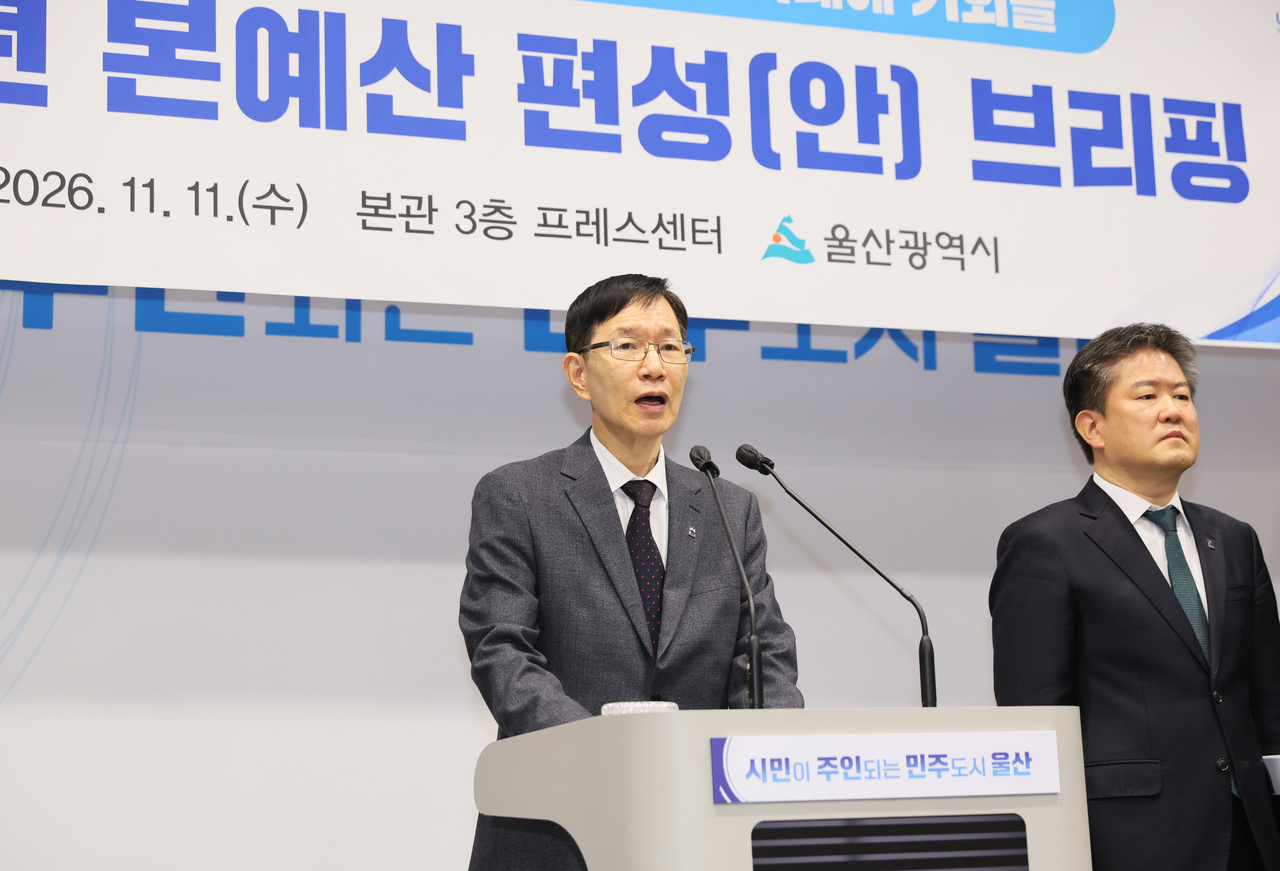
Ulsan's first budget under its ninth directly elected administration underscores livelihood stability and the cultivation of future industries. The city announced Wednesday it will submit to the city council a 2027 main budget of 5.99 trillion won ($4.46 billion) — an increase of 346.1 billion won, or 6.1 percent, from this year — with the stated goal of delivering "change that citizens can feel."
By sector, welfare and livelihood accounts for the largest share at 2.32 trillion won, or 38.8 percent of the total. The remaining allocations, in order, are: economy and industry at 549.3 billion won; environment and green spaces at 515.7 billion won; transportation and logistics at 476.9 billion won; disaster and safety at 364.6 billion won; education at 307.8 billion won; culture and sports at 297.2 billion won; and adjustment grants, public administration and other items at 1.16 trillion won.
The welfare and livelihood sector focuses on reinforcing the basic social safety net, covering basic pensions, medical aid, livelihood benefits and housing benefits. To expand marriage and childbirth support, the city introduced a marriage support grant of 4.78 billion won providing 1 million won per couple, and a newborn care support grant of 12.08 billion won to assist with the care of infants aged zero to 11 months. An additional 17.9 billion won was set aside to strengthen essential and after-hours medical services, including support for obstetrics, pediatrics, trauma and emergency care, as well as emergency medical operations during public holidays.
In transportation and urban infrastructure, the city allocated 41.3 billion won for public transit fare support — including half-price bus fares for youth — 5.5 billion won for repainting road markings and improving visibility, 2.6 billion won for safety improvements on residential roads and school routes, and 2.5 billion won for road network expansion including the Gilcheon Industrial Complex-to-Jihwa Village road.
In the economy and industry sector, the city set aside 4 billion won for ultra-wide-area manufacturing AI transformation technology development in shipbuilding and automotive in cooperation with Busan and South Gyeongsang Province; 2.2 billion won for nurturing core AI and AX talent, including the Ulsan-model industrial AI transformation core project; 1.9 billion won to build an AI transformation demonstration industrial complex for Ulsan's oil and petrochemical sector; and 3.7 billion won to support commuter workers across the Busan-Ulsan-South Gyeongsang region.
In culture and sports, the city budgeted 10.4 billion won to support the construction of sports facilities in autonomous districts, 10 billion won for the preservation and utilization of historical and cultural heritage, 1.2 billion won to expand the Citizens' Lifestyle Sports Festival, and 1.2 billion won to produce the original musical "Park Sang-jin."
For disaster and safety, the city allocated 6.2 billion won to improve nighttime road lighting, 6.7 billion won to reinforce fire department vehicles — including the introduction of wildfire-specialist suppression vehicles and unmanned firefighting robots — and 6 billion won for a multipurpose fire helicopter. In the environment and green spaces sector, allocations include 57.4 billion won for expanding and repairing sewage treatment facilities and aging pipelines, 42.2 billion won for replacing aging water supply pipes and extending service to outlying areas, and 25 billion won to prepare for the 2028 Ulsan International Garden Expo.
Alongside this, the city selected 12 "citizen-felt projects" designed to deliver immediate, tangible improvements to daily life and incorporated them into the budget. The adjustment grant rate for autonomous districts was also raised from 20 percent to 24 percent, bringing the total adjustment grant allocation to 376.9 billion won — an increase of 86.9 billion won from this year's 290 billion won.
Seo Nam-gyo, administrative vice mayor of Ulsan, said the city worked to make the first main budget of the ninth administration "warm for livelihoods and more convenient for daily life."
The Ulsan Metropolitan Office of Education also set its 2027 budget at 2.41 trillion won, an increase of 138.6 billion won, or 6.1 percent, from this year's main budget.
Key allocations include 387.6 billion won for "a more sustainable environment" to create safe and comfortable learning spaces; 68.3 billion won for "more enjoyable learning," including integrated foundational academic support; 220.7 billion won for "more tailored care," covering student-customized educational welfare and childcare; 43.5 billion won for "warmer relationships" to foster a school culture of respect and consideration; and 23.3 billion won for "closer administration" to improve on-site school support and educational administrative services.
Both budget proposals will go through deliberations during the second regular session of the 269th Ulsan Metropolitan Council before being finalized on Dec. 11.
cityblue@heraldcorp.com