Deputy Prime Minister Lee Hyung-il chairs first meeting of Yeongnam Mega-Project Implementation TF
Six conglomerates — Samsung, Hyundai Motor, SK, LG, Doosan and Hanwha — attend investment review
Greater Seoul grew 57% while Yeongnam managed only 23% over 14 years, widening regional gap
Government, companies and local authorities to act as 'one team' to remove bottlenecks
The government will work directly with major conglomerates and local authorities to monitor progress on the 312 trillion won ($232 billion) Yeongnam mega-project and push through regulatory reforms to keep the initiative on track.
The plan aims to break the country's Seoul-centric growth pattern by grafting advanced industries — semiconductors and AI — onto the Yeongnam region's existing manufacturing base, ensuring that large-scale private investment translates into real economic gains for the area.
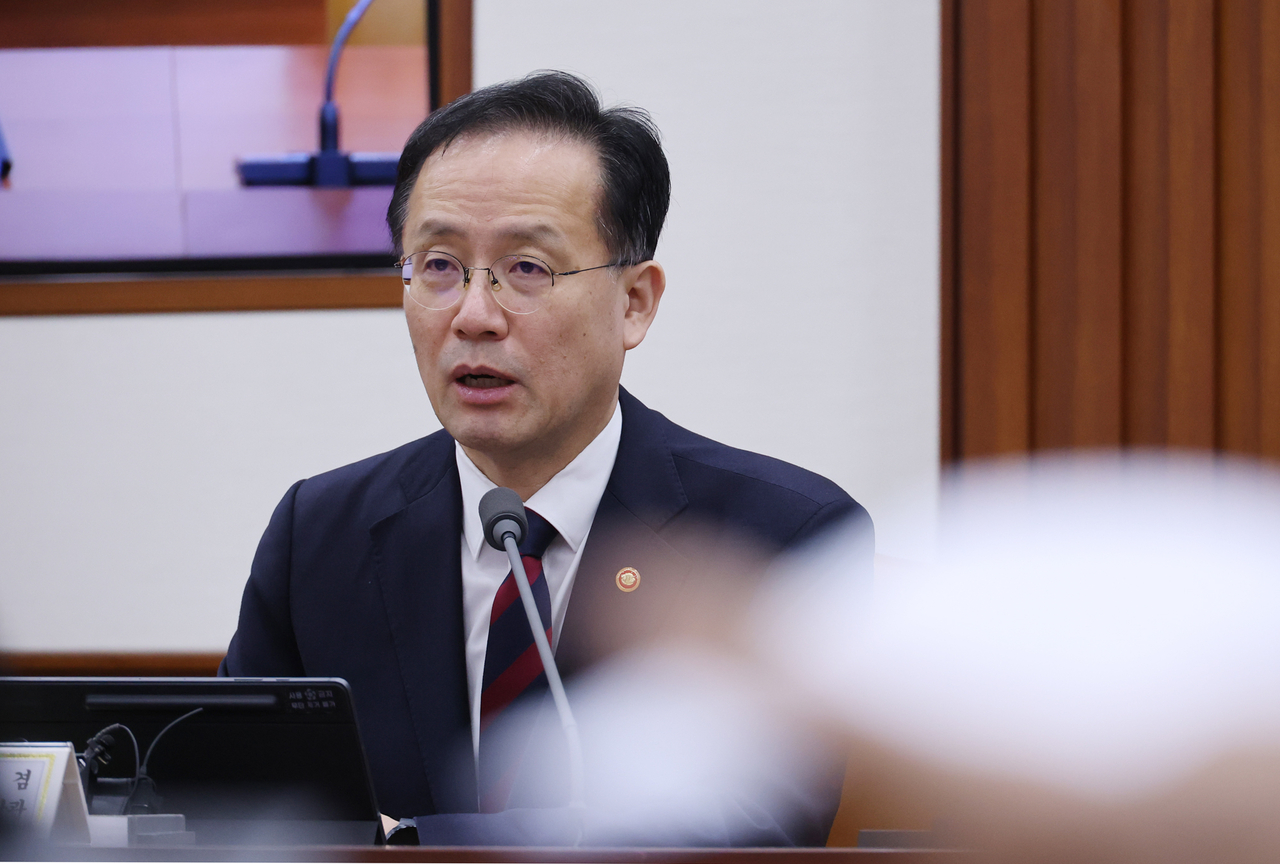
Deputy Prime Minister and Minister of Economy and Finance Lee Hyung-il chaired the inaugural meeting of the Yeongnam Mega-Project Implementation TF at the Export-Import Bank of Korea in Yeouido on Wednesday, reviewing each company's investment progress and the status of local government permitting. The meeting was attended by officials from the Ministry of Science and ICT and the Ministry of Trade, Industry and Resources, along with representatives from Busan, Daegu and Ulsan and from North and South Gyeongsang Province, as well as executives from six companies: Doosan, Samsung, Hanwha, Hyundai Motor, LG Group and SK Group.
The meeting was convened to identify and resolve obstacles arising as the 312 trillion won project moves from commitment to actual investment, and to coordinate key tasks needed for swift execution. The government had previously held three working-level TF sessions chaired by the director general of the Ministry of Economy and Finance's innovation and growth office; Wednesday marked the first time Lee himself presided.
"Our economy is currently trapped in a 'bad equilibrium' of concentration in the greater Seoul area," Lee said. The numbers bear that out: from 2010 to 2024, real gross regional domestic product in the greater Seoul area rose 57.4 percent, while non-metropolitan regions grew just 33.1 percent. The Yeongnam region — home to the country's core manufacturing industries including automobiles, shipbuilding, steel and petrochemicals — posted growth of only 23.0 percent, less than half the greater Seoul rate.
That leaves a 34.4 percentage-point gap between the two regions. The government's assessment is that while Yeongnam's manufacturing-heavy industrial structure once drove South Korea's economic rise, the economic divide with the greater Seoul area has widened sharply over the past decade or so.
"For sustainable growth, we must make a fundamental shift toward 'growth for all' — a leap forward that brings every region and every citizen along," Lee said, stressing that three mega-projects designed to make the regions engines of growth are the path to a "good equilibrium."
The government intends to focus its policy efforts on combining Yeongnam's traditional manufacturing strengths with advanced industries. The strategy is to layer semiconductors, AI data centers and physical AI onto existing pillars — automobiles, shipbuilding, steel and petrochemicals — and develop the region into a new high-tech hub.
"Yeongnam has underpinned our economy for decades through traditional manufacturing in automobiles, shipbuilding, steel and petrochemicals," Lee said. "Built on that solid manufacturing foundation, the region must now add semiconductors, AI data centers and physical AI to leap forward again as an advanced-industry hub. The investment by the companies gathered here today is the starting point of that leap."
To that end, the government will clarify the division of roles among companies, local governments and the central government to accelerate investment execution. Companies are expected to press ahead boldly with planned investments; local governments are to process permitting procedures swiftly; and the central government will provide backing through institutional reform and deregulation.
"No single company, ministry or local government can deliver a mega-project on its own," Lee said. "Companies must invest boldly, local governments must take responsibility for permits, and the central government must provide institutional support — we must become one team."
"A single small bottleneck can delay the entire schedule and cause us to miss the moment our economy needs to leap forward," he added. "We will manage every bottleneck throughout the entire investment process and immediately clear away outdated regulations and obstacles."
Related ministries will promptly review the investment difficulties and requests raised by companies at the meeting, with results to be checked again at the next TF session. Local governments were also asked to accelerate their permitting support.
The investment monitoring framework being applied in Yeongnam is expected to be extended to mega-projects in other regions. The government said it will strengthen inter-ministry cooperation to ensure that large-scale investment projects in the Honam region and the Chungcheong region also proceed without disruption.
"I will personally oversee the Yeongnam TF and stay with it to the end, so that Yeongnam becomes the leading model for 'growth for all,'" Lee said.
fact0514@heraldcorp.com