'A few billion won in taxes is peripheral — focus on jeonse and monthly rent market impact'
Closed-door session raises fears that 'owner-occupancy preference' policy could worsen rental shortage
Jung Chung-rae: 'Back-and-forth on easing comprehensive real estate tax not helpful'
Cho Kuk: 'If Democratic Party gets its way, comprehensive real estate tax exempted up to 2 billion won'
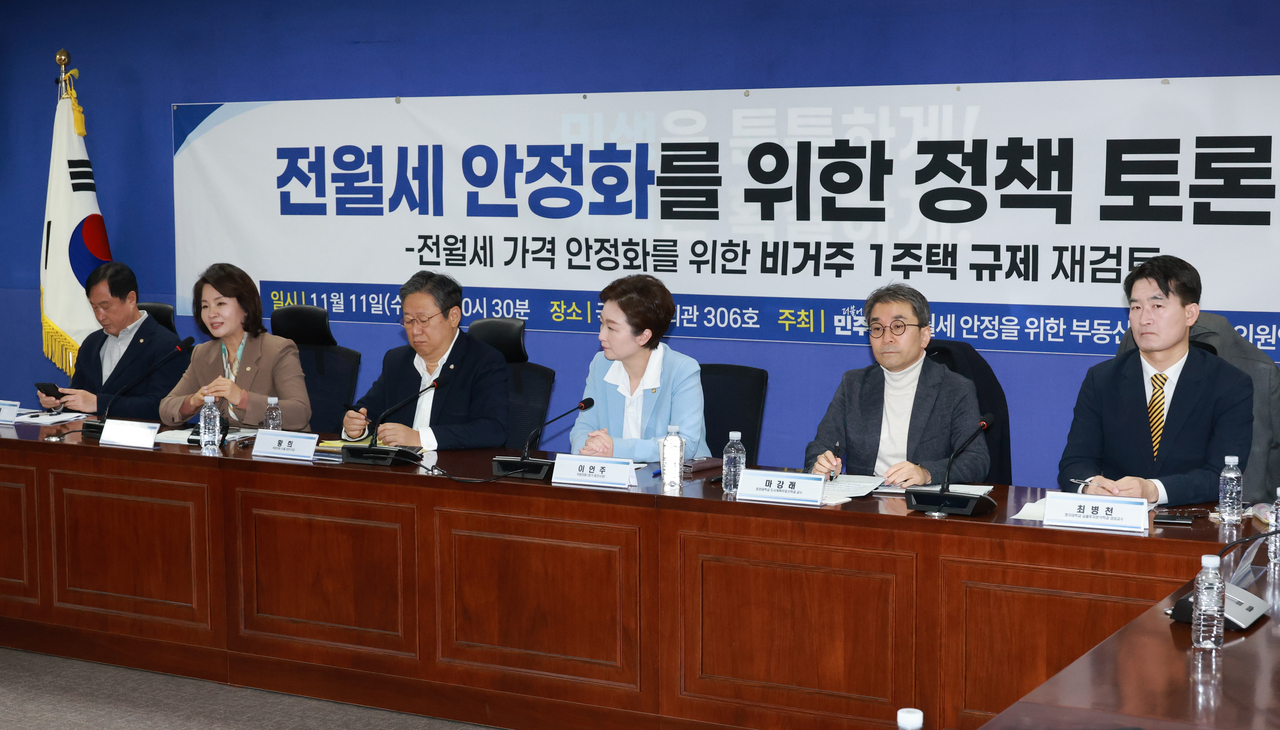
Democratic Party of Korea lawmakers from Greater Seoul constituencies continued discussions Wednesday on real estate policy affecting non-owner-occupied single-home owners, voicing concern that the government's push to favor owner-occupants could cost the party heavily in the 2028 general election — while still taking care not to break openly with the administration.
The Democratic Party's Pragmatist Lawmakers Research Group for Jeonse and Monthly Rent Stabilization held a forum at the National Assembly Members' Office Building on Wednesday titled "Reviewing Regulations on Non-Owner-Occupied Single Homes to Stabilize Jeonse and Monthly Rent Prices." It was the group's inaugural forum, but only four of its 16 member lawmakers attended — Lee Eon-ju (Yongin, Gyeonggi Province), Hwang Hee (Yangcheon-gu, Seoul), Lee Su-jin (Seongnam, Gyeonggi Province) and Kim Jun-hyeok (Suwon, Gyeonggi Province). The low turnout appeared to reflect a directive from party leadership to avoid publicly airing differences with the administration.
Lee Eon-ju said a few billion won in taxes may be a peripheral issue, adding that the group would focus instead on the impact on the jeonse and monthly rent market. "The causes could lie in supply-and-demand problems in the lease market, the distinction between owner-occupied and non-owner-occupied homes, tax issues, low-income lending, or the transaction-permit system — we will examine which of these is decisive and most serious," Lee said.
Kim Jun-hyeok said the group fundamentally supports the Lee Jae Myung government's real estate policy. "The government's real estate policy is for ordinary people and the middle class. There may be some confusion right now, but things will stabilize soon, and the housing supply initiatives the Lee Jae Myung government is pursuing will also proceed smoothly," Kim said.
Experts who attended the closed-door session raised concerns that the government's real estate policy could worsen the jeonse and monthly rent shortage. Choi Byeong-cheon, an adjunct professor in the Department of Real Asset Investment Analysis at Myongji University, argued that applying differentiated comprehensive real estate tax and capital gains tax to non-owner-occupied single-home owners could drive out existing tenants, leading to a shortage of jeonse and monthly rental listings and pushing up prices. Ma Gang-rae, a professor in the Department of Urban Planning and Real Estate at Chung-Ang University, also assessed that the government's policy — which pressures multi-home owners and favors owner-occupants — could deepen the rental shortage.
Within and outside the party, however, voices calling for the real estate policy direction to be maintained also emerged. Assembly member Jung Chung-rae wrote on his Facebook page Wednesday that the Lee Jae Myung government's owner-occupancy preference policy must be upheld. "The spectacle of internal party debate over a plan to ease the comprehensive real estate tax burden — such as raising the deduction threshold to 1.4 billion won ($1.04 million) for non-owner-occupied single-home owners, on par with owner-occupants — is not helpful," Jung wrote.
Cho Kuk, head of the Rebuilding Korea Party's policy research institute, also wrote on Facebook that if the Democratic Party's proposal goes through, the comprehensive real estate tax would be fully exempted on homes valued at up to around 2 billion won regardless of whether the owner lives there. "Will ordinary people and young people, who are struggling with recently rising jeonse and monthly rent costs, vote for the Democratic Party when they see benefits like these?" Cho said.
addressh@heraldcorp.com