Labor shortage rate in food manufacturing at 3.6%, above industry average
Restaurants at 4.0%, burdened by long standing hours and weekend shifts
Higher wages linked to lower turnover; better leave and working conditions urged

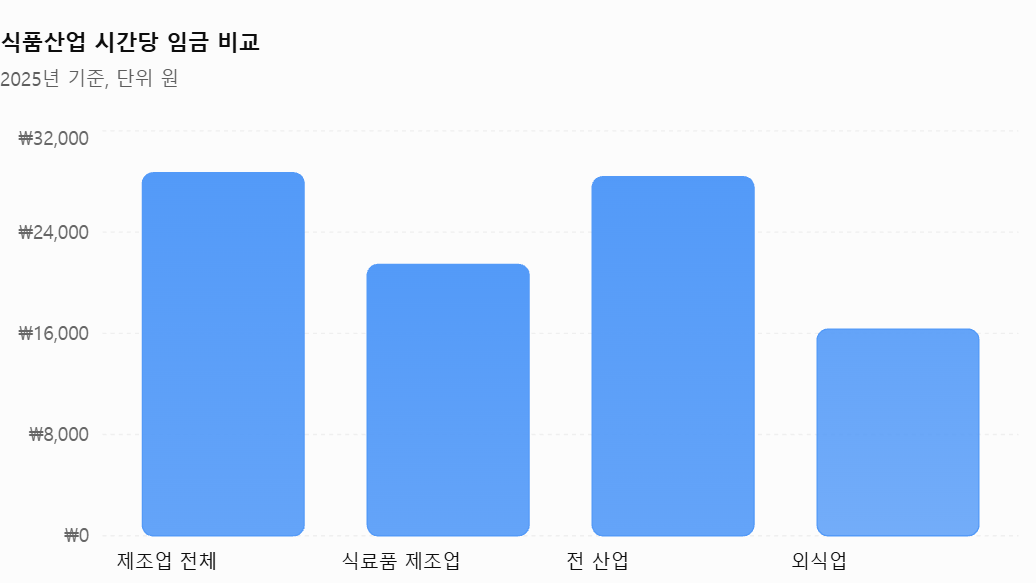
Labor shortages in food manufacturing and the restaurant industry are more serious than in other sectors, with low wages and poor working conditions emerging as the main barriers to recruitment, a new report shows. Hourly wages in the restaurant industry stand at just 58 percent of the all-industry average, while food manufacturing wages reach only 75 percent of the broader manufacturing average. Beyond pay, weekend work, emotional labor and inadequate leave policies were found to significantly influence workers' decisions to quit.
According to a report published Thursday by the Korea Rural Economic Institute (KREI), the labor shortage rate in food manufacturing stood at 3.6 percent — 1.1 percentage points above the overall manufacturing average of 2.5 percent. The shortage rate for restaurants and drinking establishments reached 4.0 percent, exceeding the all-industry average of 2.4 percent by 1.6 percentage points.
The wage gap was equally stark. Hourly pay in food manufacturing averaged 21,444 won ($16), some 7,246 won less than the overall manufacturing average of 28,690 won. Restaurant workers earned 16,332 won per hour, trailing the all-industry average of 28,385 won by 12,053 won — equivalent to roughly 74.7 percent and 57.5 percent of their respective comparison averages.
Worker turnover was also high. The turnover rate in food manufacturing reached 3.7 percent, one percentage point above the manufacturing average of 2.7 percent. In the restaurant sector, the rate hit 9.7 percent — more than double the all-industry average of 4.8 percent. The simultaneous presence of labor shortages and high turnover means the industry is struggling to build and retain a skilled workforce.
Working conditions also set the sectors apart. Food manufacturing workers were disproportionately exposed to physically demanding conditions, including pain-inducing postures, heavy lifting and prolonged standing. Restaurant workers faced long hours on their feet and a high rate of weekend shifts, while emotional labor in customer service was also found to drive turnover.
An analysis of the factors behind employment and resignation decisions found that in food manufacturing, higher real hourly wages statistically and significantly reduced the likelihood of workers leaving for another industry. In the restaurant sector, by contrast, greater emotional labor demands and unfavorable working hours increased the probability of workers switching industries. Welfare benefits such as paid leave were identified as factors that lowered the likelihood of turnover.
The report also examined the profile of workers newly entering the restaurant industry. Those who had earned higher real hourly wages in their previous jobs were less likely to take up restaurant work — suggesting that the sector tends to draw workers who were already in relatively low-paying positions.
A mismatch between workers' skills and their actual job duties was flagged as another problem. Food industry workers were more likely than those in comparable sectors to feel that their assigned tasks fell below their level of skill or education. The researchers said this kind of job mismatch could negatively affect workers' engagement and skill development.
The researchers recommended wage increases alongside broader improvements to working conditions, including expanded leave policies, flexible work arrangements and shorter working hours. Given the structural difficulty of raising wages sharply in the short term, they argued that strengthening non-monetary compensation was essential to reducing attrition among existing workers.
Better matching of workers to roles that suit their abilities and aptitudes, along with expanded education and training, were also proposed as priorities. Rather than focusing solely on recruiting new workers, the report said the industry needed to create an environment where existing employees could stay and build their skills over time.
"To address the labor shortage in the food industry, it is important not only to attract new workers but also to create stable working conditions for those already employed," said Im Ji-eun, an associate research fellow at KREI. "A comprehensive workforce strategy is needed — one that improves wages and welfare, and expands education and training opportunities suited to workers' capabilities."
adastra@heraldcorp.com