Hanban Institute releases special forum video on first National Population Strategy Master Plan
'Expanding scope from birth rate to aging and immigration policy is meaningful progress'
'Life satisfaction as a key indicator is too abstract — people need to see concrete benefits'
For South Korea's first national population strategy to succeed, people must be able to feel a tangible difference in their lives within five years, experts said at a recent forum.
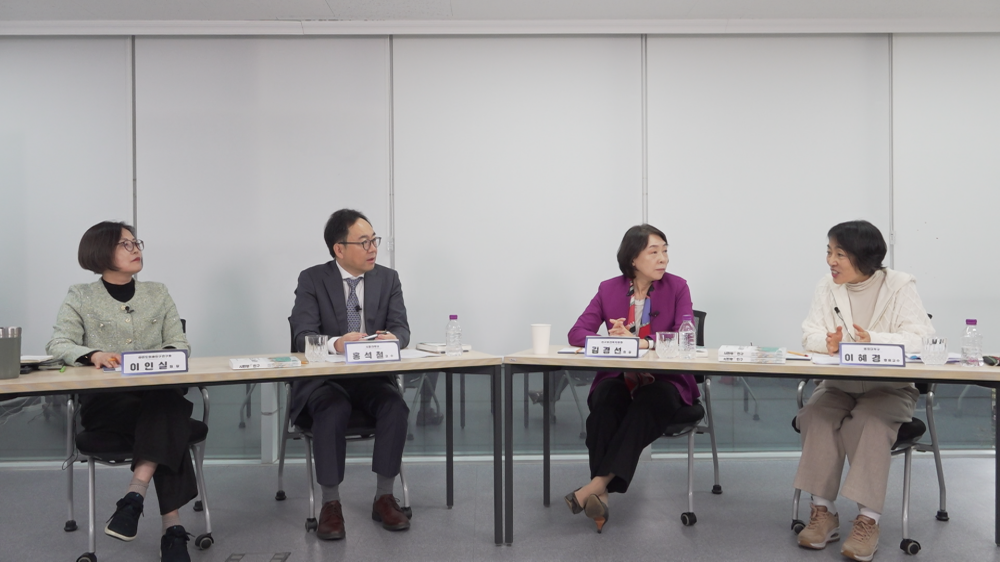
The Hanban Institute, a private think tank specializing in population issues, released a video of a special forum it held to assess the first National Population Strategy Master Plan, which the Cabinet approved on Oct. 27.
The forum was moderated by Institute President Lee In-sil and featured Kim Kyung-sun, president of the Korea Institute for Population and Health and a former vice minister of the Ministry of Gender Equality and Family; Lee Hye-kyung, emeritus professor of public administration at Pai Chai University and a former president of the Korean Population Association; and Hong Seok-chul, a professor in the Department of Economics at Seoul National University.
The panelists called it a meaningful step forward that the plan moves beyond the framework of the basic plans on low birth rates and an aging society that have guided policy for the past two decades, shifting the focus from birth rates to quality of life.
Hong said the plan's biggest change is its focus on individual quality of life and social sustainability rather than a birth rate target, and that incorporating issues such as extending the retirement age, continued employment, redesigning age-based standards, and the fiscal sustainability of the national pension and national health insurance systems represents a meaningful direction. He cautioned, however, that the plan's broader scope risks becoming a department-store-style wish list, and that implementation plans must set clear priorities.
Lee Hye-kyung noted that past plans used the term "utilization of foreign labor," whereas the new plan uses the word "immigrants," calling it a shift in perspective toward viewing them as residents who live alongside Koreans. She also viewed the establishment of immigration as an independent policy area and the creation of a dedicated immigration committee as positive signals.
Kim said that after financial burden, difficulty balancing work and family life is the most commonly cited reason people hesitate to marry or have children. "Since financial burden falls within the domain of macroeconomics, the core focus of population policy should be work-family balance," she said.
The panelists also raised concerns about the plan's headline indicator — a life satisfaction score rising from 6.6 points in 2025 to 7.0 points by 2030 — saying it would be difficult for the public to feel in concrete terms.
Hong said moving from 6.6 to 7.0 points is a vague concept that could undermine the plan. Kim proposed splitting the targets: using clear numerical goals for the low birth rate area and emphasizing swift execution for the super-aged society adaptation area. Lee Hye-kyung said that looking at groups with below-average satisfaction scores and at gaps by age, income and region would provide a better basis for the next round of policy.
Panelists also said the plan's 857 trillion won ($641 billion) five-year funding framework needs to be explained in terms that resonate with ordinary citizens.
Hong said the average annual growth rate of population-related budgets, at 9.1 percent, is not significantly different from natural increases, and that the plan must clearly show what new initiatives are distinct from existing spending. He particularly stressed that technology investment — such as in age tech — is critical to reducing the costs of responding to a super-aged society, and said the budget for technological innovation should be raised tenfold from its current level, growing from 1.2 trillion won in 2025 to 1.7 trillion won by 2030.
Kim said the figure of 857 trillion won does not resonate with individuals. "To be persuasive, the plan needs to show in concrete numbers how much the benefits that people actually receive will increase," she said.
The effectiveness of the Population Strategy Committee was also flagged as a challenge.
Kim said that preliminary consultations in which the committee merely offers opinions on ministry budget proposals would not be enough to ensure real impact, and that policies the committee wants to advance should be incorporated into the Ministry of Planning and Budget's budget formulation guidelines, which are finalized each March. Hong said the committee's authority derives from its legal mandate and expertise, and that since its legal role has not changed significantly, it must build expertise by linking up with research institutions that can back its policy rationale — only then will it be able to persuade and coordinate with ministries and local governments.
The panelists also identified priorities that must be held onto to deliver results in five years.
Hong said that while he understands the government's intent in not leading with a birth rate target, the public will ultimately judge the plan's success by the total fertility rate, and that it should reach around 1.2 by 2030. Kim said the message that "having a child does not mean giving up your career" must be conveyed through both policy and communication throughout the five years. Institute President Lee said population is both a national agenda and a deeply personal one, and that the private sector has an important role to play alongside the government's plan.
The full forum is available on the Hanban Institute's YouTube channel.
The video, titled "Can the new population strategy change the demographic landscape? — Hanban Institute special forum on the first National Population Strategy Master Plan," is available at the link below.
thlee@heraldcorp.com