October applications reach 3,947, up 8.2% from September
Home prices rise in northern and southwestern Seoul
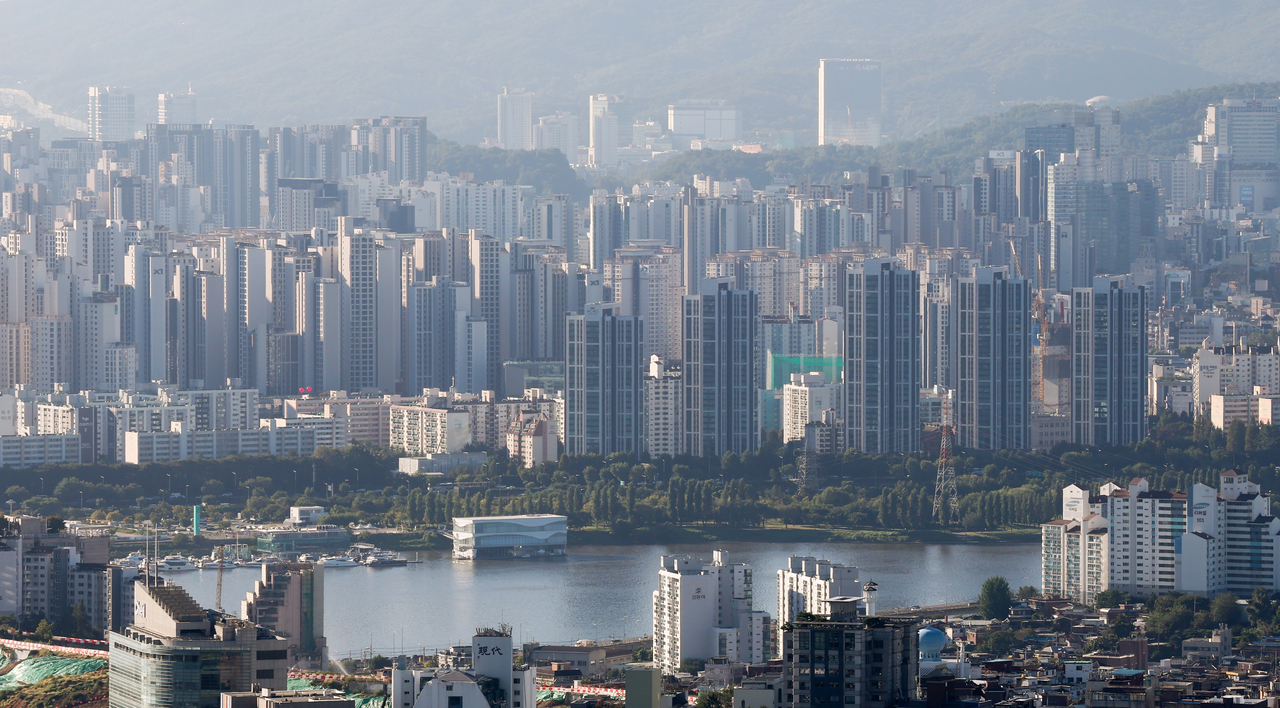
New applications for land-transaction permits for Seoul apartments rose for a second consecutive month in October, though the total remained less than half the year's peak recorded in April. Prices fell in the three Gangnam districts and Yongsan-gu while the Han River belt and outer areas continued to climb, highlighting a growing divergence across the city.
According to the Seoul Metropolitan Government, new land-transaction permit applications for Seoul apartments reached 3,947 in October, up 298, or 8.2 percent, from 3,649 in September. Applications had peaked at 8,886 in April before falling for four consecutive months through August, then began rising again in September.
October's figure was still only 44.4 percent of the April peak, and the month-on-month growth rate slowed to 8.2 percent from 24.2 percent in September. The Seoul Metropolitan Government said it would need to monitor further trends to determine whether the recent uptick signals a broader recovery in the housing market.
The number of applications processed in October stood at 3,945. Since Seoul was designated a land-transaction permit zone citywide on Oct. 20 last year, cumulative applications through the end of October this year totaled 63,447, of which 62,014, or 97.7 percent, had been processed.
Applications increased across all four zones compared with the previous month. The three Gangnam districts and Yongsan-gu posted the highest growth rate, rising 109 applications, or 20.6 percent, from 530 in September to 639 in October.
The seven Han River belt districts rose 9.7 percent from 784 to 860 applications, while the four southwestern districts climbed 9.5 percent from 708 to 775. The 10 northern districts also edged up 2.8 percent, from 1,627 to 1,673.
In absolute terms, the northern districts recorded the highest number of applications. However, their share of total applications declined for two consecutive months — from 49.2 percent in August to 44.6 percent in September and 42.4 percent in October. By contrast, the share held by the three Gangnam districts and Yongsan-gu rose from 11.9 percent to 14.5 percent and then 16.2 percent over the same period.
Applications for owner-occupancy requirement exemptions — available for properties with existing tenants — totaled 195 in October, accounting for 4.9 percent of all land-transaction permit applications. That was up two from 193 in September, but the exemption share dipped from 5.3 percent to 4.9 percent as overall applications grew at a faster pace.
By zone, the northern districts recorded the most owner-occupancy exemption applications at 68, followed by the Han River belt at 57, the three Gangnam districts and Yongsan-gu at 44, and the southwestern districts at 26. Cumulative exemption applications from June through October reached 1,000, representing 4.9 percent of the 20,398 total applications filed during that period.
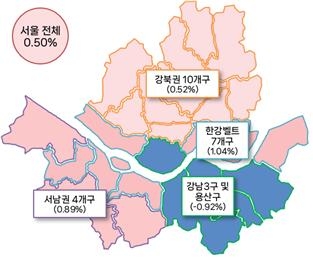
Price trends diverged by area. The average application price for Seoul apartments overall rose 0.50 percent in October from the previous month, though that was a significant slowdown from the 1.51 percent gain recorded in September.
Application prices in the three Gangnam districts and Yongsan-gu fell 0.92 percent month on month, extending a 0.41 percent decline in September and widening the pace of decline.
In contrast, the seven Han River belt districts — Gwangjin, Seongdong, Mapo, Dongjak, Yangcheon, Yeongdeungpo and Gangdong — rose 1.04 percent, accelerating from a 0.39 percent gain in September. The Seoul Metropolitan Government attributed the increase to price-lifting transactions at select complexes driven by location preferences and demand for newer buildings.
The 10 northern districts and four southwestern districts rose 0.52 percent and 0.89 percent, respectively. Both zones maintained their upward momentum, though the pace eased considerably from September gains of 2.17 percent and 2.44 percent.
For apartments with an exclusive use area of 59 square meters, the average application price in the southwestern districts climbed from 830 million won ($621,000) in August to 900 million won in September and 910 million won in October. The northern districts followed a similar trajectory, rising from 810 million won to 870 million won and then 900 million won over the same period.
Since Seoul was designated a land-transaction permit zone citywide on Oct. 20 last year, the Seoul Metropolitan Government has been publishing monthly data on permit application volumes and price changes across all 25 autonomous districts on a temporary basis, aiming to reduce information gaps in the real estate market that arise from the pre-contract approval process.
quq@heraldcorp.com