Non-renewal rule exists but has never been applied
Tension between tenant housing rights and victim protection
External committee under review; consultations with ministry planned
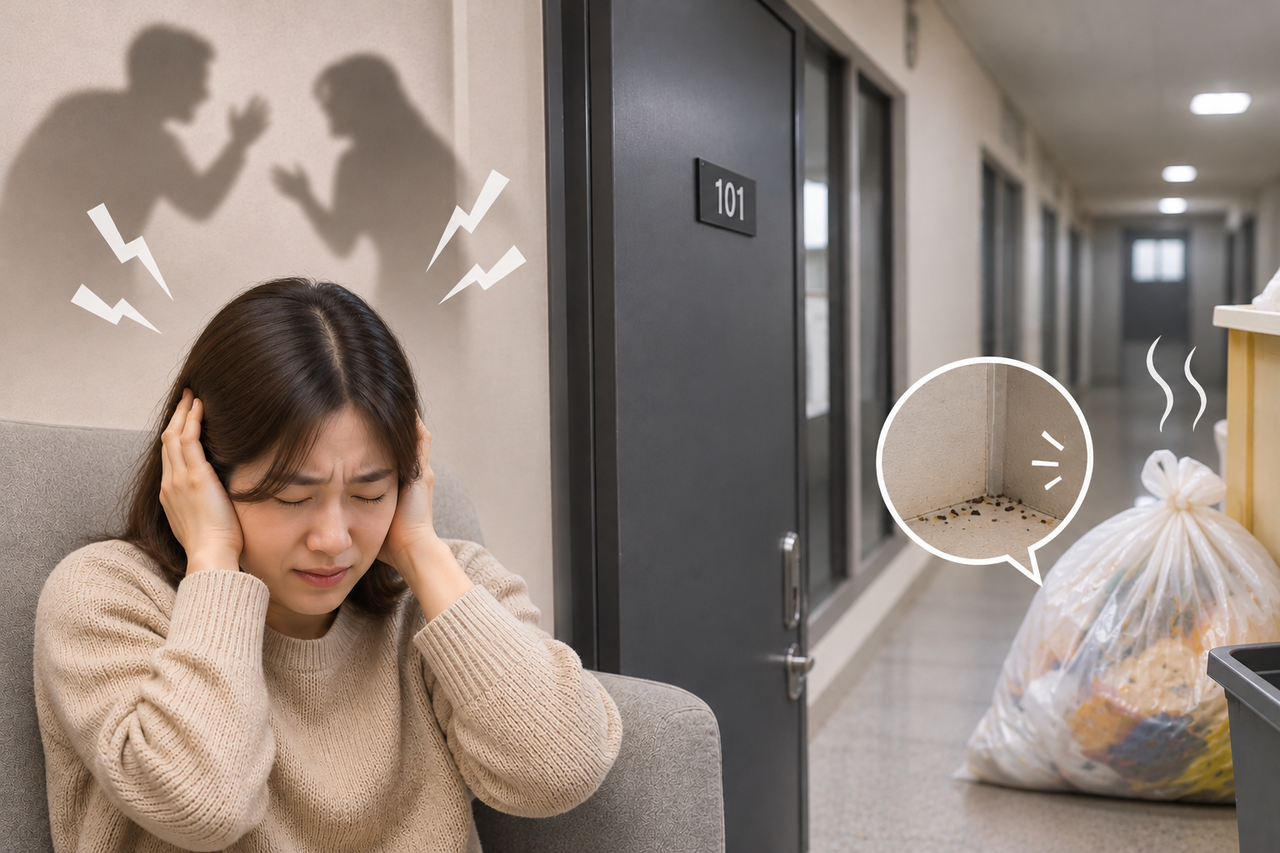
Earlier this month, a cockroach infestation originating from one unit in a Korea Land and Housing Corporation public rental complex in Guro-gu, Seoul spread to neighboring units, drawing a flood of complaints. The tenant responsible ultimately signed a voluntary eviction agreement but was reported to be looking for another rental unit managed by either the Seoul Housing & Communities Corporation or Korea Land and Housing Corporation.
A similar case unfolded two years ago at a public rental complex in Suwon, Gyeonggi Province, where a tenant repeatedly harassed neighbors — shouting profanities, ringing doorbells and kicking front doors. With no effective remedy available, it was ultimately the victim who had to move out.
Cases like these — where tenants cause harm to neighbors through poor sanitation, noise or harassment — are mounting in public rental housing, yet institutional mechanisms to address them remain inadequate. Regulations allow lease non-renewal for violations of order-maintenance obligations, but critics say the rules lack teeth because no concrete criteria exist for applying them. Korea Land and Housing Corporation, known as LH, says it plans to establish clearer standards for lease non-renewal, including through the introduction of an external expert committee.
LH said Friday it is reviewing the introduction of a system to objectively assess whether public rental tenants have violated their order-maintenance obligations. The corporation is examining options including the use of an external committee composed of specialists, and plans to consult with the Ministry of Land, Infrastructure and Transport going forward.
As disputes in rental housing persisted, LH had pushed for legal provisions allowing lease non-renewal and eviction when necessary to maintain order. After extensive deliberation, the approach shifted from National Assembly legislation to a revision of ministry enforcement rules: in August last year, the Ministry of Land, Infrastructure and Transport amended its regulations to introduce order-maintenance obligations and a lease non-renewal provision.
In practice, however, applying these rules on the ground remains difficult. Unlike clear-cut violations such as rent arrears or eligibility breaches, conflicts between tenants or lifestyle noise vary widely in severity and circumstance, making it hard to apply a uniform standard for order-maintenance violations. As a result, no lease has been denied renewal under the provision to date.
LH acknowledged the gap. "When a specific tenant's conduct causes harm to neighboring residents, the complex management office and the relevant LH branch go through a verification process and issue a caution against recurrence — or notify the tenant that lease non-renewal is possible," the corporation said. "However, there is no internal policy to immediately void the legal effect of a lease agreement."
The victim in the Suwon case had requested that the management office and LH forcibly evict the offending tenant, only to be told that forced eviction was not an option — the only alternatives offered were a unit transfer within the complex or a move to a different complex.
Even if a lease is eventually denied renewal, no institutional safeguard exists to prevent the same problems from recurring elsewhere. No cross-agency system restricts a tenant whose lease was not renewed for order-maintenance violations from applying to a public rental unit managed by a different operator.
The Seoul Housing & Communities Corporation said it can deny lease renewal on grounds of disrupting communal living, but added: "There is no way to block an application outright, and in terms of tenant protection, mid-contract eviction is in effect nearly impossible unless there is a direct violation of the grounds for contract termination."
Still, caution is warranted given that lease non-renewal and eviction directly affect tenants' right to housing. LH noted that human rights and civic groups raised concerns about protecting tenant housing rights during the process of introducing the related regulations.
Jung Jae-hoon, a professor at Dankook University's Department of Urban Planning and Real Estate, said protecting tenants' housing rights is important, but repeated harm to other residents cannot be allowed to continue. "There are warning signs before the damage escalates, so it is necessary to establish concrete administrative criteria for order-maintenance violations and to set up a consultative body involving landlords and tenants to clarify the decision-making process," Jung said.
lucky@heraldcorp.com