Longlist announced for Korea Federation of Banks president
Yoon Jong-kyoo, Park Jong-bok seen as frontrunners
Yoon Jong-won only former government official in the running
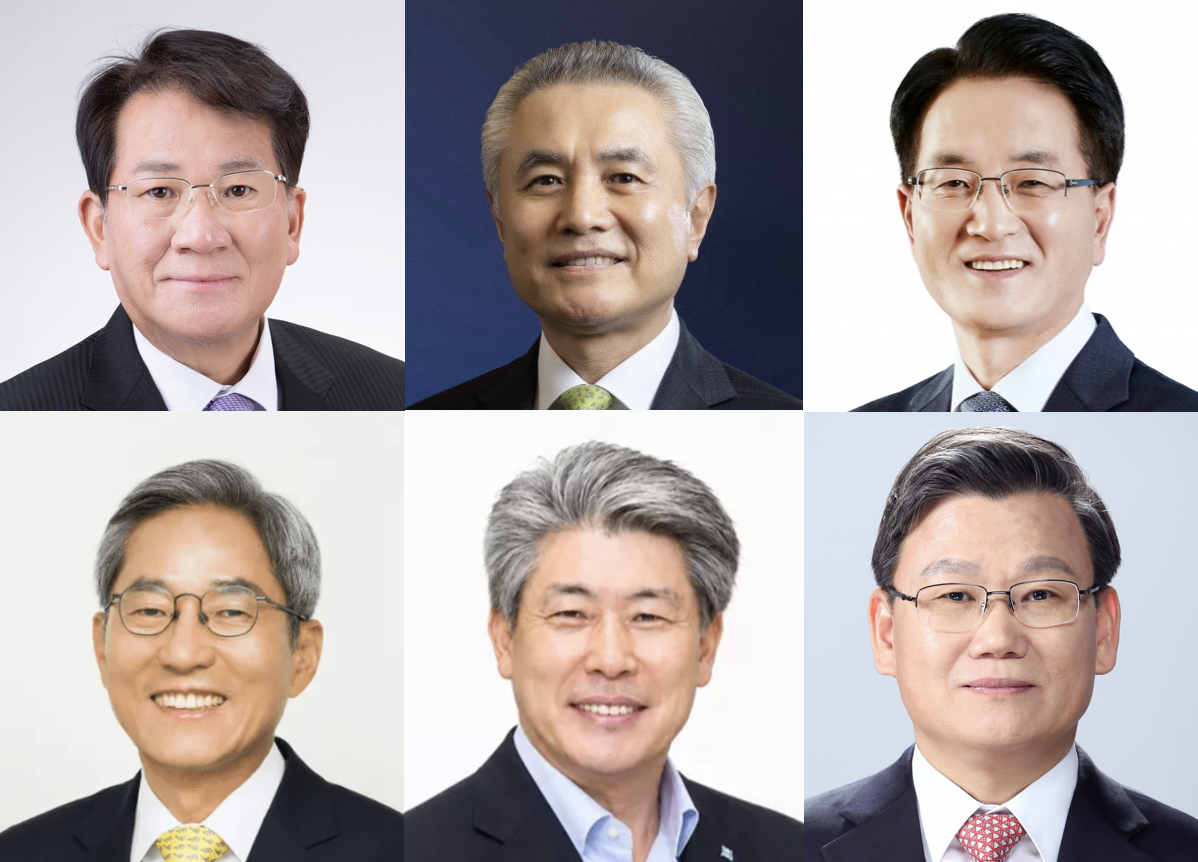
Six former financial holding company chiefs and bank presidents have been named to the longlist for the next president of the Korea Federation of Banks, with the final candidate to be announced Nov. 23.
The federation convened its second presidential nomination committee meeting Friday morning at a hotel in Jung-gu, Seoul, to select the initial pool of candidates.
The six candidates, listed in Korean alphabetical order, are Kim Han-jo, former president of Korea Exchange Bank; Park Jong-bok, former president of SC First Bank; Son Byung-hwan, former chairman of NH NongHyup Financial Group; Yoon Jong-kyoo, former chairman of KB Financial Group; Yoon Jong-won, former president of Industrial Bank of Korea; and Lee Won-deok, former president of Woori Bank.
Of the six, all are from the private sector except Yoon Jong-won, who previously served as a government official at the Ministry of Economy and Finance.
Within financial circles, former KB Financial Group Chairman Yoon Jong-kyoo and former SC First Bank President Park Jong-bok are considered the leading contenders. Yoon is credited with steering KB Financial through a period of internal turmoil and establishing it as the country's top banking group.
Park has spent more than 40 years in banking since his days at First Bank and holds the title of longest-serving bank president. Yoon Jong-won, as the only candidate with a bureaucratic background, is regarded as a dark horse.
Several names not previously mentioned in speculation have also made the list. Kim Han-jo served as president of Korea Exchange Bank before becoming vice chairman of Hana Financial Group and, most recently, chairman of Samsung Electronics' board of directors. Son Byung-hwan is a career NongHyup insider who has led NongHyup Bank, NH NongHyup Financial Group and NongHyup University. Lee Won-deok served as senior executive vice president of Woori Financial Group and played a central role in the group's privatization.
A key variable is how state-owned banks cast their votes. The government and political circles have at times used policy banks to signal their preferred candidate during federation leadership selections, and the closer the race, the greater the swing-vote influence those institutions are expected to wield.
The nomination committee is composed of the heads of 11 member institutions, including incumbent federation President Cho Yong-byung, the chiefs of major commercial banks — KB Kookmin Bank, Shinhan, Hana, Woori and SC First Bank — as well as policy and specialized lenders including Korea Development Bank, Industrial Bank of Korea and NongHyup, along with Busan Bank, K bank and Suhyup Bank. KB Kookmin Bank President Lee Hwan-joo did not attend Friday's second meeting due to an overseas business trip.
The federation plans to hold a third nomination committee meeting on Nov. 23 to select the final candidate, after which the next president will be chosen through a vote of the general membership.
The incoming federation president will face a heavy workload from the outset. On Thursday, the Financial Services Commission unveiled a corporate governance reform plan for financial companies that tightens the requirements for financial holding company CEOs to seek reappointment and expands the channels through which independent directors can be nominated via institutional investors such as the national pension fund.
The financial industry fears that if the government's proposals take effect, regulatory pressure on banks will intensify further. Demands from the government for more productive and inclusive lending are also growing louder. The next federation president will need to find common ground between the government and the banking sector while also charting a course for the industry's development.
hyuk@heraldcorp.com