A leveraged India stock market ETF has claimed the top spot for one-month returns among exchange-traded funds listed on the domestic market. India's equity market, long weighed down by high oil prices as the world's third-largest crude importer, has rebounded as oil prices stabilized following the US presidential election and the market emerged as an alternative destination for funds rotating out of AI and semiconductor stocks.
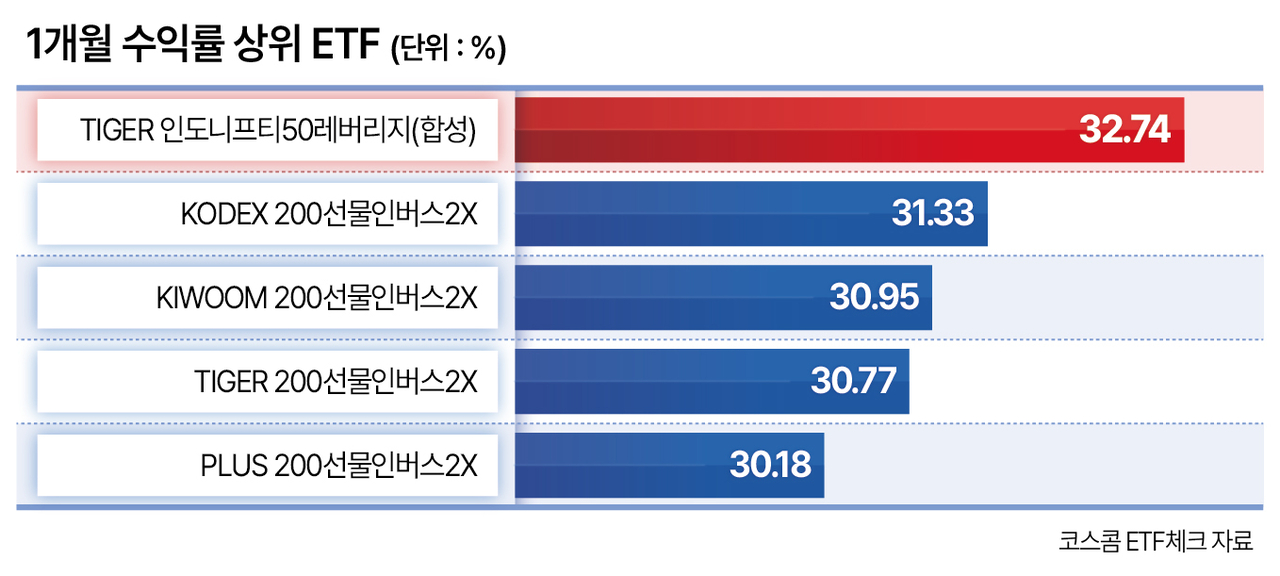
According to ETF CHECK, as of Thursday, the TIGER India Nifty50 Leverage (Synthetic) led all domestically listed ETFs with a one-month return of 32.74%.
Non-leveraged India ETFs also ranked near the top. The KODEX India Nifty50 returned 15.44% over the same period, followed by the KIWOOM India Nifty50 (Synthetic) at 15.17%, the TIGER India Nifty50 at 14.71% and the KODEX India Tata Group at 14.31%. The broad strength across India-focused products shows the rally was not simply a leveraged effect.
India's stock market has gained attention as a beneficiary amid weakness in AI-related shares in both Korea and the United States. Falling international oil prices and a search for alternatives to globally concentrated AI investments have driven a rapid short-term inflow of foreign capital into Indian equities.
Foreign investors have been driving a rebound in Indian equities this month through heavy net buying. Through Thursday, they had net purchased approximately 11.6 trillion won ($8.71 billion), or 75,392 crore rupees, in the Indian stock market this month — already surpassing the previous monthly record of 66,135 crore rupees set in December 2023. The Nifty50 index rose about 9.6% over the same period.
Kim Geun-a, a researcher at Samsung Securities, said India's stock market had been struggling throughout the year, with the benchmark NIFTY50 falling more than 10% from its year-opening level by late October. "High oil prices, a concentration of global capital flows into AI-related sectors, and foreign fund outflows triggered by rising US long-term interest rates had all weighed on the market," Kim said.
V.K. Vijayakumar, chief investment strategist at Geojit Investments in India, said the selloff in AI-related stocks had made India an attractive market for foreign portfolio investors. "However, the US 10-year Treasury yield rising back toward 5% could somewhat limit further upside," he added.
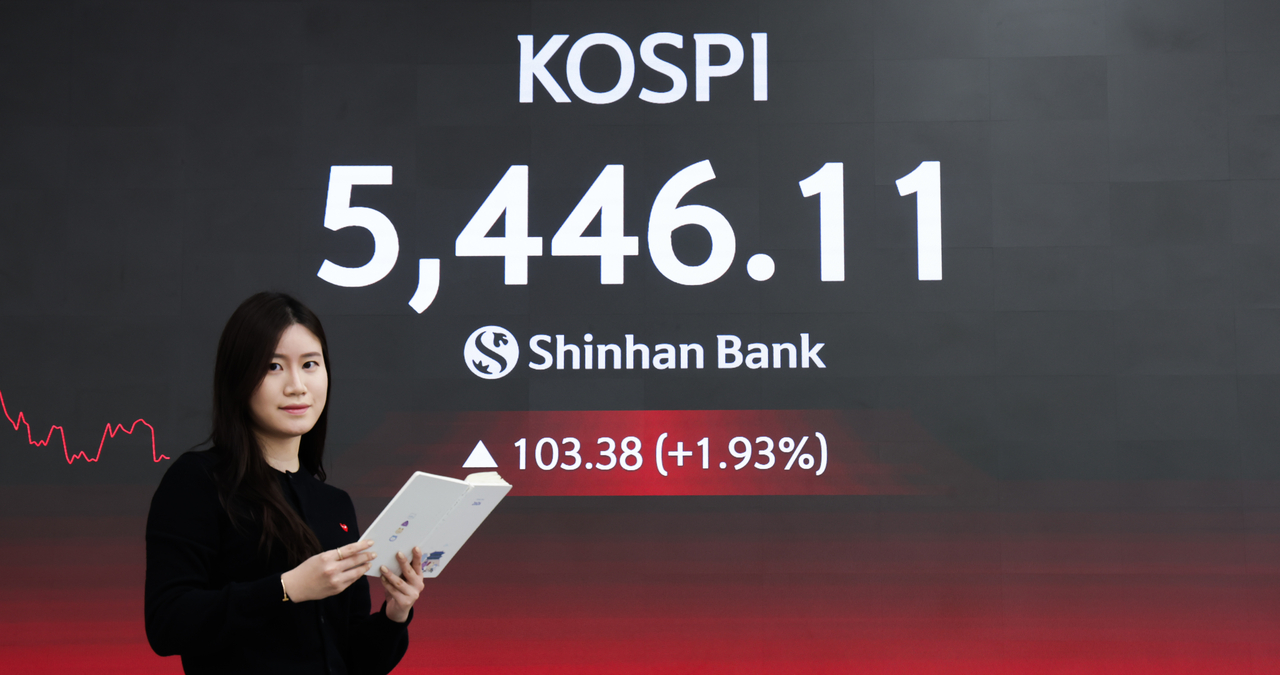
South Korea's stock market, by contrast, has continued to weaken after AI and semiconductor heavyweights led its earlier rally. The Kospi, which was trading around 6,300 points a month ago, has struggled to recover as concerns over data center regulation emerged following the Democratic Party's sweeping victory in the US elections. The index has shed more than 100 points and was trading in the low 5,000s, closing at 5,342.73 on Thursday.
As the decline in major domestic indexes deepened, inverse ETFs — products that deliver twice the daily inverse return of an index — dominated the top-performers list. Of the 20 highest-returning ETFs over the past month, 12 were inverse products. KOSPI 200 futures inverse products accounted for six, Kosdaq 150 futures inverse products for four, and single-stock inverse products tracking Samsung Electronics and SK hynix each claimed one spot. Products posting returns above 30% included the KODEX 200 Futures Inverse 2X at 31.33%, the KIWOOM 200 Futures Inverse 2X at 30.95%, the TIGER 200 Futures Inverse 2X at 30.77% and the PLUS 200 Futures Inverse 2X at 30.18%.
With foreign capital inflows into the domestic market remaining subdued, supply-demand pressure is building again ahead of a major US AI company's initial public offering. There are concerns that Anthropic's upcoming listing could draw capital away from Korean investors as well as global funds toward the US market, potentially deepening the slowdown in retail buying on the Kospi.
Kim Min-gyu, a researcher at KB Securities, said that regardless of how the offering performs, Korean investor flows could shift toward Anthropic in the short term. "Domestic market trading is already quiet and money is moving back toward US stocks — Anthropic's listing could accelerate that trend," Kim said. Kim Du-eon, a researcher at Hana Securities, said a large-scale public offering would also weigh on the supply-demand dynamics of existing AI and semiconductor stocks. "Even if AI-related shares broadly wobble after the Anthropic IPO, companies with AI businesses that can ultimately generate real profits could emerge as the next market leaders," Kim said.

kacew@heraldcorp.com