Land minister cites economic viability, balanced regional development
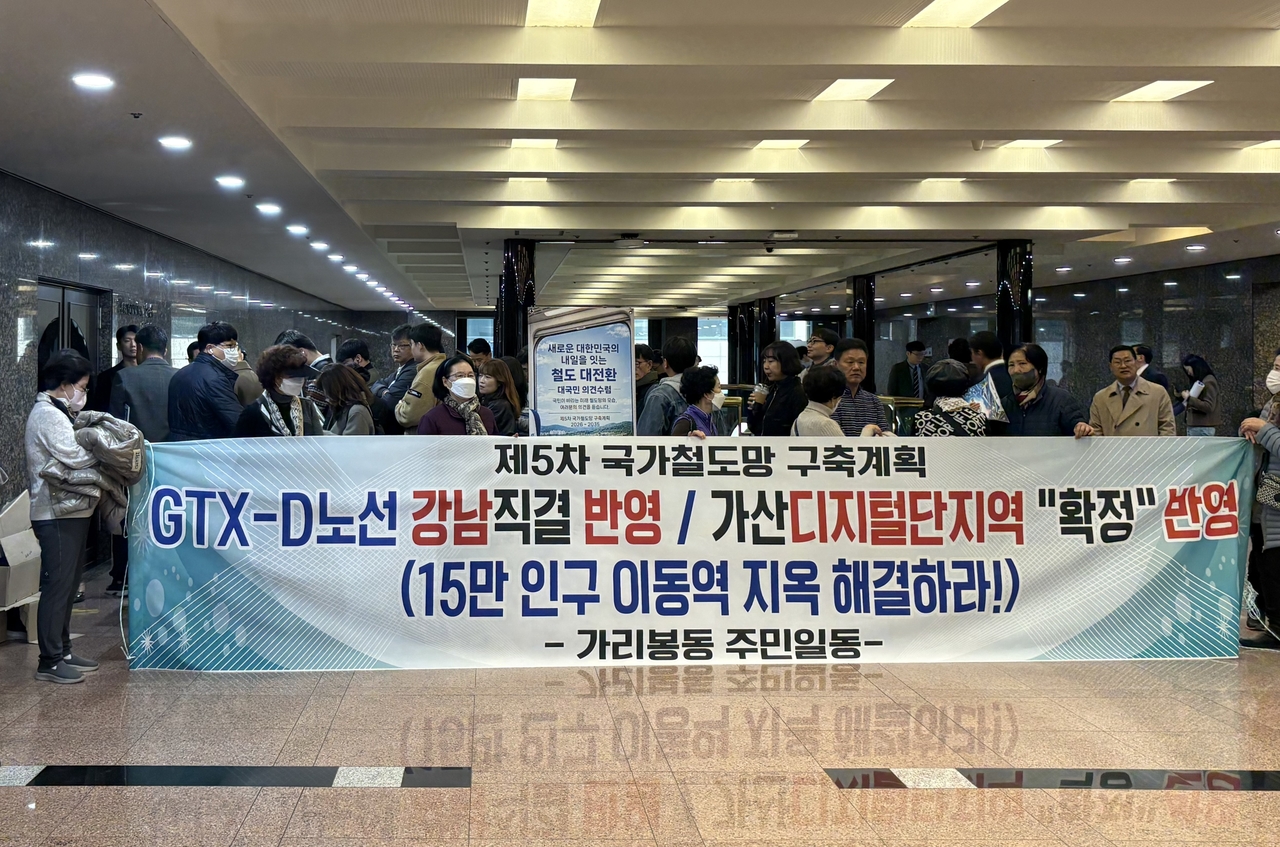
As the government moves to establish the Fifth National Railway Network Construction Plan covering 2026 to 2035, a large majority of survey respondents said they support expanding rail investment.
Local governments proposed an appropriate investment scale of 100 trillion to 200 trillion won ($75.1 billion to $150 billion) for new projects to be included in the plan, while the Ministry of Land, Infrastructure and Transport said it would weigh economic viability and balanced regional development, among other factors.
The Korea Transport Institute released the results of surveys targeting the general public and local governments at a public hearing on the Fifth National Railway Network Construction Plan, held Friday at the Specialized Construction Hall in Dongjak-gu, Seoul.
In the public survey, 96.9 percent of the 90,714 respondents said national railway investment should be expanded. Of those, 71.2 percent favored "active expansion," while 25.7 percent supported "phased expansion centered on necessary projects." Only 1.5 percent said the current level should be maintained, and 1.0 percent called for reduced investment.
Some 66.2 percent of respondents said rail service in their area of residence was insufficient. Another 67.4 percent said they expected rail to play a larger role than roads over the next 30 years.
However, opinions on which regions should receive priority rail investment diverged depending on where respondents lived.
Among Greater Seoul residents (68,516 respondents), 60.6 percent said the metropolitan area should be prioritized, while 73.6 percent of non-metropolitan respondents (22,198 respondents) said their regions should come first.
On the appropriate investment ratio, 69.9 percent of Greater Seoul residents favored a 60-to-40 split in favor of the metropolitan area, while 43.8 percent of non-metropolitan respondents preferred a 30-to-70 split favoring their regions.
In a separate survey of 15 metropolitan and provincial governments, seven chose "about 100 trillion won" as the appropriate investment scale for new projects, while six chose "about 200 trillion won."
The Korea Transport Institute said Greater Seoul governments most commonly chose 100 trillion won, while non-metropolitan governments most commonly chose 200 trillion won. Two governments selected "about 80 trillion won," and none chose the roughly 43 trillion won level of the current Fourth Plan.
Thirteen of the local governments (86.7 percent) said national railway investment should be actively expanded, and 14 (93.3 percent) said rail projects should be pursued in tandem with development planning from the earliest stages.
The top policy priority cited was "expanding non-metropolitan rail networks and promoting balanced regional development," named by eight governments, followed by "high-speed connections between major hub cities and creating a single national living zone" (four governments) and "easing traffic congestion in the Greater Seoul area and shortening commute times" (three governments).
In opening remarks, Land, Infrastructure and Transport Minister Hong Ji-seon said that "since railways take a long time from planning to opening, there is a need to look ahead to future demand and consider expanding investment," adding that "housing and transportation must go hand in hand."
However, Hong cautioned that "government resources are limited and existing projects must be completed without disruption," and said that while "it will not be possible to include every project, we will look comprehensively at economic viability, balanced development and the connectivity effects between lines to find a reasonable path forward."
At the event, representatives of 14 local governments — including Gyeonggi Province Governor Choo Mi-ae and Incheon Mayor Park Chan-dae — took the floor to request that their regional rail projects be included in the Fifth Plan.
Choo said the province had submitted proposals for 40 rail projects it considers essential to the Fifth Plan, urging the government to "help ensure the transportation network is in place to support Gyeonggi Province as it shoulders responsibility for housing stability and industrial growth across the country."
Park said that "Incheon is part of the Greater Seoul area, but suffers various forms of double marginalization relative to Seoul, Gyeonggi Province and the regions," and called for the inclusion of the GTX-D Y-line and an extension of the Daejang-Hongdae line.
hss@heraldcorp.com