Prices frozen for 5 months as maximum price regime enters 9th consecutive month
Ministry says price controls have stabilized inflation, but future of program beyond this year remains undecided
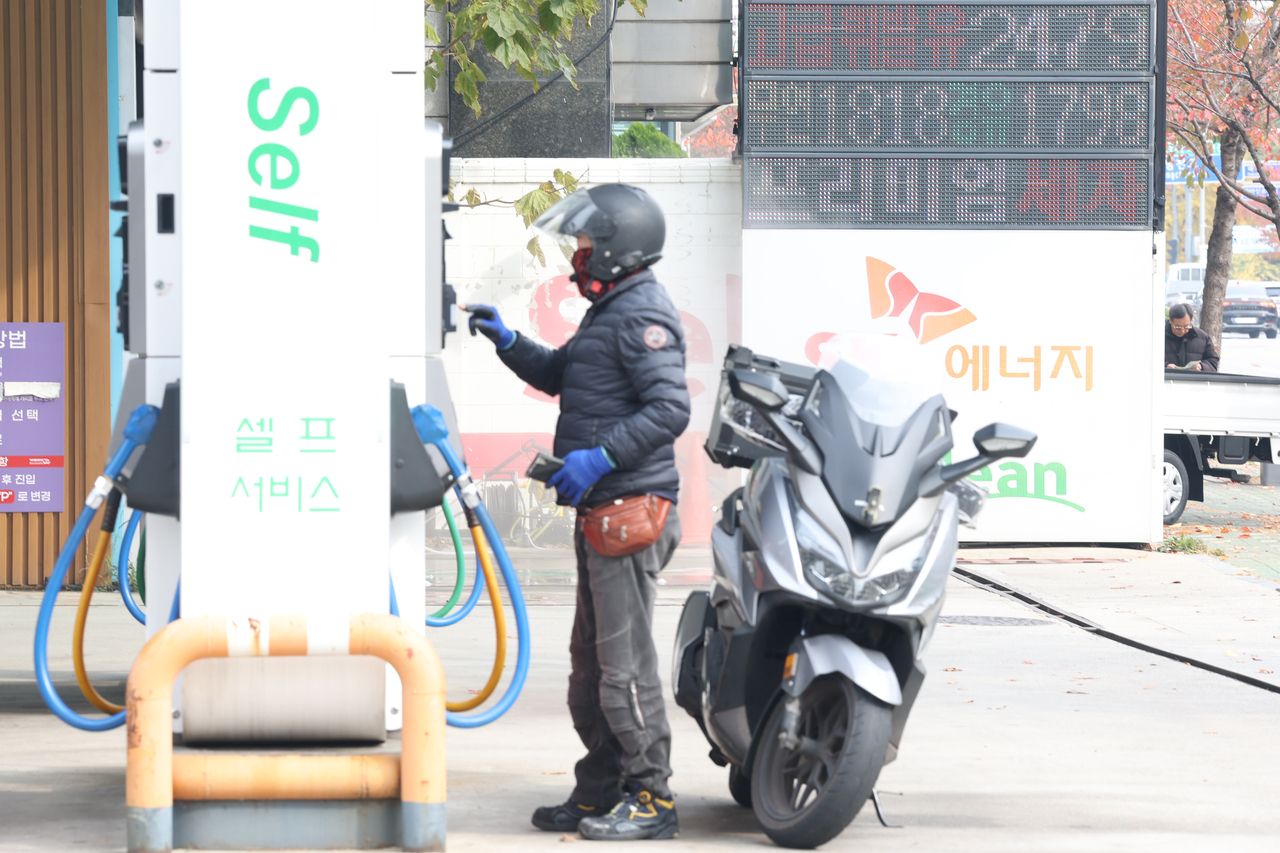
South Korea will extend its petroleum price caps for another four weeks, keeping gasoline at 1,784 won per liter, diesel at 1,773 won and kerosene at 1,380 won. The extension means the maximum price regime, introduced in the wake of the Middle East war, will run for nine consecutive months from March through next month.
South Korea's Ministry of Trade, Industry and Energy announced Thursday that the 12th round of petroleum price caps, effective from midnight Saturday, will be held at the same levels as the 11th round.
The decision keeps prices unchanged for more than five months since the government cut the seventh-round cap by 150 won per liter in late June, when the United States and Iran reached a ceasefire agreement.
Expectations of a lasting US-Iran peace have risen again recently, but uncertainty across the Middle East remains.
International oil prices as of Thursday stood at $96 per barrel for Brent crude, $90 for Dubai crude and $89 for West Texas Intermediate.
Those levels are lower than when prices briefly topped $100 per barrel last month, but still about $20 or more above where they stood in late June when the current caps were set.
Persistently high global oil prices, combined with growing risks such as vessel attacks near the Strait of Hormuz, have also pushed up maritime freight costs.
The government nonetheless decided to maintain the price caps to protect public welfare. The Korea Development Institute recently estimated that the price control regime had lowered the monthly average rate of petroleum price increases by about 12 percentage points and the monthly average consumer price inflation rate by about 0.6 percentage points between March and October this year.
The Korea Institute for Industrial Economics and Trade also assessed that the price caps had helped contain further expansion in the rate of oil price increases.
Yang Ki-wook, director general for industrial resource security at the Ministry of Trade, Industry and Energy, cited both reports in saying the regime had demonstrated a measurable stabilizing effect on prices and petroleum costs since its introduction.
"We plan to pursue public welfare stability while closely monitoring domestic and international conditions as we operate the price cap system," Yang added.
With this latest extension, the maximum price regime introduced on March 13 will run at least through December. However, the longer the system continues, the greater the fiscal burden on the government from compensating refiners for their losses.
The ministry has set aside 4.2 trillion won ($3.15 billion) in contingency reserves and allocated 1.45 trillion won in next year's budget, on the assumption that the price caps will remain in place through the fourth quarter of this year.
The ministry said it is also weighing when and how to end the regime. The conditions it has previously outlined for termination are an end to the Middle East war, normalization of navigation through the Strait of Hormuz, and international oil prices settling in the $90-per-barrel range.
"The exit conditions remain valid," Yang said, "but the Middle East war is dragging on, and if it extends like the Russia-Ukraine war, we cannot maintain the price caps indefinitely — we will need to assess the situation as it develops."
"No decision has been made on whether to continue the price cap system next year," Yang said. "If it does continue, I understand the National Assembly is holding various discussions on how to handle the budget, but nothing specific has been decided."
Meanwhile, the ministry plans to calculate and notify refiners of their first loss compensation payment — covering the period from March 13 to June 30 — by late this month or early next month.
oskymoon@heraldcorp.com