Director Ko Sun-ung's 'Two Scenes' reunites Mabangjin veterans for the troupe's 20th anniversary
The production shines a light on a South Korean society that loses an average of 41 people a day to suicide
The company's first co-created work strips away verbal flair in favor of raw, everyday language
"You called everyone here and now you keep fighting."
Music director Kim Yong-hwa mutters the words while leaning toward the actor seated beside the piano. It is not in the script — a quiet aside that would never reach the audience — yet Kim has been saying it throughout rehearsals.
"I'm an observer, a character standing one step outside the actors," Kim said. "The director in the play hired me to play a little music, and then they just keep fighting among themselves — so of course I say something like that."
The very director Kim is talking about — Seo Jeong-wan, head of theater company Mabangjin — bursts out laughing from the next seat.
"In the play, I'm the one who hired him," Seo said. "He came because I asked him to play, and these people just keep arguing — no wonder he wants to go home."
Two late-blooming first-time actors take the stage in "Two Scenes," Mabangjin's new production marking the troupe's 20th anniversary, running Friday through Nov. 22 at Mapo Arts Center. Seo, who leads the company, plays "former director Oh Gwang-su," while Kim — who has worked with Mabangjin since the 2010 premiere of "Kalo Macbeth" — plays a character sharing his own name, "musician Kim Yong-hwa."
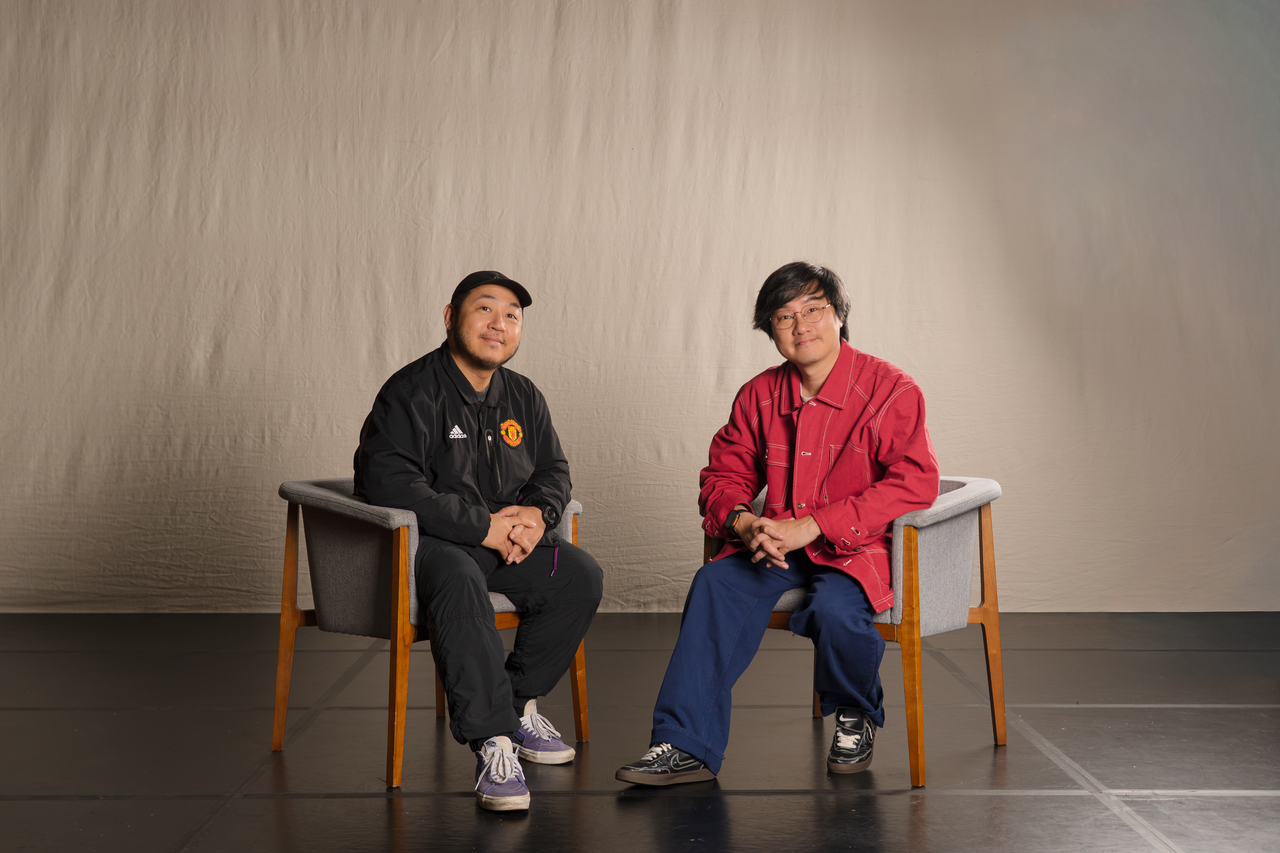
The two met recently with The Korea Herald at Mapo Arts Center. Seo called the production "a chance to learn a little more about what it means to be human," while Kim described it as "something like treatment — a work that lets me finally confront the stage fright I have carried my whole life."
Mabangjin at 20: a first co-created work cuts to the heart of Korean society
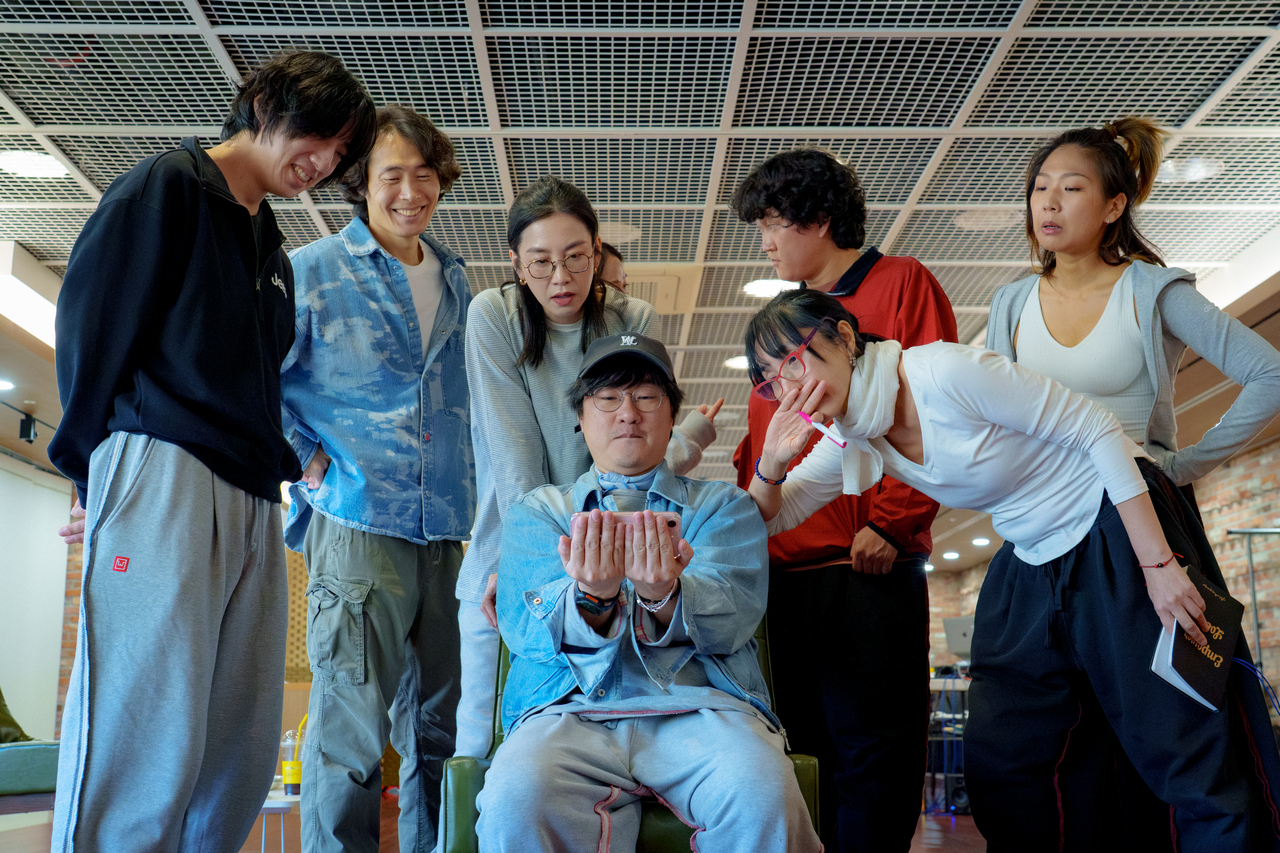
In the rehearsal room at Mapo Arts Center on Nov. 5, a week before opening night, director Ko Sun-ung was working obsessively on the final scene's details. Won-sam stands before a narrow window. Crouching before him is director Oh Gwang-su, played by Seo Jeong-wan, who speaks in a calm, soothing tone: "How are you feeling right now, hyung?" Then a torrent of cutting contempt and mockery follows.
"You can't even jump because you want attention again." "Hey, you were acting just now — what are you doing out there?" "We were about to cook some ramyun."
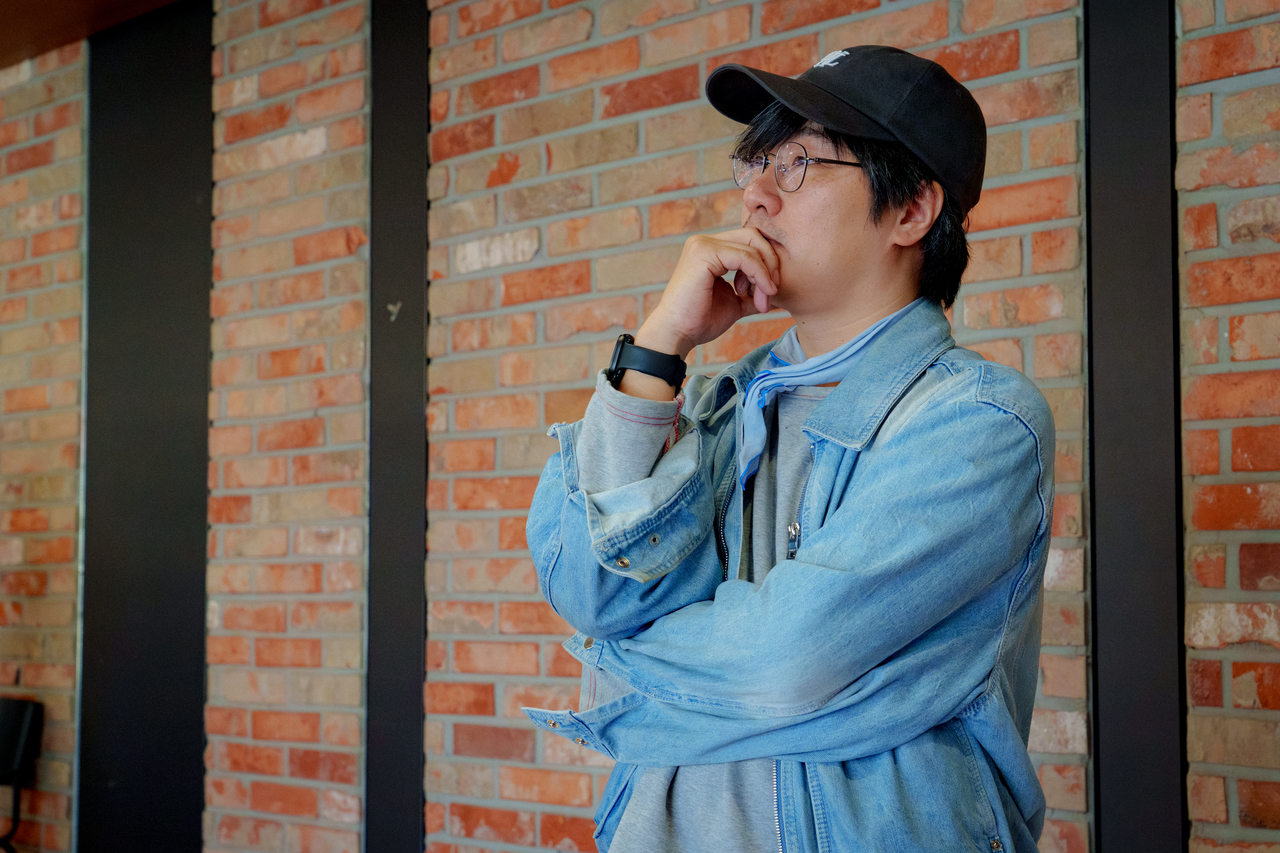
Ko tells actor Won Gyeong-sik, who plays Won-sam, "You have to start going down the moment you begin to smile — going down, going down." Ko's theater has always been an art of timing. As his voice marks each beat of the orchestra pit descending, the actors' lines settle coldly into place. "We're underground here." "There's nowhere left to go down."
South Korea loses an average of about 41 people a day to suicide. When "Two Scenes" was conceived in 2024, that figure stood at 38 a day. It was a painful cross-section of Korean society that Ko noticed after completing a three-year tenure at the Seoul Metropolitan Theater and returning to Mabangjin as artistic director.
The production actually began not with a theme but with a form. "When director Ko came back to Mabangjin, he said he wanted to try co-creation," Seo said. "Mabangjin has 50 to 60 actors alone, 65 people including staff, and the ones whose schedules aligned came together." Ko, who has never looked away from the problems of the world around him, turned his gaze first to "the various ills of Korean society." The country's devastating suicide rate was a subject he could not sidestep.
The setting is a co-working space. "I've used one myself, and they're strange places," Seo said — "spaces full of people who are completely indifferent to one another, each absorbed in their own work." He said the idea was to let two worlds run in parallel: "the theater company, a place that smells of human life, and the cold, indifferent co-working space — with the issue of suicide flowing through the middle." As ideas accumulated and a larger framework took shape, the production's central question emerged from a sharp provocation by Ko.
"The director suddenly asked, 'In a place that cold, if someone opened a window and jumped, would anyone try to stop them?' I said I didn't think so. Then he said, 'Let's say that happened — let's improvise it,'" Seo recalled.
The script opens in a rehearsal room set inside a co-working space. The fictional director Oh Gwang-su shows the actors CCTV footage and a police report: a man squeezed through a gap in an 11th-floor window and jumped, while the people around him did nothing to stop him. Oh proposes that the actors reconstruct the incident through improvisation, hoping to uncover what lay beneath the bystanders' inaction. The title carries a double meaning — "투신" means "to throw oneself," while "Two Scenes" points to the play's dual structure.
A sudden acting debut: 'You need to embarrass yourself at least once'
Neither of the two had planned to step in front of the camera. Kim's entry onto the stage was settled abruptly, in the back of a taxi, right after the pair had finished reworking Mabangjin's signature production "Kalo Macbeth" 16 years on. When Ko first brought up the new work, Kim assumed things would go as they always had.
"In the taxi, he casually said, 'Hey, I think you need to get on stage.' I waved him off and said I had stage fright. He said, 'You're not getting any younger — you need to embarrass yourself and get over it,'" Kim recalled.
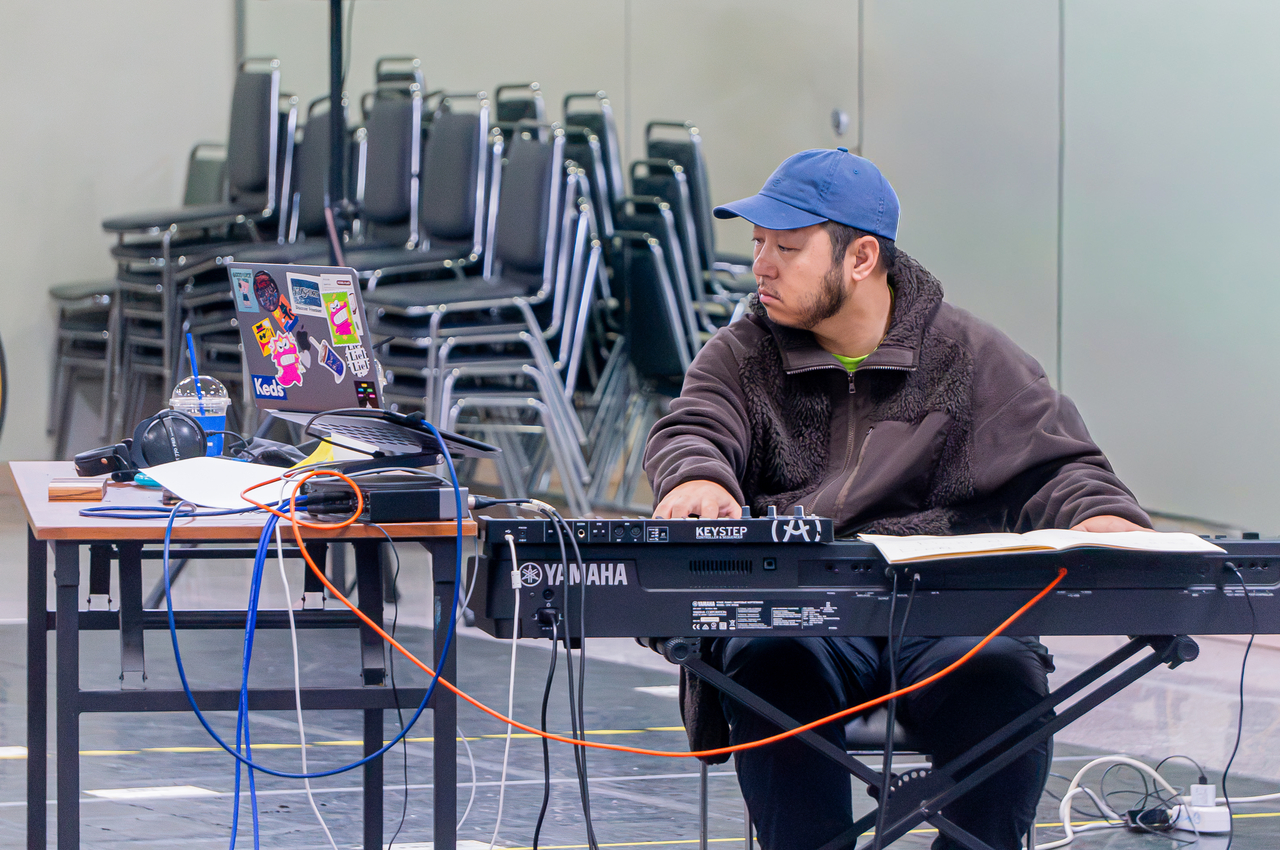
The role Kim was given is that of a musician who moves between the world inside the play and the world outside it, watching the conflict unfold from one step back, observing the rehearsal room and stepping in at the piano when the scene calls for it. "He just tossed me in like an odd piece out," Kim said, marveling at Ko's powers of observation. "But when I thought about it, that's exactly how I've always moved around in rehearsal rooms — hovering on the edges." Kim added that the other characters also closely resemble the actors' real-life speech patterns.
For Seo, Ko has been a mentor for more than a decade — someone Seo worked alongside as assistant director, and later as co-director on "I Was Not in Gwangju." Through all those years, Ko's direction had always landed with crystalline clarity. But the moment Seo became an actor, everything changed.
"Watching from the outside, I'd nod along and think, 'Yes, of course.' But once I was inside the stage, my head and my body stopped cooperating. I'd go home, watch the footage, read the script, and think — the director said this, so why can't I do it? Why is it so hard?" Seo said.
Reviewing rehearsal footage and the script after returning home became a new daily ritual. Seo had always believed, from the director's chair, that the actors' struggles were fully understood — but standing under a spotlight proved otherwise. It was not simply a matter of memorizing lines. Movement, eye contact and the timing of reacting to a fellow actor's words all had to be controlled at once. "I finally understand what actors go through," Seo said with a rueful laugh.
The contrast between working with Ko as a creative collaborator and facing him as an actor is stark. "As music director, whenever I got a note to revise something, I'd just say, 'I'll come back with a new version,'" Kim said. "Now the thing I hear most is, 'You just need to play well.'" It is Ko's characteristically offhand encouragement toward someone who must weave improvised melodies in real time on stage. Kim admitted to feeling a little stung: "I want detailed direction too."
For Seo, who carries a far heavier load of dialogue, the relentless direction is more of a snare. The fictional director Oh Gwang-su assigns roles to the actors, stops scenes, corrects lines and steers the improvisation — and in the process, Ko's actual direction bleeds into the character's scripted lines. Seo must hold both identities at once: the director and the actor.
"Mid-speech, a direction line suddenly slips in — 'No, do it like this.' That's the moment my real self and my character collide," Seo said. "If I lose the thread for even a second, the actors all suddenly stare at me. That's when I snap back and think — oh, it's my turn."
Verbal flair gives way to the rawness of everyday speech
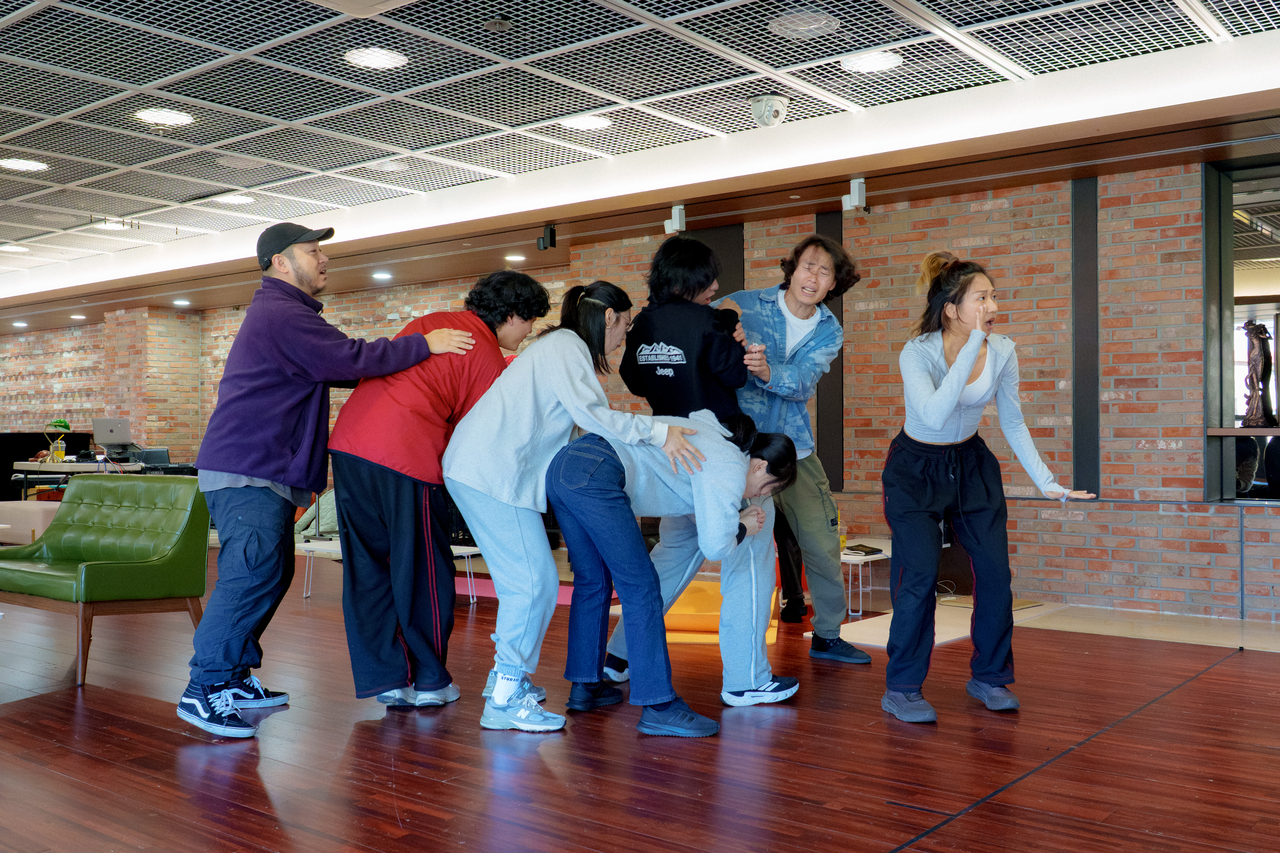
A front-desk receptionist, the founder of a running-shoe startup, a webtoon artist, a tarot reader — the actors each took on the roles of people who were in the co-working space at the time of the incident. The central figure is Won-sam, the person who jumped. The actors swapped roles and improvised the situation, and the language and behavior that emerged from those sessions were gathered and woven into the script.
The production's weight extends beyond a reconstruction of events. A play that began as an attempt to understand a stranger's death ends up shaking loose the festering relationships within the actors themselves. Won-sam is wounded by his colleagues' sharp words and begins to wonder whether he is simply surplus to this space. Those around him seem to offer comfort, only to push him toward the edge with commands to endure, to stop, to leave. The bystander behavior that played out in the co-working space is replicated, note for note, in the sealed world of the rehearsal room.
The rapid-fire dialogue and rhythmic verbal flair that have defined Ko's theater are considerably softened in "Two Scenes." "The director wanted to find a new point of departure from conventional drama, and to make a production closer to the raw style that Mabangjin hasn't explored much," Seo said. The lines lean on the actors' own spoken rhythms and everyday language, and the relationships between characters feel closer to the familiar landscape of a rehearsal room. It is an extension of a shift that first took root in "Ghost," Ko's production about unregistered deaths during his time at the Seoul Metropolitan Theater.
Using everyday language has not loosened Ko's directorial grip — if anything, he scrutinizes every word ending. "Whether an outburst reads as a sunbae's affectionate advice or an uncontrollable explosion of anger can hinge on a single sentence-ending particle," Seo said. "The director catches those hairline fractures with uncanny precision." Kim, seated nearby, added with admiration: "He's even an incredible actor himself."
The moment Seo identifies with most deeply is a monologue by the fictional director Oh Gwang-su. Worn out by the emotional toll on the actors, Oh faces their resistance — "Why do we have to do this cruel thing?" — and the suspicion that he is simply mining someone's death for a grant-funded production. At the moment he is about to stop the rehearsal and walk out, Oh finally gives voice to why he started making this play at all.
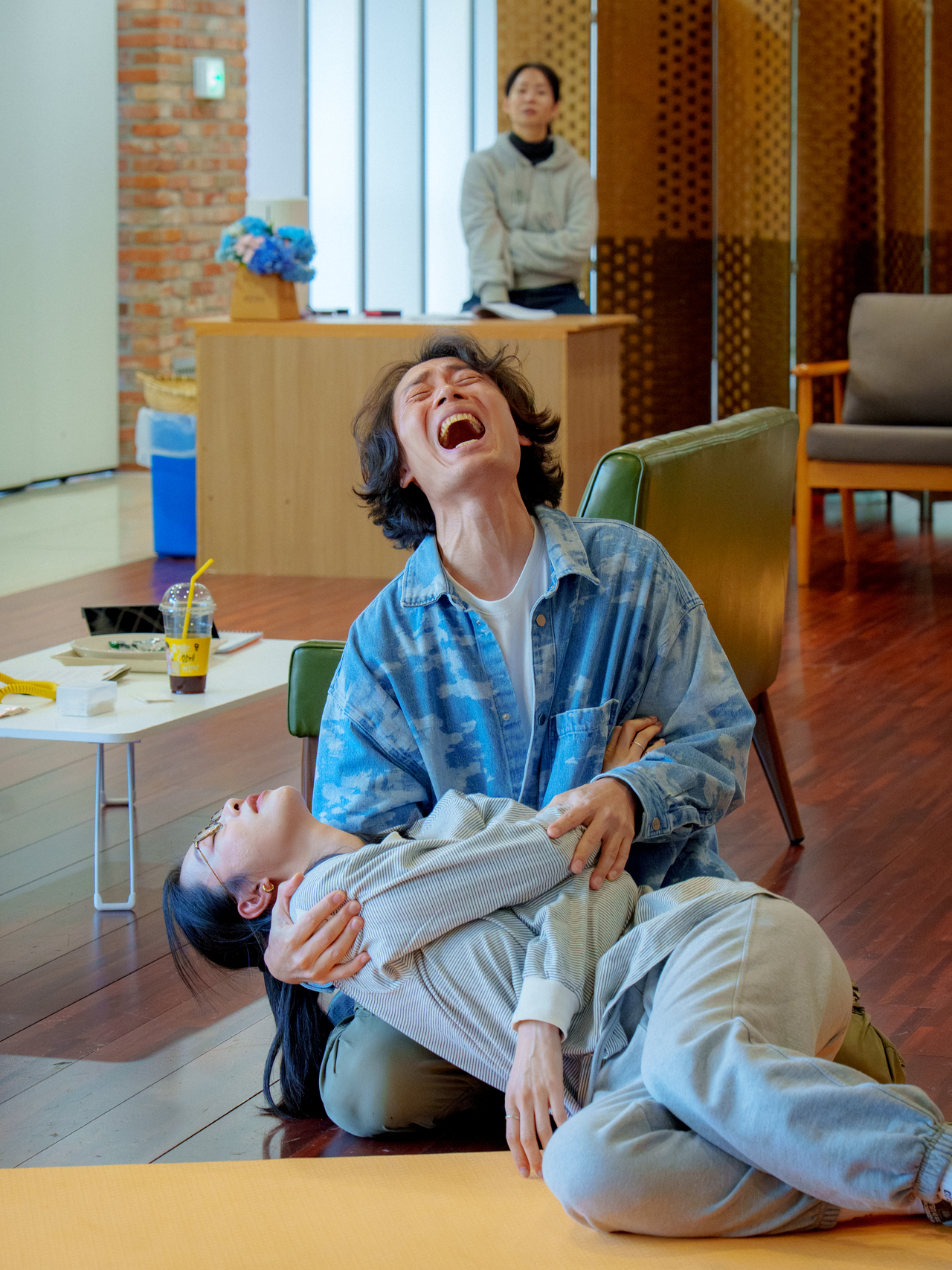
"There were people there. And no one tried to stop him. And he fell and died. I couldn't understand that. I thought it was cruel. We're not those kinds of people, are we? If someone is hurting, do you just dig into that wound and twist the knife? No. If someone is about to fall — you hold on to them. Isn't that what it means to be human?" (from Oh Gwang-su's monologue)
"At first I found Oh Gwang-su hard to understand — I just thought he was a bad person," Seo said. "But eventually I realized he's a director who deeply loves people and is endlessly curious about them, and that's why he keeps driving the scene forward." Seo says 100 percent of his own identity is projected onto Oh. "The director in the play doesn't usually get angry either. (Laughs)"
The play's questions do not stop at the level of bystander behavior. It presses its lens closer to ask why people fail to reach out even when they witness another's despair, and what makes us indifferent to the lives of those sharing our space — offering a glimpse into the barren, solitary existence of modern life. The message Ko passed on to Seo was simple: "Let's not die by suicide."
Recorded music and live piano alternate on stage. "The thing I'm most careful about is not letting the music exaggerate or trivialize the weight of a scene," Kim said. "Even in the scene where the webtoon artist is attacked by friends and loses their way, I wanted to give a sense of loneliness without going too deep — that's the balance I kept working on."
The goal is to shape the spatial atmosphere of each scene through minimal melody while keeping the actor at the center. "I didn't want to drown out the actors' lines or their breathing," Kim said. Ko's own guiding principle was the same: "The music must never get ahead of the actors." Seated at the piano, Kim watches the tension build and waits for the precise moment a character's emotions cross a threshold before adding sound — and sometimes, in response to a single line of dialogue, chooses silence instead. On stage, the identity of the character who provides the music and the identity of the actual music director of the production overlap completely.
The two first joined forces as director and music director on "Anchor" in 2018 and have since become close fishing companions. Now, surrounded by actors, they lean on each other as a mutual refuge.
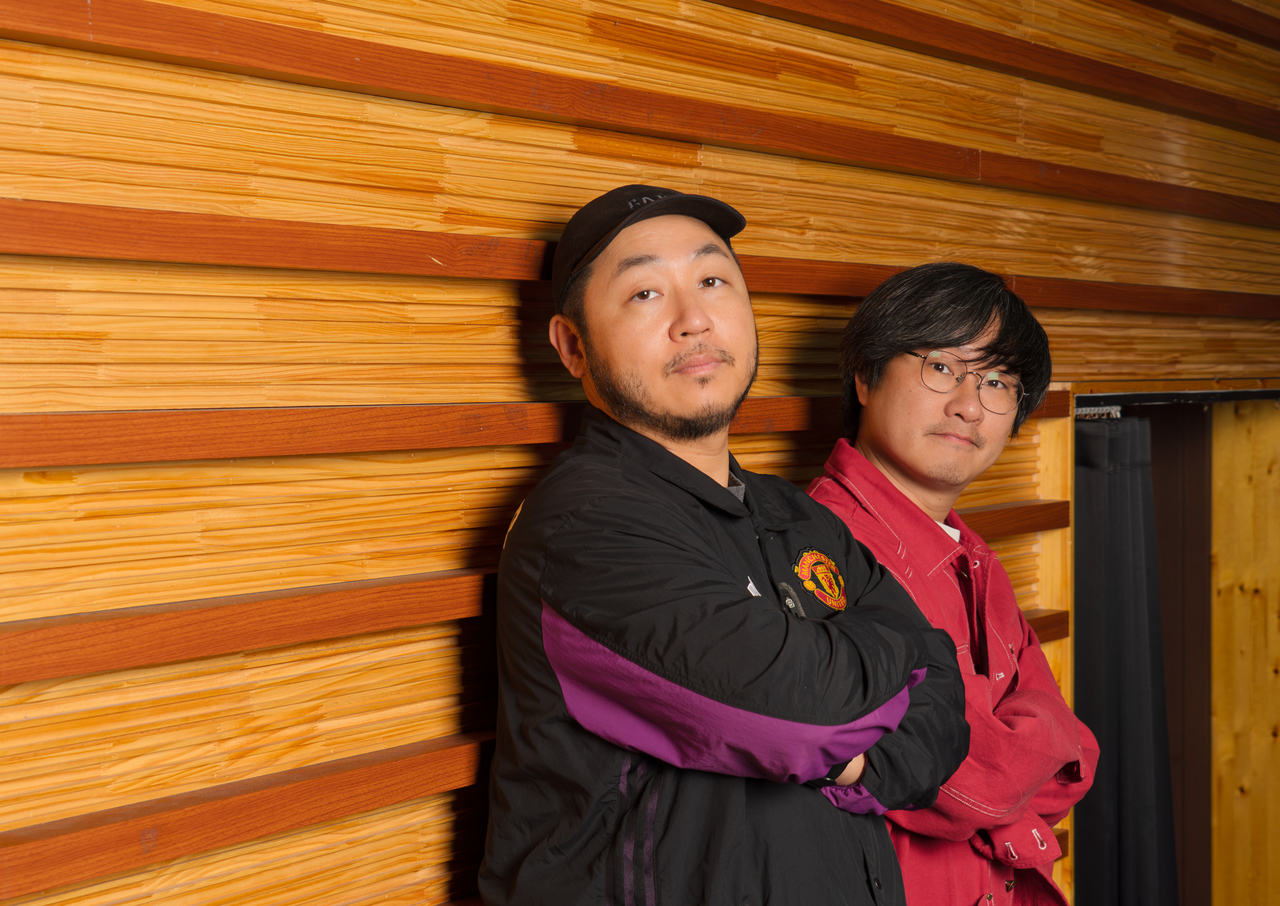
"Everyone else is an actor and we're the only two who aren't — at first I thought, what are we going to do, this is a disaster," Seo said. Kim, listening, laughed: "I was cast first, so I imagine your first reaction was secretly, 'Ha — good luck with that.'"
Two years in the making and with more than two months of rehearsals behind them, the pair have grown into something resembling actors. "I don't have many lines, but he has an enormous number," Kim said of Seo. "Watching him, I can only feel awe. When he walks across the stage delivering a long speech, I think — how does he do that?" The fictional director also resembles the real Seo. "Director Ko tends to listen quietly when I bring him music and just watch," Kim said. "But Seo tells me when my music hits the mark — he says he likes it." Kim has become thoroughly absorbed in the role of the observer on stage.
"I'm watching everything that happens. Sometimes I get up and drift toward the main character, and every time I do, Director Ko says, 'Good — keep that.' The fact that I can move like that means I already exist as the character. He's the kind of director who would tell me to stop if it felt random or out of place," Seo said in praise of Kim. Kim responded: "I just keep asking myself — what would I do here? That's how I approach it."
Each in their own square, no one looking away
The name Mabangjin is rooted in the company's founding philosophy. A magic square — 마방진 in Korean — is a mathematical arrangement in which the numbers in every row, column and diagonal add up to exactly the same sum.
For 20 years, Ko has told the company's members: "Theater is about the sum. Each person just needs to perform their own square perfectly." The aesthetic is one of fierce dedication to one's own part, without trespassing on another's territory, to produce an ultimate ensemble. The organizational culture Seo takes pride in at Mabangjin fits that philosophy precisely.
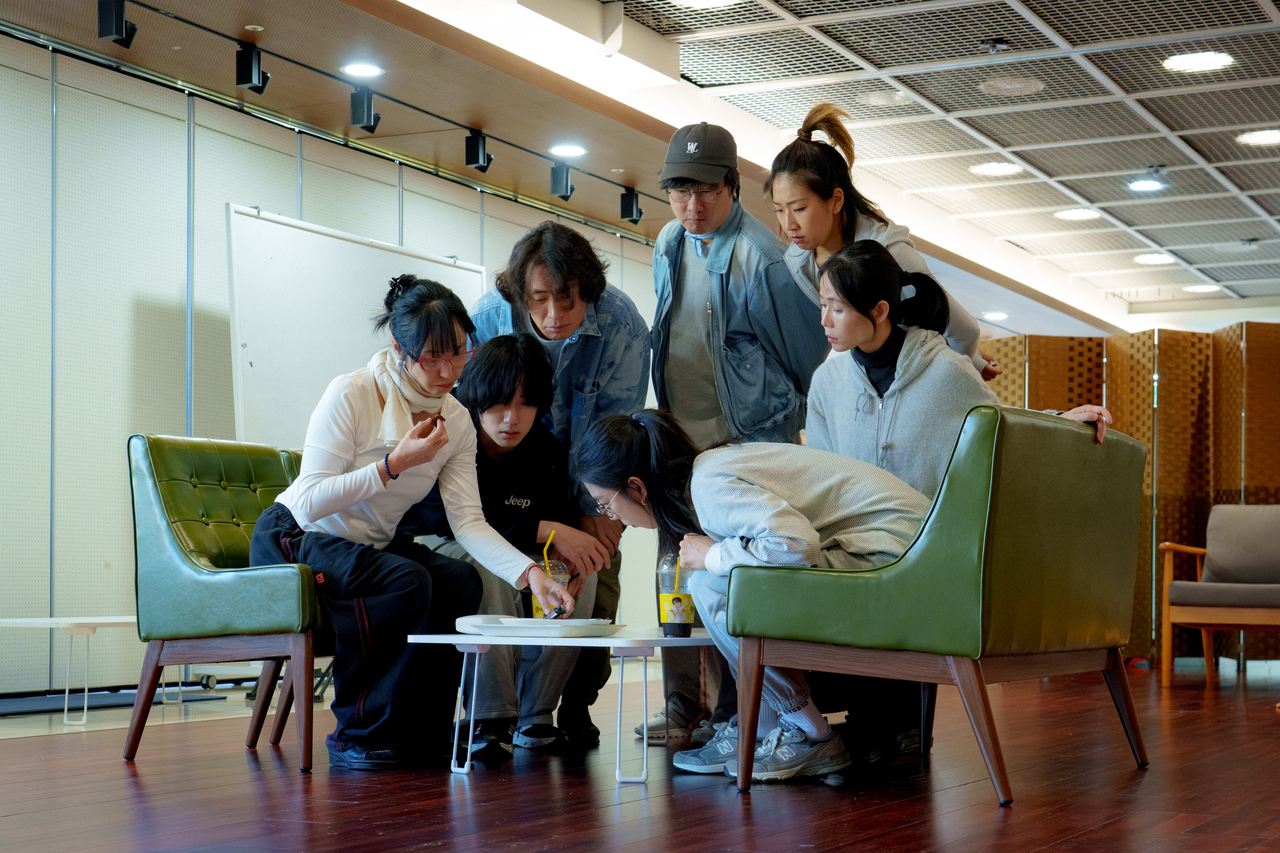
"He often says, 'Don't cross into someone else's square just because you're a sunbae — work hard in your own.' It doesn't feel hierarchical; it feels equal. You can see it even at company dinners. In his style, spoons go with spoons, chopsticks with chopsticks, bowls with bowls — everyone, sunbae and hoobae alike, clears up together," Seo said.
The understanding that theater is not driven by any single person but completed by the convergence of individual roles has been encoded into the company's DNA. Seo sees this horizontal spirit as the engine of what he calls "the Mabangjin sum."
Kim had watched Mabangjin from the outside for a long time. Stepping inside as an actor, the sense of solidarity exceeded all expectations. "It feels like a family where, if I came home having been beaten up outside, all 60 of them would charge out together to fight for me," Kim said with a laugh.
The dilemma of bystander behavior that "Two Scenes" poses is, paradoxically, bound up with the grammar of relationships the company has built over 20 years — a community that holds its own ground while refusing to look away from a colleague in crisis, one that does not stop at reproducing another's pain but extends genuine compassion to the real people standing nearby. The questions asked on stage always circle back to the life of Mabangjin beyond the rehearsal room walls.
For these two late-blooming actors, the production is a rite of passage into a world unlike any they have known before. Seo called it "a work that overturned my fixed ideas about directing" — having re-read a longtime mentor's artistic vision through the lines Ko wrote, and having entered the stage to experience firsthand what actors endure. For Kim, it has been a direct confrontation with a lifetime of stage fright.
"At first, even pressing the keys in front of the other actors made my hands shake. But the moment I met the actors' eyes on stage, I understood — I am already a complete part of this fierce world. Though I still dream about being scolded every time I think about opening night. (Laughs)" Kim said.
shee@heraldcorp.com