229. Pieter Bruegel the Elder
Known as the jovial 'Peasant Painter' — yet he also painted skeletons, punishment and death
Amid an age of chaos, a deep fascination with human nature
Did he reflect on raw desire and the absurdity of life?
His work is far more unsettling than it first appears
Editor's note
Huam-dong Art Museum is the original home of long-form cultural storytelling suited to the boundless digital space. Subscribe to the reporter to enjoy a new art story every weekend. Articles are written as narrative storytelling grounded in historical fact, with some imaginative embellishment.
Death, painted by the 'Peasant Painter'
What good is it to struggle now?
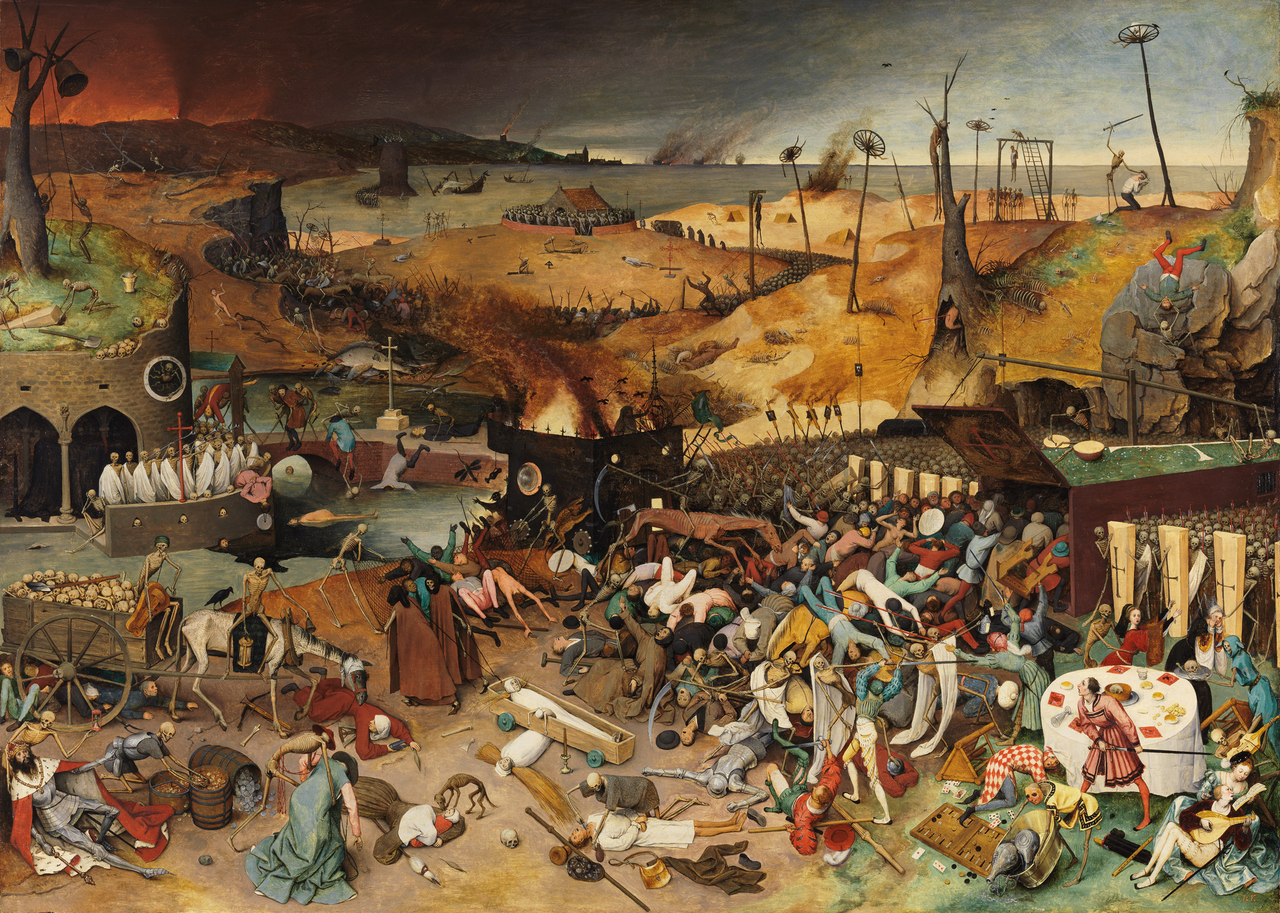
An army of skeletons advances — hundreds, perhaps thousands of them, laying waste to everything in their path. All they leave behind are screams and flames, blood and shards of bone. Beyond the hills, fire rages. Ships on the water sink lifelessly, as if swallowed by a swamp. The skeletal horde performs a strange ritual on the trampled plain, gathering inside a red-roofed building marked with a cross, all striking the same pose. Nearby, some carry coffins or dig graves. A short distance away stand a gallows and a stake — victims are hanged or bound, then observed as if on display.
The hunt continues. A sword is raised over a man in prayer; dogs are unleashed to chase a naked fugitive. A few still resist, clutching spears and rallying together. But they stand no chance against death rolling in like a wave.
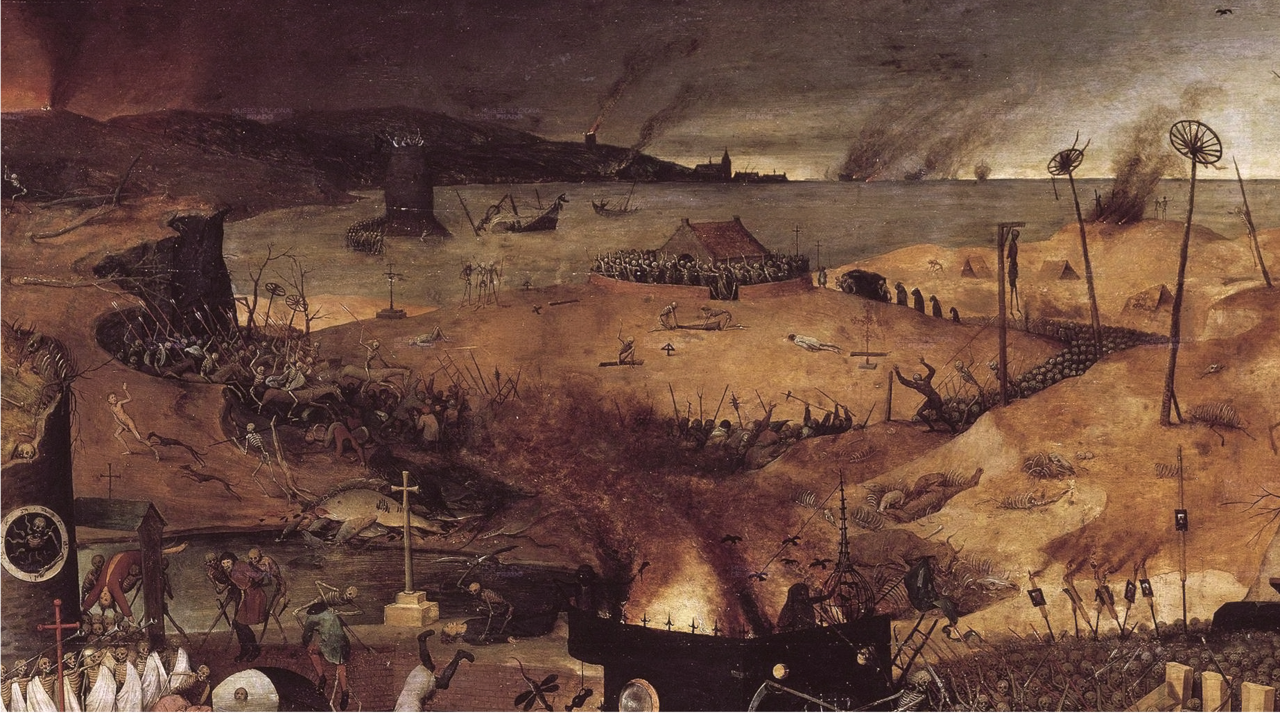
Beyond the open plain, the village ahead fares no better.
A skeleton on horseback, scythe in hand, herds humans like sheep toward a trap shaped like a coffin. Another hauls people up in a net as if fishing; yet another drives a cart piled with skulls, trampling anyone in its way.
And still there is more.
Skeletons scoop up a king's gold coins, steal a knight's armor, and without hesitation target even the infant clutched by a fallen mother. Beneath a skeleton tolling a bell to announce the end of the world, a grotesque burial rite of their own unfolds.
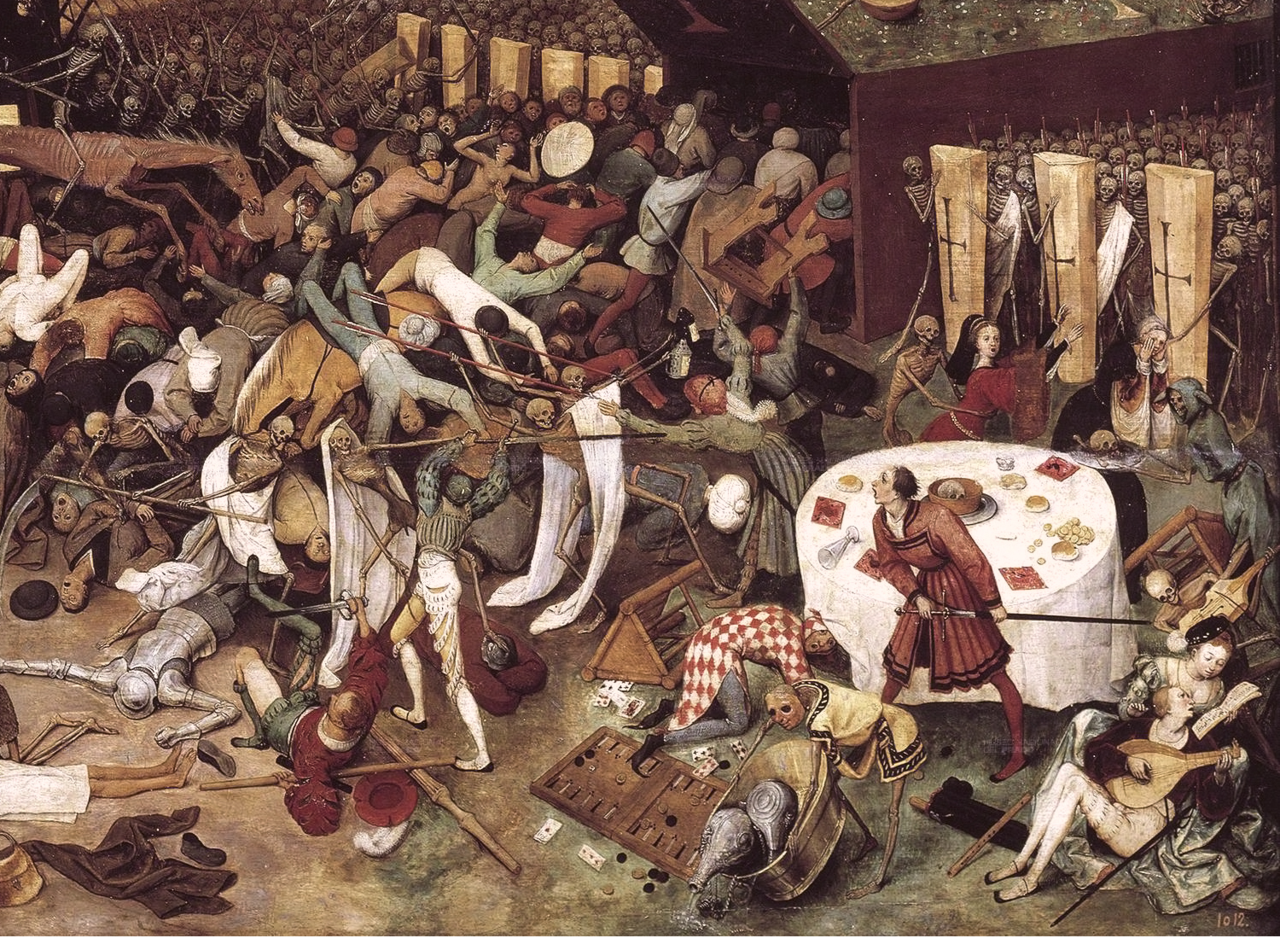
In one corner, a final battle erupts between skeleton and human.
But what good is it, really, to struggle now?
The skeletons' spears and scythes will easily break the humans' swords. Whether one fights, hides, flees or simply looks away, the outcome is the same. Money and honor, youth and old age, food and play — none of it can stop the tragedy. That is the nature of humanity: when you look closely, we are creatures this fragile, this powerless, this fleeting.
Pieter Bruegel the Elder painted this. The title: "The Triumph of Death."
Yet was Bruegel not known as the Peasant Painter? Was he not the artist who filled his canvases with humble farmsteads, simple country folk, and the cheerful festivities of rural life? Knowing his name and looking at this painting again, one might feel a strange dissonance. To put the conclusion first: to see Bruegel only as a witty pastoral artist is to know only half of him.
He was fully capable of painting something like "The Triumph of Death." On closer inspection, it would not be strange to say that his true strength lay not in humor and tranquility, but in depicting ruin and extinction. Why, and how, did it come to this?
Something unsettling beneath the simple genre scenes
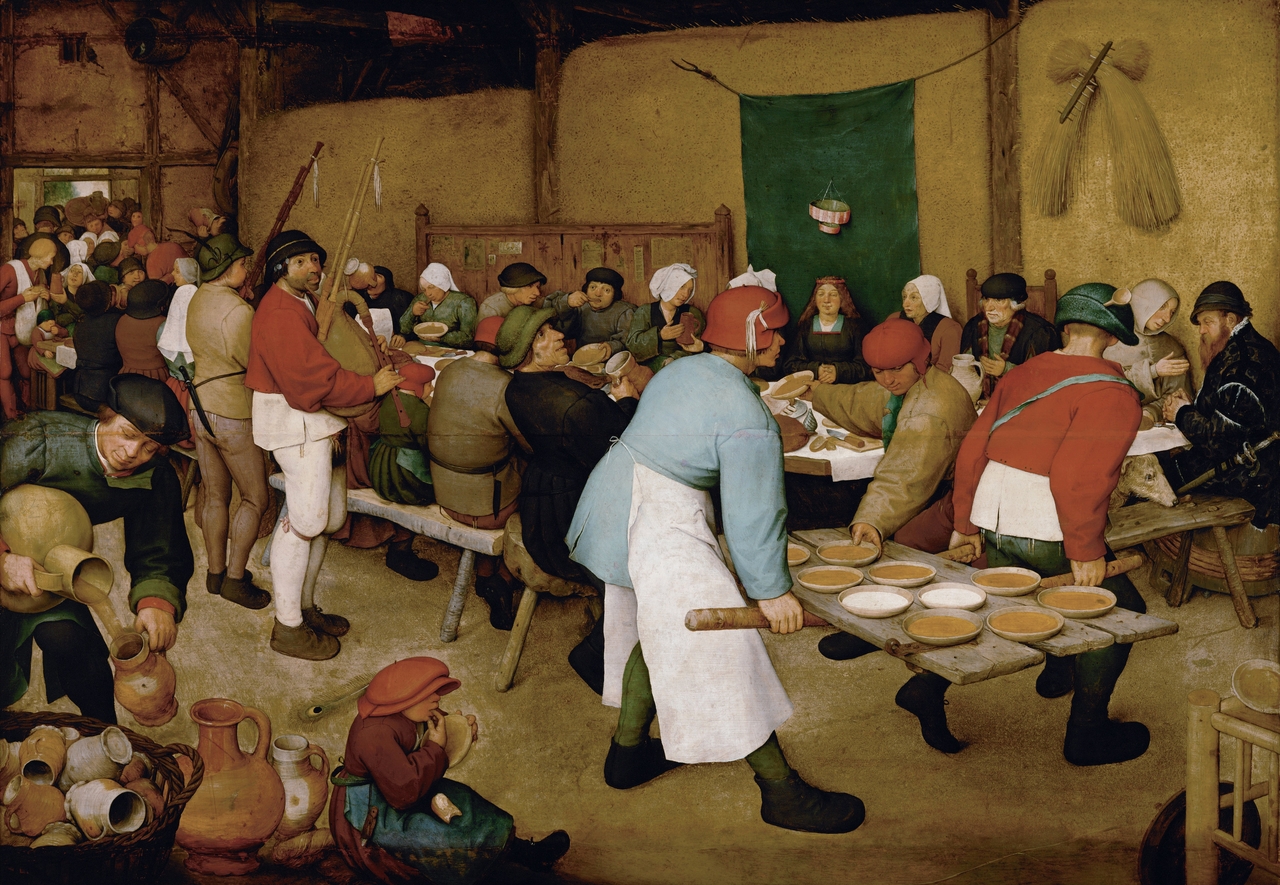
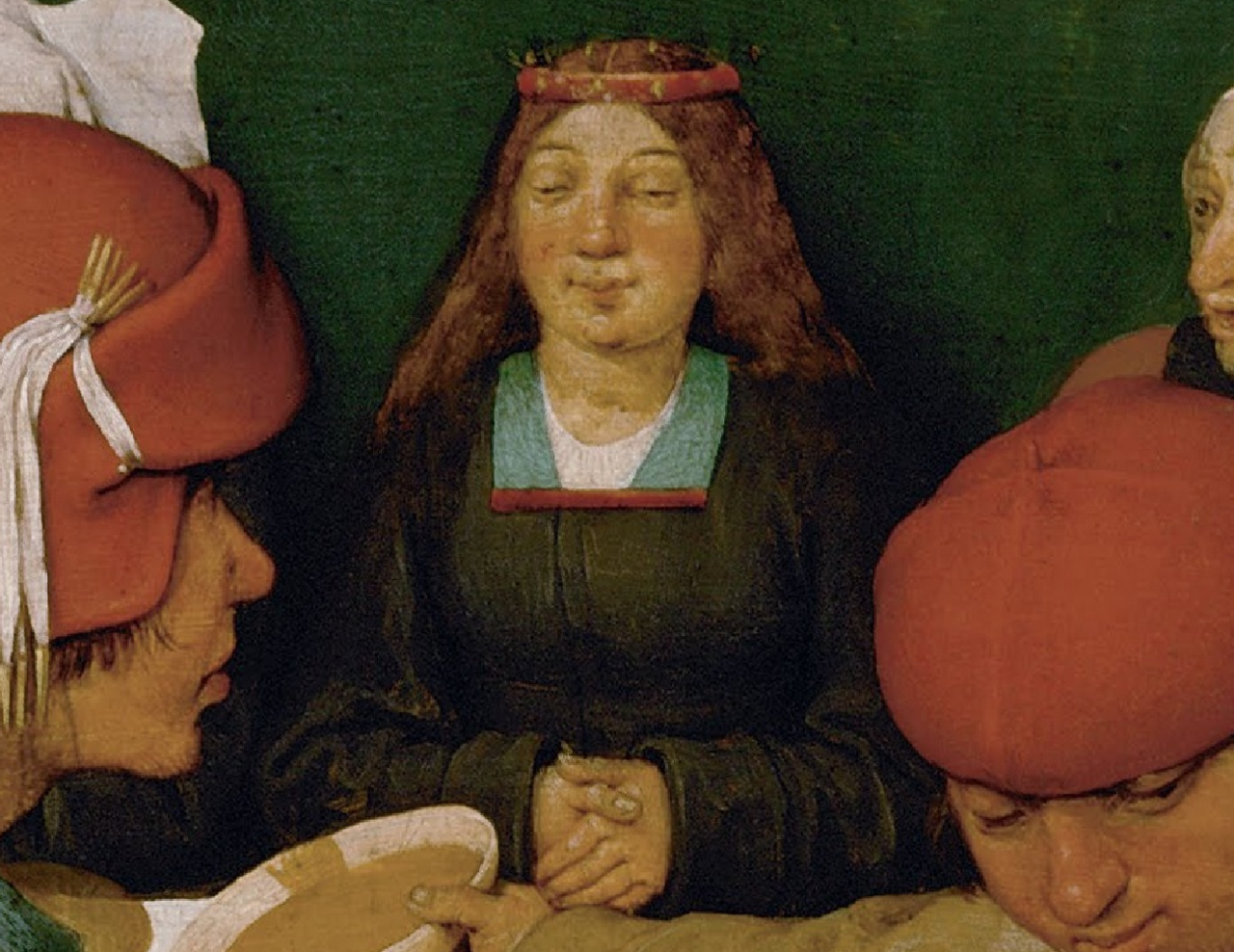
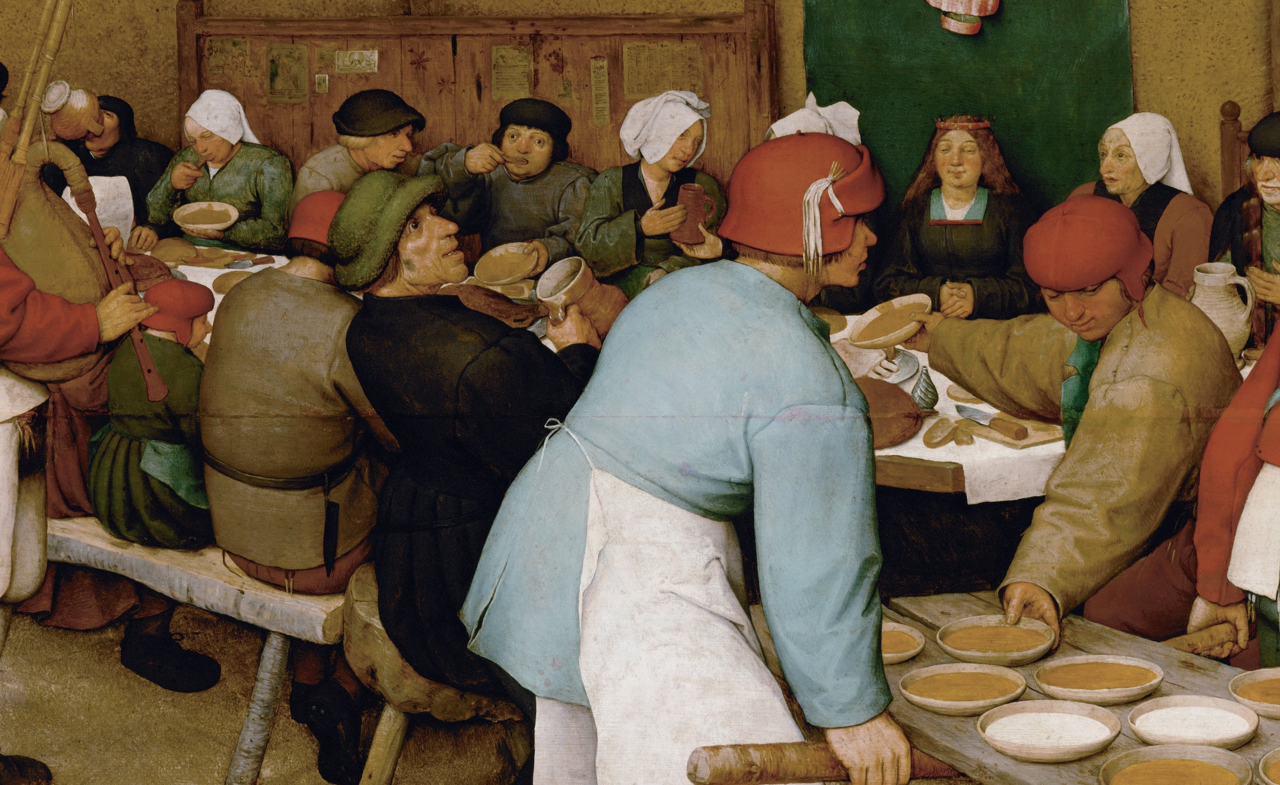
The bride wears a paper crown.
She sits before a wall hung with green cloth, hands folded, beaming with contentment. She seems about to say to the guests greeting her: "We haven't much, but please eat your fill." Here, in a farmhouse barn, a wedding celebration is in full swing.
The main fare is bread, porridge and soup. Today, even a door taken off its hinges serves as a tray. People crowd in, searching for empty seats, grabbing plates and jugs of ale. Two musicians lift the mood with their bagpipes. In front of them, a boy in a cap seems to have already wolfed down a bowl and is now busy licking his fingers. Warm, cheerful and peaceful — "The Peasant Wedding" is the kind of Bruegel painting most people know.
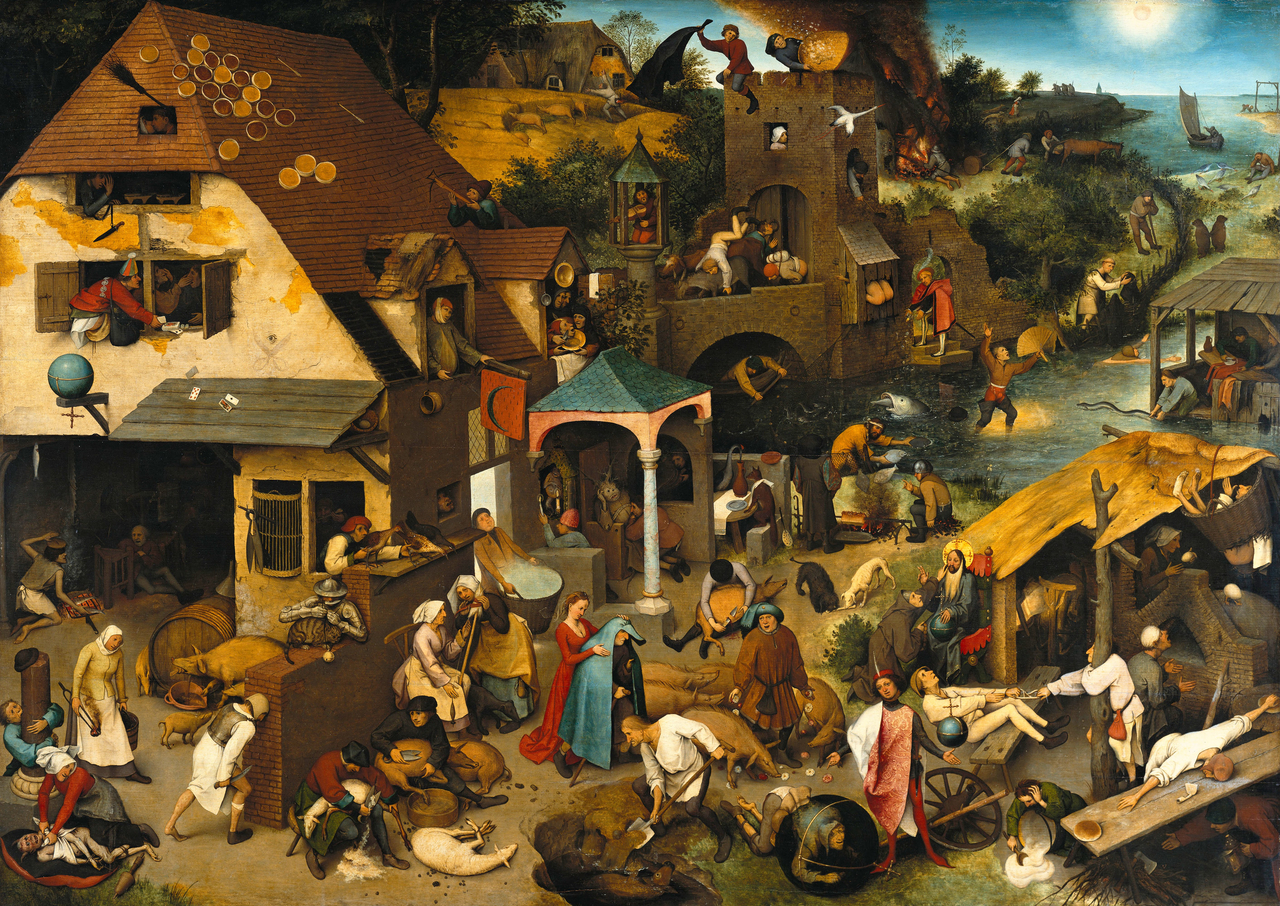
Then there is "Netherlandish Proverbs."
Here too the setting is a village beside a river or sea. Bruegel illustrated more than 100 well-known proverbs of the day through this single landscape. The scenes are wonderfully odd: a wealthy man throwing money into the water, a soldier hanging a bell around a cat's neck, a militiaman wearing only one shoe and banging his head against a wall — all absurd at first glance. A farmer grabbing another by the nose, a fisherman trying to catch a wriggling eel by the tail, a merchant offering roses to pigs — these too can seem merely comic.
And then there is "Children's Games," which at first appears simply charming. Children fill a town square — from toddlers to teenagers, each engaged in one of more than 80 different games. They spin tops, walk on stilts and roll hoops. They play piggyback, chase each other's tails and do handstands, stretching their small limbs in every direction. This too can be taken as a delightful, endearing work.
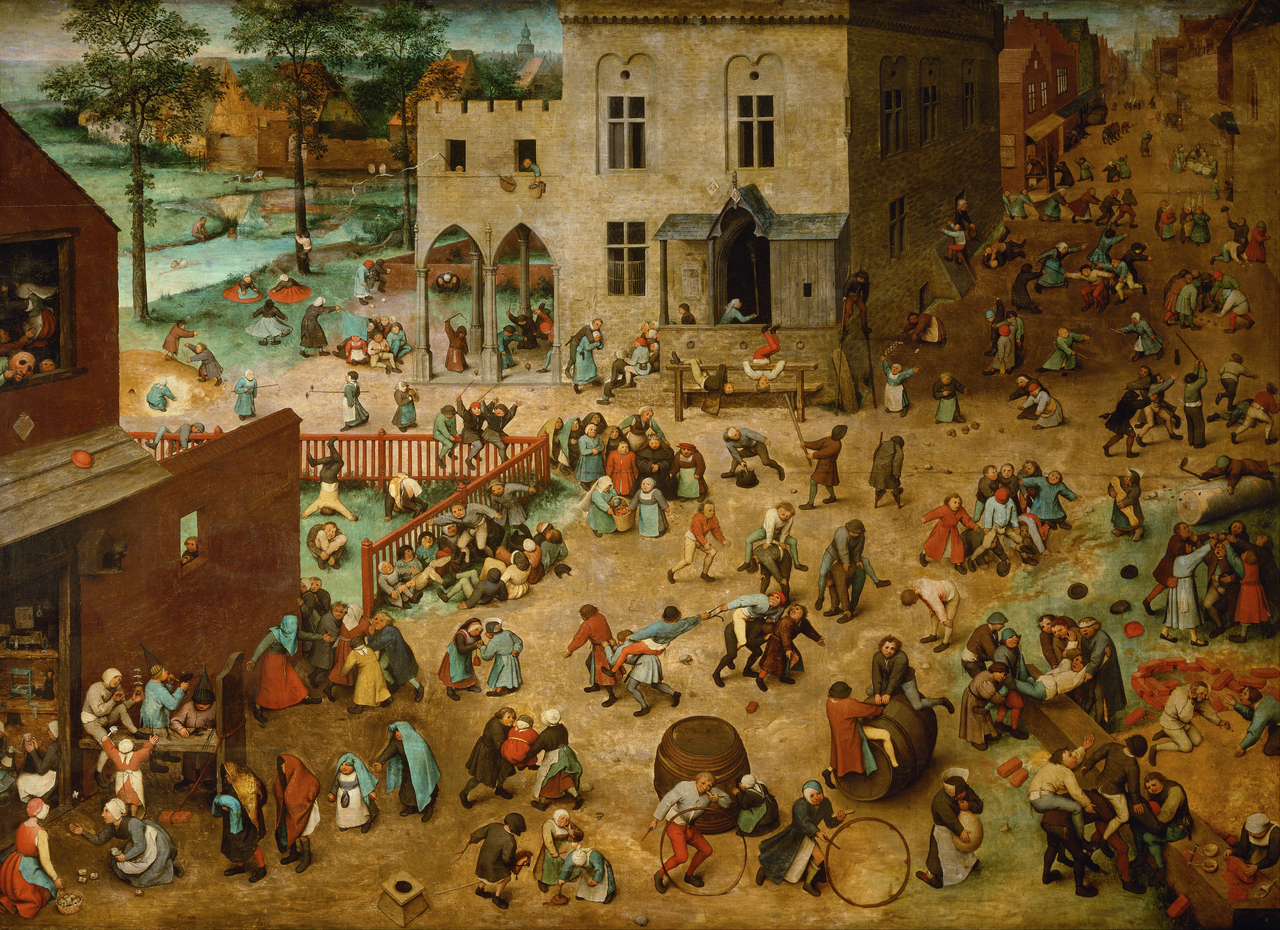
Yet analysts in no small number argue that even these paintings carry something unsettling beneath their seemingly simple genre surfaces.
They are not, in reality, merely warm and familiar scenes. If that is so, do these works also contain devices that hint at ruin, extinction and absurdity? It is time to look more closely at Bruegel's vision as a painter.
Human nature and desire laid bare in a city in turmoil
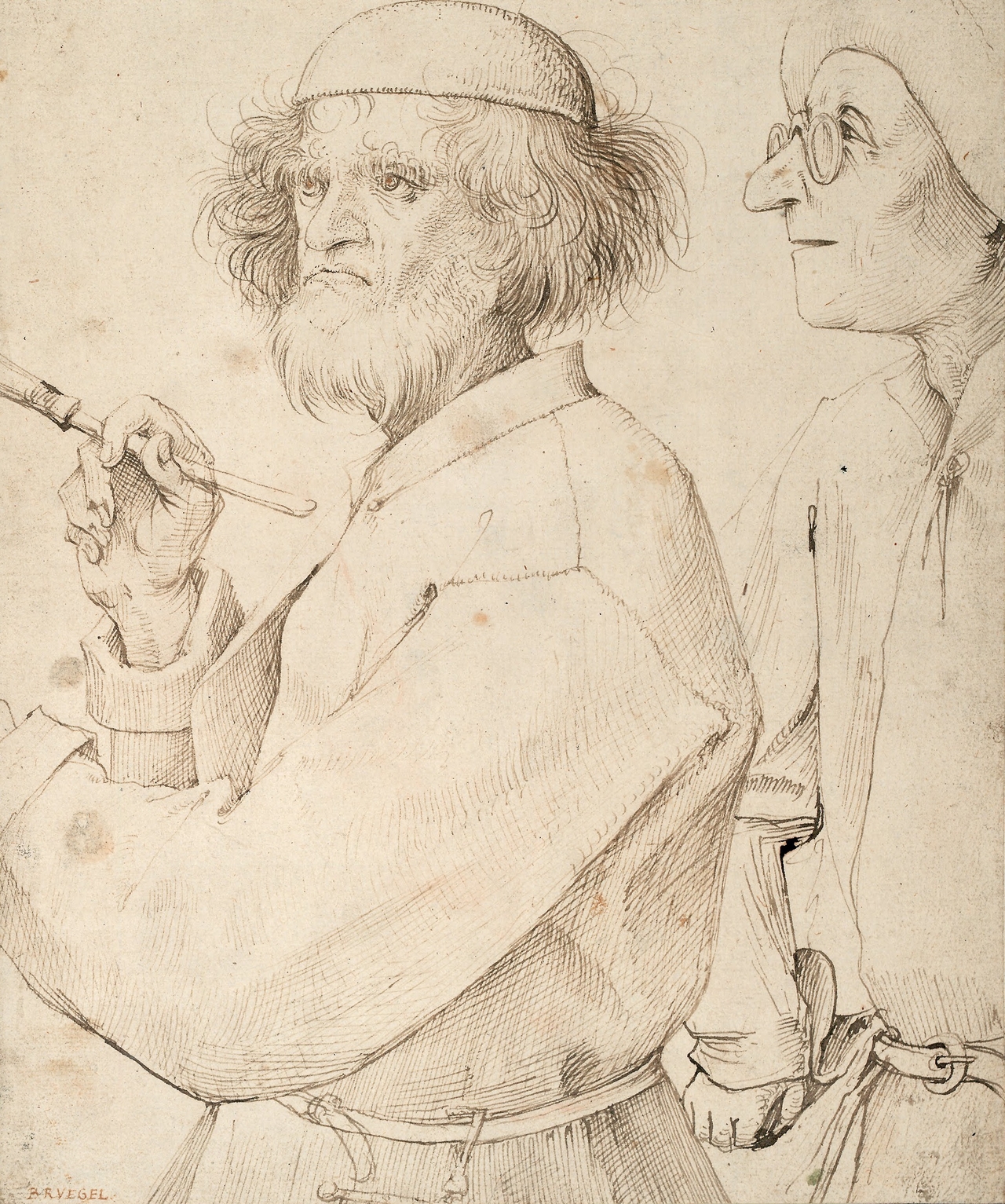
Bruegel is believed to have been born in the Netherlands around 1525.
It was a period when the winds of modernity were beginning to stir after the Middle Ages. The exact time and place of his birth, however, remain uncertain. According to "Het Schilder-Boeck" (1604) by the painter Karel van Mander, Bruegel came from a rural village called "Bruegel" near Breda — though the book also contains a number of unreliable accounts and anecdotes, making it difficult to accept at face value.
Bruegel registered with the Antwerp painters' guild in 1551, then traveled to Italy for roughly three to four years, visiting cities from Rome in the north to Reggio Calabria at the southern tip of the peninsula, and possibly Sicily as well. He returned to Antwerp around 1555 by an unknown route, became involved with a circle of humanists in the city and may have been quite active among them. In 1563 he married in Brussels, where he is believed to have remained until his death.
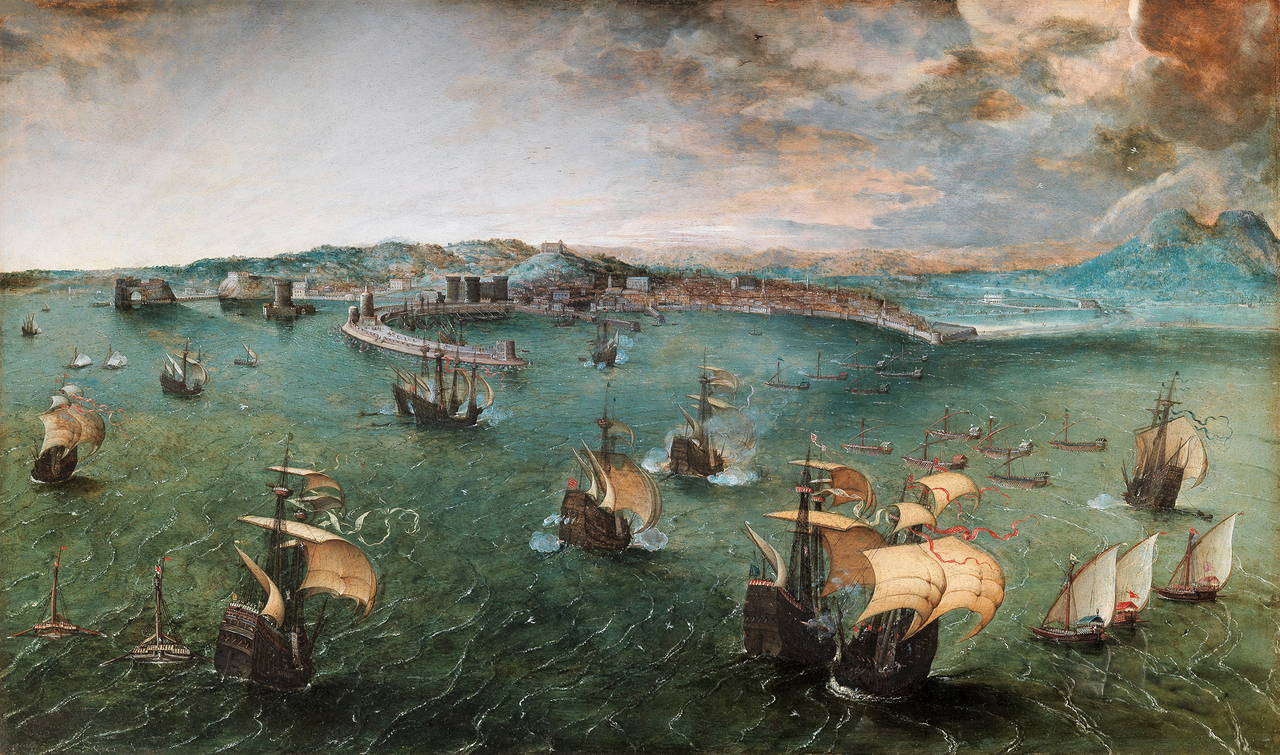
To understand Bruegel, one must look beyond his personal life to the era in which he lived.
In 1517, nearly eight years before Bruegel's birth in the Netherlands, Martin Luther wrote what became known as the Ninety-Five Theses, launching the Reformation from what is now Wittenberg, Germany. It was the beginning of a convulsion that would shake the entire continent.
The ruler of the Netherlands at the time was Charles V, head of the House of Habsburg, who was himself a native of Ghent in the Netherlands. Yet he did not treat his homeland gently. The Habsburgs levied heavy taxes on the region, which was then one of Europe's foremost commercial centers — Antwerp in particular, with its constant flow of ships, generated more wealth than many a mining city. But the richer the region grew, the heavier the tribute it owed to the Habsburgs.
That fiscal burden smoldered as a source of urban discontent. By around 1539, when Bruegel was a teenager, armed uprisings and their suppression were occurring in succession.
Into this already volatile situation swept the tide of the Reformation. Charles V was Catholic, as was his son and successor Philip II. Yet Protestantism, born of the Reformation, was spreading through the Netherlands. On top of the existing economic conflict, a clash between Catholics and Protestants became unavoidable. Tensions built and broke repeatedly, in a cycle of pressure, backlash, repression and resistance.
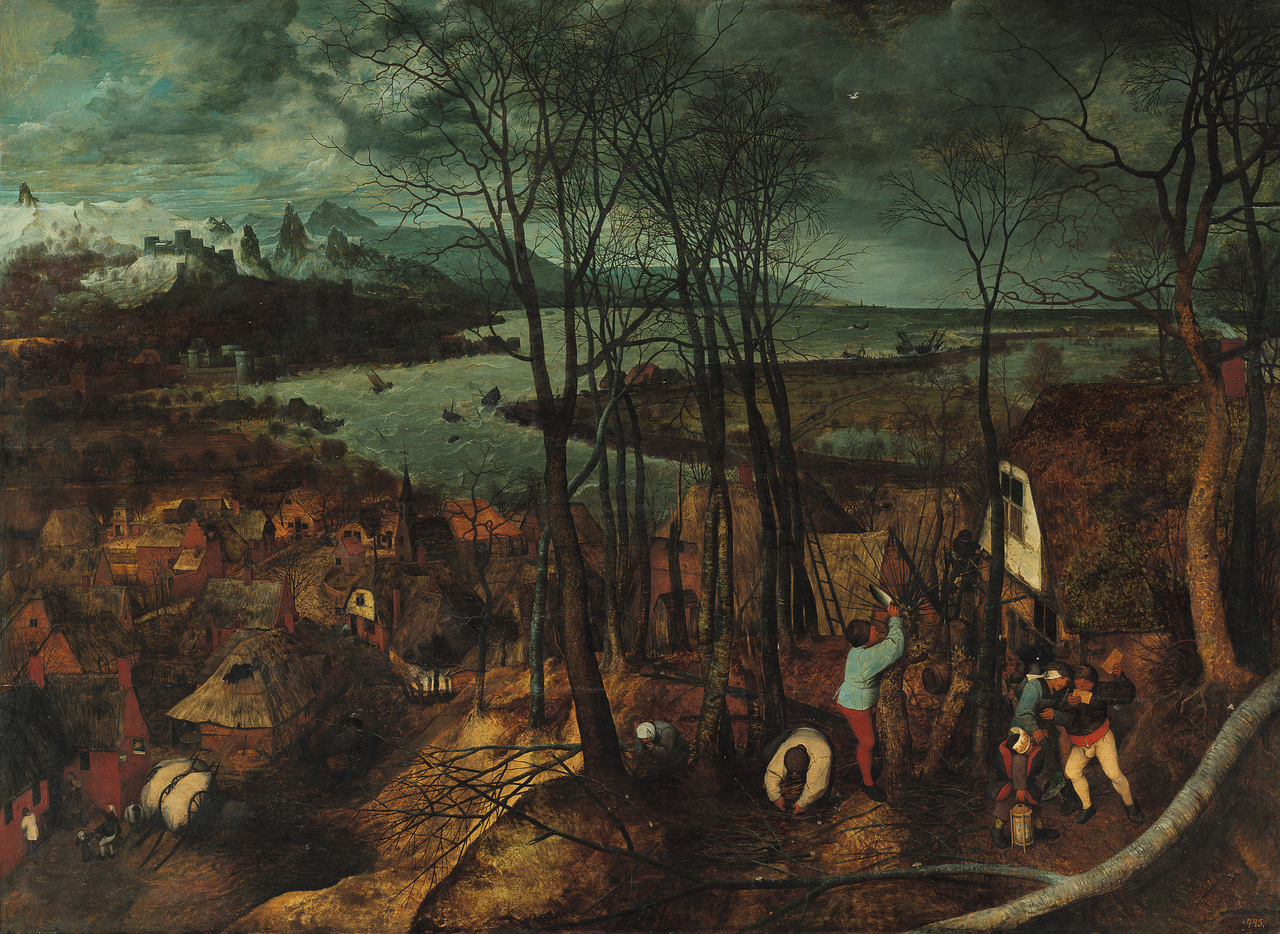
What makes this particularly interesting is that the conflict could not be reduced to a simple standoff between two camps.
Human beings are not so simple. Even in such circumstances, there was betrayal and flattery in the name of survival, deceit and hypocrisy in the pursuit of gain. The arrogance of royalty and the corruption of commoners, and the deeper contradiction of lives that ultimately carry nothing away — the absurdity of death itself — pervaded every corner of that world.
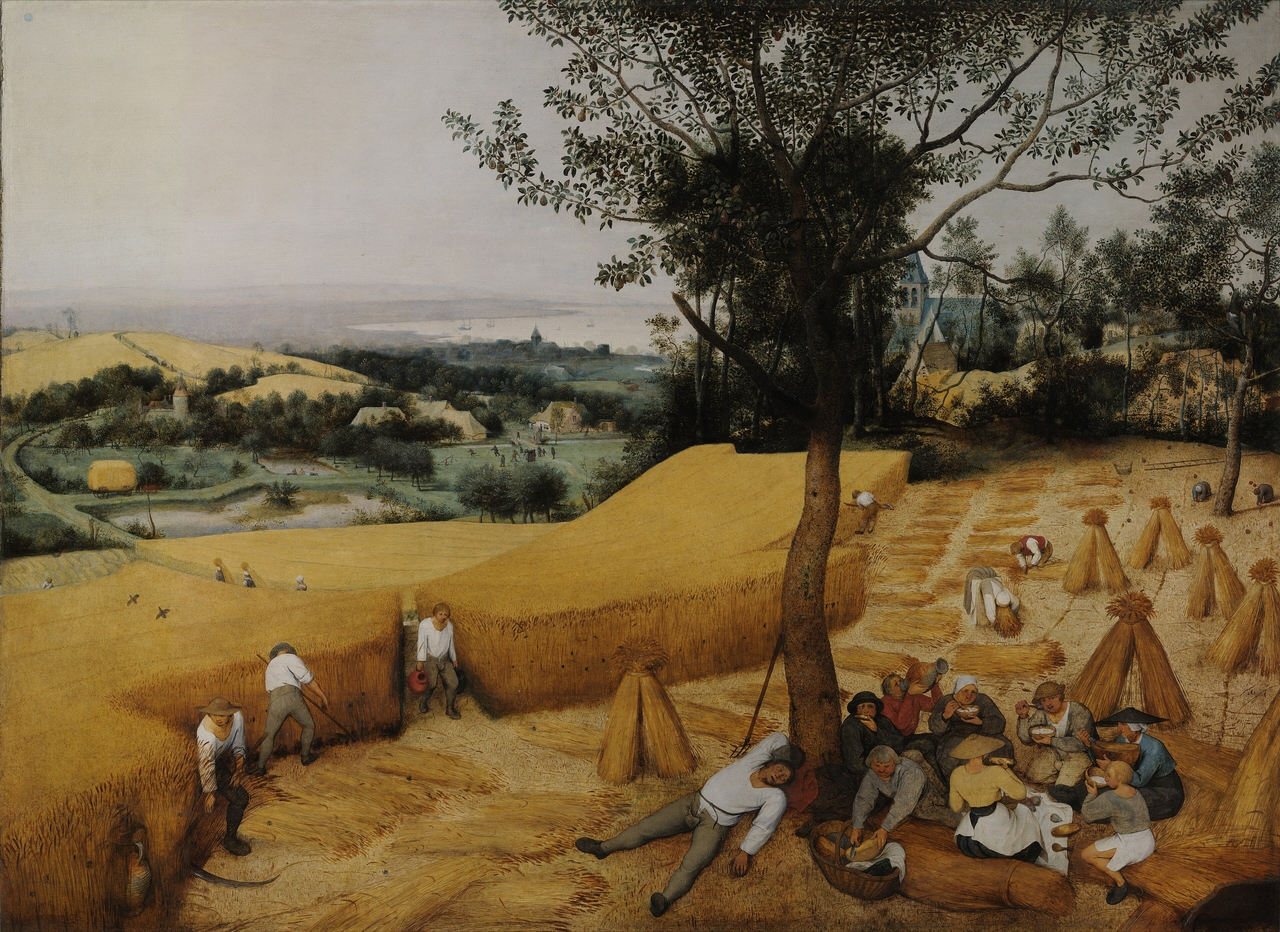
Bruegel lived through that age.
At the heart of Antwerp, and later in Brussels, he would have had ample occasion to witness the theater of human deception. He met regularly with prominent humanists, reflecting a deep interest in people and the world around him. Society was too turbulent for a man of his sensibility to be merely painting rural scenery. It is against this backdrop that one can reasonably speculate he used peasants as a vehicle for depicting human nature, and farmsteads as a lens through which to capture the spirit of his times.
Hidden codes? The theories are many
Knowing all this and returning to Bruegel's paintings, one may find new layers of interest.
Take "The Peasant Wedding," for instance. The wedding guests simply eat and drink — shoveling food into their mouths, gulping from jugs of ale whole.
Few seem to pay much attention to the couple at the center of the occasion. The groom, in fact, is difficult to identify at all. Is it the young man sitting against the wall, spoon in hand? The figure in the black coat in the middle? Or perhaps the man in the red hat passing food at the end of the table? The painting may simply be a record of rural wedding customs. But another reading has also emerged: that Bruegel used the modest setting of a peasant wedding to quietly reveal how human beings, even here, are ultimately drawn to their most primal desires.
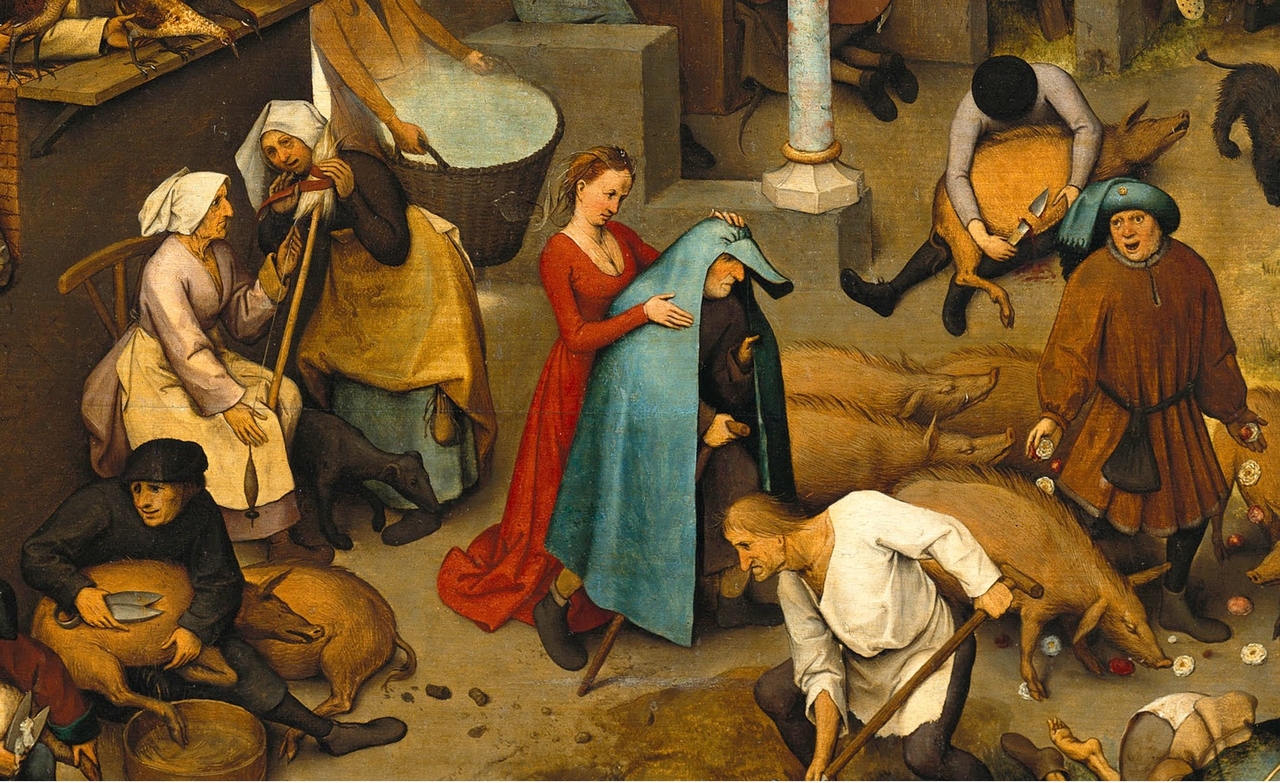
"Netherlandish Proverbs" invites a similar reading.
The eye is drawn first to the center of the canvas, where a woman in a red dress drapes a blue cloak over her husband — a gesture signifying that she is deceiving him. Elsewhere, a man gnaws at a pillar, another scrapes up spilled porridge, a laborer fills a well only after a calf has already drowned in it — a parade of bewildering, foolish acts. While some exaggeration is inherent to the nature of proverbs, the painting is notably heavy with scenes that highlight negative meanings and behaviors. The work was known in its own time by titles including "The Blue Cloak" and "The Folly of the World." That, perhaps, is why the analysis persists that Bruegel deliberately set out to paint human folly.
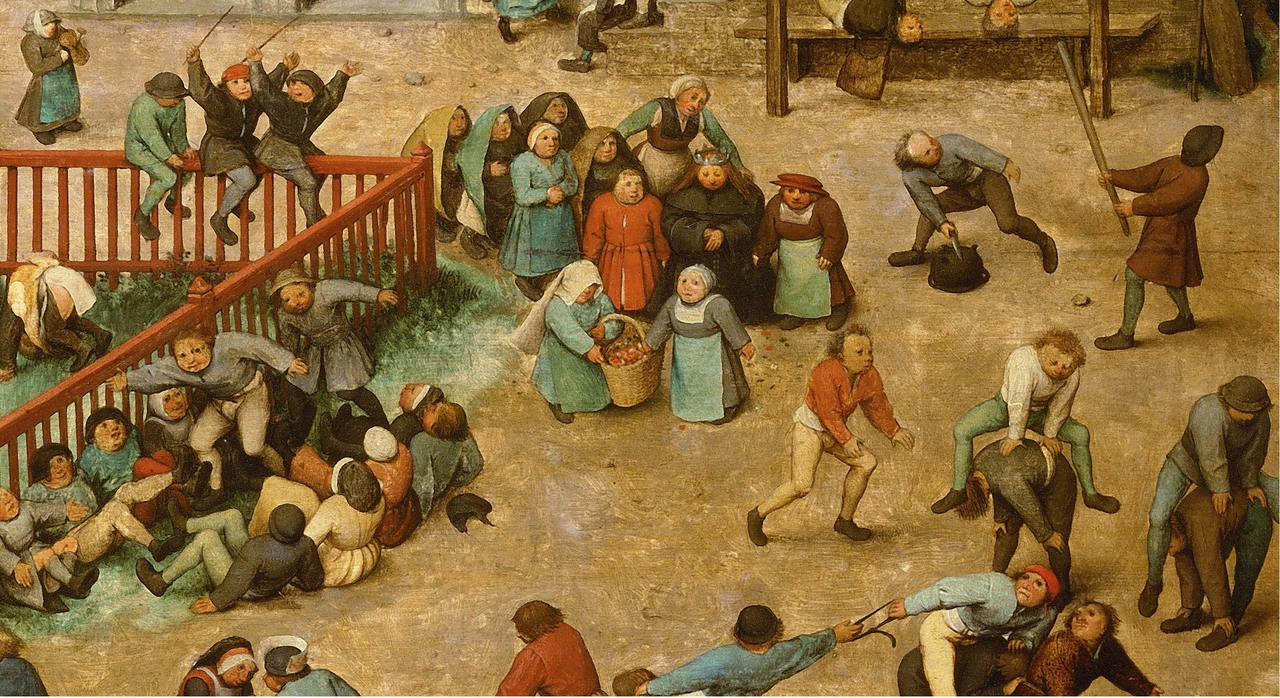
Viewing "Children's Games" through the same lens, one might even feel a tinge of sadness.
Where are the adults?
As the children roam the town hall, the square and every alley, almost no adult is visible watching over them. Some have suggested they may be away — at war, or at forced labor. Others read the painting as a lesson that the politics and scheming adults devote themselves to are, in the end, no more meaningful than children's games. Drawing specific conclusions from this alone may be a stretch, and the interpretations mentioned here are just a few among the many that surround Bruegel's work. The painter said nothing. But perhaps it is precisely because he said nothing that we cannot help but look more closely and listen more carefully.
The Tower of Babel: a symbol of arrogance and impermanence
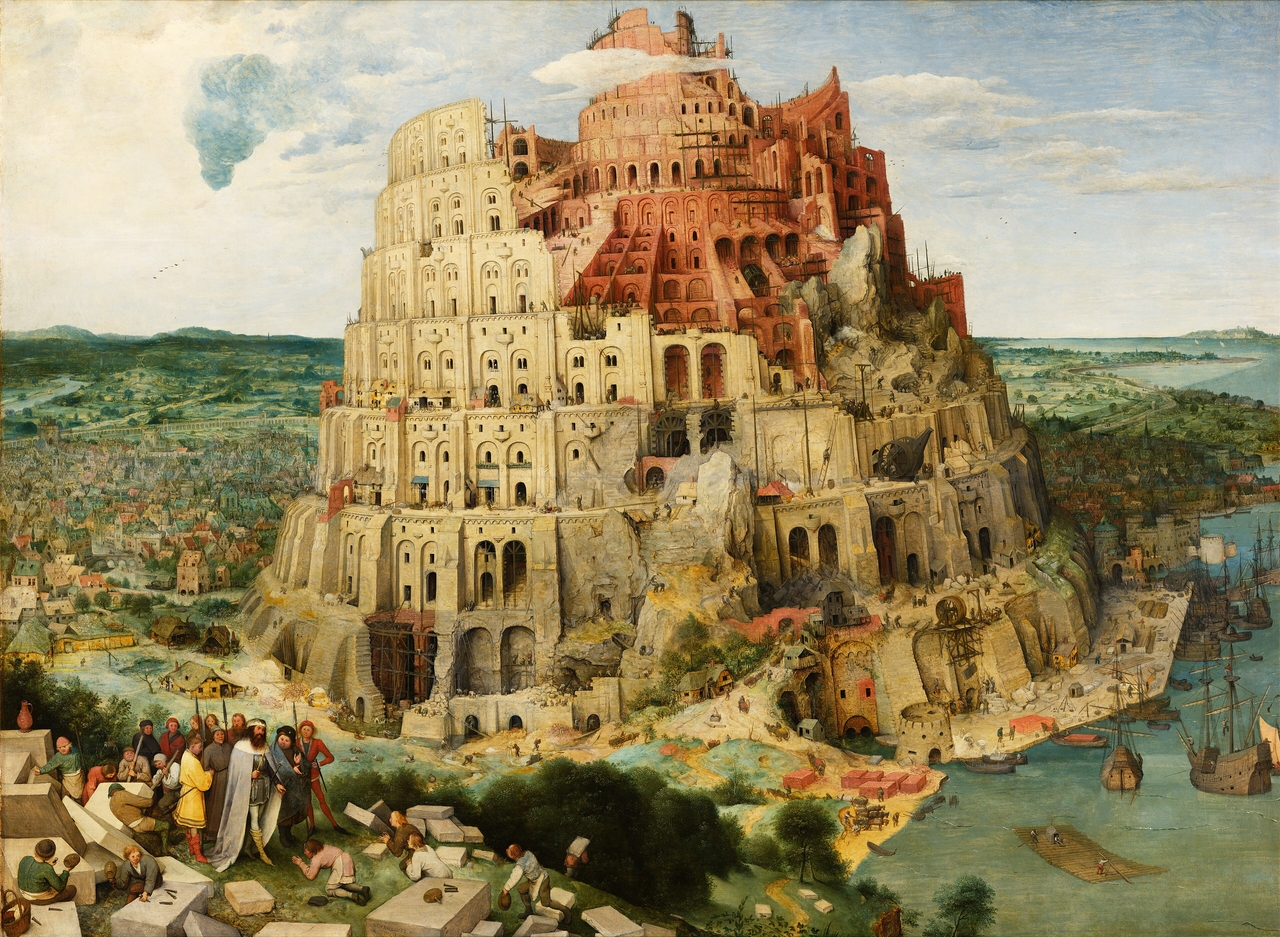
If much of what came before lay in the realm of speculation, here we move into territory where Bruegel's vision as a painter becomes clearer. The symbol of humanity's arrogance and impermanence: "The Tower of Babel."
Bruegel painted humanity in the midst of constructing the tower, its form resembling Rome's Colosseum — which in his day was regarded as a symbol of vanity and persecution. The upper reaches already touch the clouds. Yet for all the labor poured into it, the structure is already tilting to one side. Countless workers add materials, and stone columns and wooden supports strain to hold it upright, but to no avail.
According to the Book of Genesis, humanity once shared a single language. Together, people sought a way to reach the heavens — a means of staying united rather than scattering, and of immortalizing the skills and knowledge they had accumulated. What they agreed upon was the construction of a tower of limitless height.
God does not stand by.
To judge those who dare challenge the divine realm and refuse to spread across the earth, God acts swiftly: human speech is made "confused," languages multiplied. Communication ceases. Collaboration breaks down. Construction grinds to a halt. People can only gather with those who still share their tongue and scatter in all directions. The tower in the painting follows exactly that sequence. Without cooperation, the work collapses into carelessness.
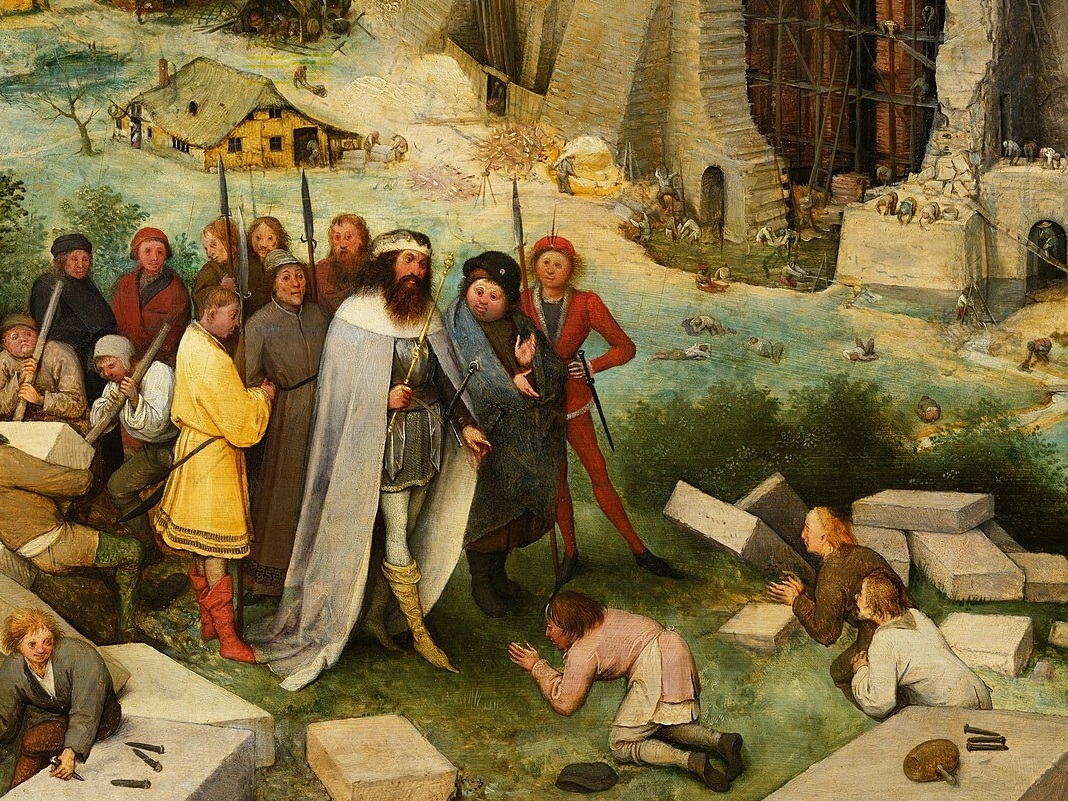
The figure receiving the bows of stonemasons at the lower left is believed to be King Nimrod, identified in some traditions as the driving force behind the tower's construction. The atmosphere on the hill where the king stands is solemn enough, but just below it things are anything but — workers nap openly, others relieve themselves with their trousers down. It seems to suggest, once again, that all of humanity's outwardly grave endeavors may ultimately yield nothing but absurdity.
What message did he mean to send through peasants and farmsteads?
No matter how much humanity craves, deceives, obsesses and builds — in the end, it is death that triumphs.
No strategy, no form of resistance, can hold back the ruin and extinction that rolls in like a tide. For all human beings, no amount of struggle changes that. A painter who lived, watched and felt so much at the center of a turbulent time and place — when he painted peasants and farmsteads and children, what he may truly have been pointing to was this very order of things, this inevitable sequence.
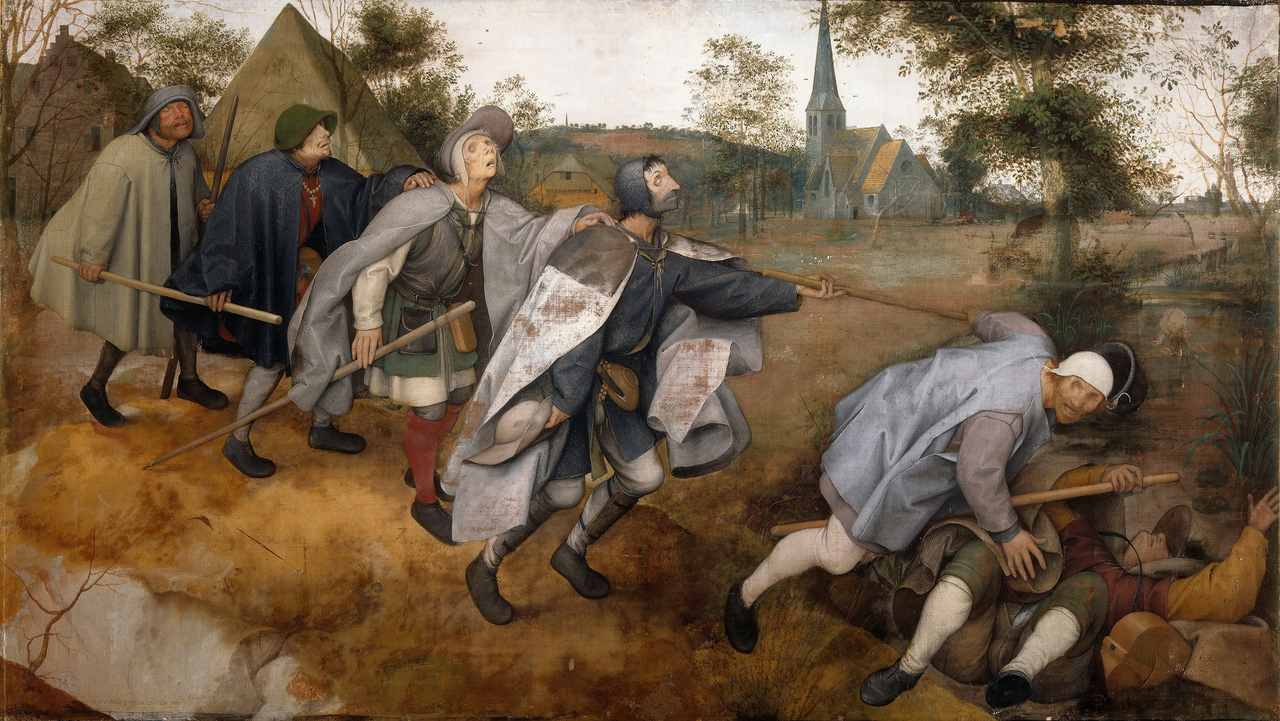
The final painting introduced here is "The Blind Leading the Blind." Painted a year before Bruegel's death, it too carries unmistakable weight. The work appears to draw inspiration from Matthew 15:14 — "If the blind lead the blind, both will fall into a pit."
A procession of blind figures walks in a line, each afflicted with a different condition — corneal damage, atrophied or missing eyes. The leader has already tumbled headlong into a ditch. The others, connected by arms and staffs, seem about to meet the same fate, unaware of what is happening. "The Blind Leading the Blind" is itself, in all likelihood, a metaphor — a warning and a satire aimed at a society seized by madness and self-righteousness, leading one another toward destruction and repeating the same mistakes once again.
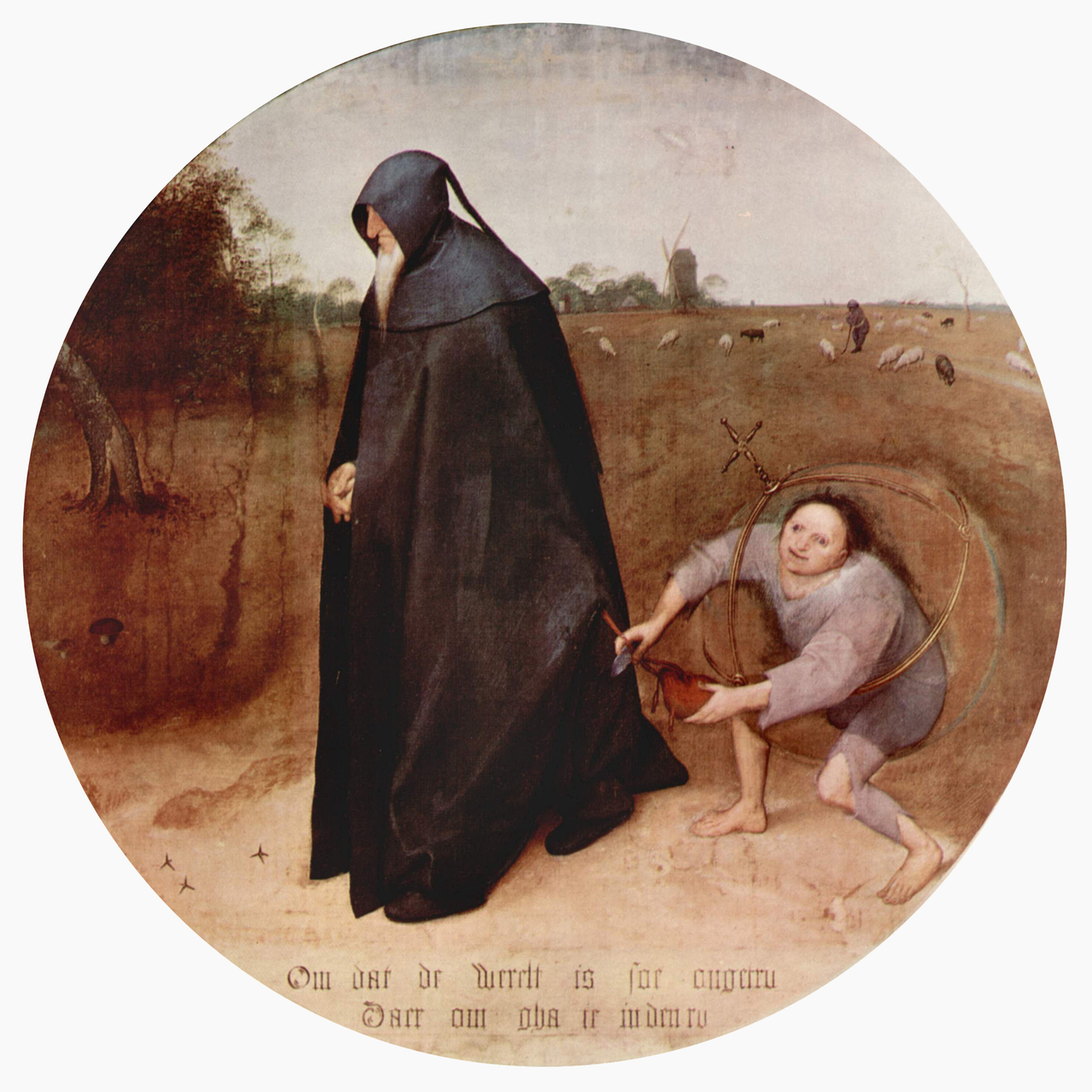
A year before Bruegel completed that work, the Habsburg governor of the Netherlands, acting on Philip II's orders, intensified the persecution of Protestants through a body known as the Council of Troubles — a special tribunal of sorts that issued death sentences in such numbers it earned the name the Council of Blood. A church appears in this painting too, and it has been suggested that the grim atmosphere of that period may have influenced its creation. The prevailing view, however, is that Bruegel's religious beliefs and political leanings remain unclear.
Not a painter of peasants, but of all humanity
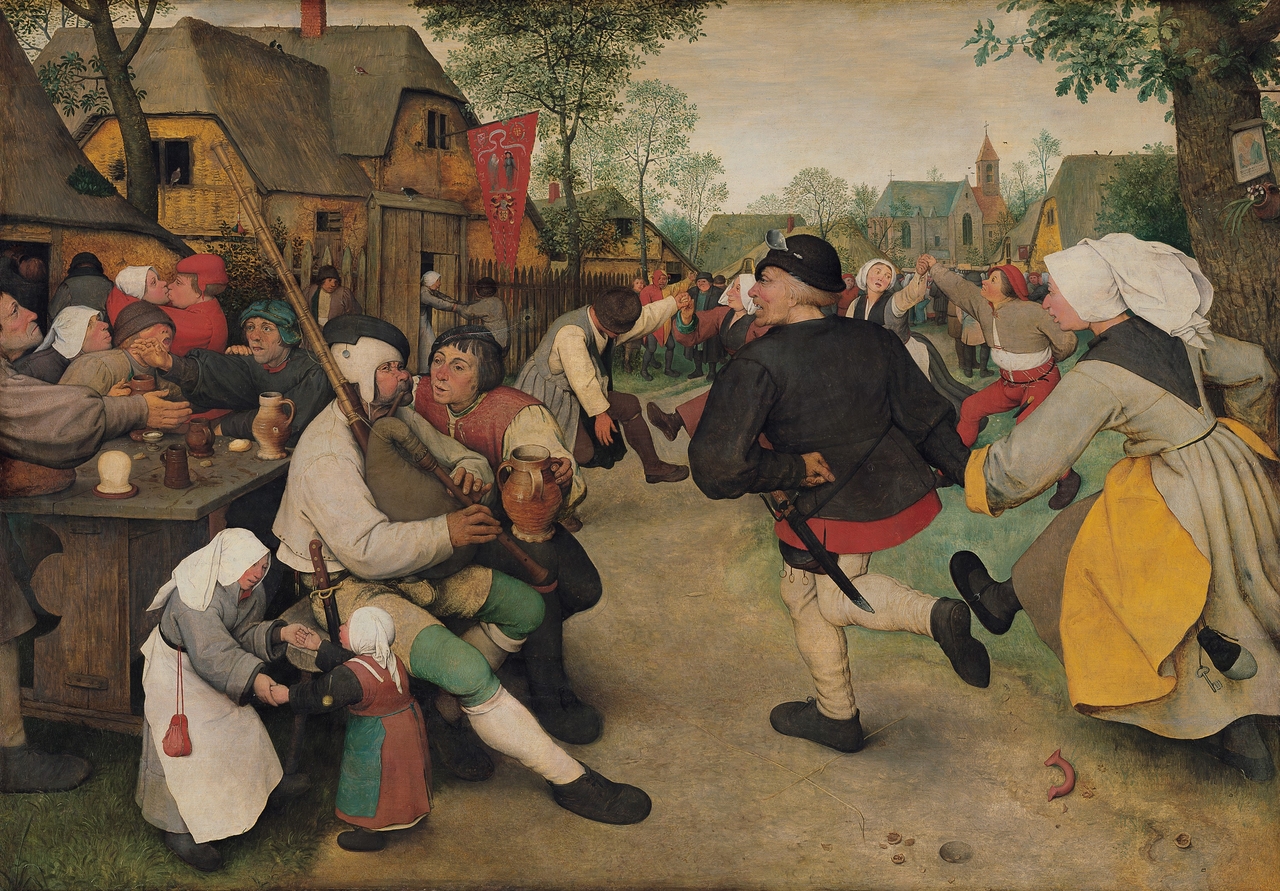
During his lifetime, Bruegel's distinctively dense paintings earned high praise from art lovers.
They also stirred the acquisitive instinct: not only the wealthy of his day but even the House of Habsburg counted his works among their collectibles.
Yet just before his death, Bruegel asked his wife to burn some of his paintings.
Exactly why he made that request is not known. Those works may have contained satire so sharp that they could have brought political or religious harm to the family he left behind. Then again, he may have wished to enact in life the very message embedded in his paintings — that human existence is, in the end, fleeting and hollow. Perhaps, in letting go without regret of even the precious paintings to which he had devoted his life, he meant to deliver his message one final time, on the threshold of death. What those lost paintings were, we will never know.
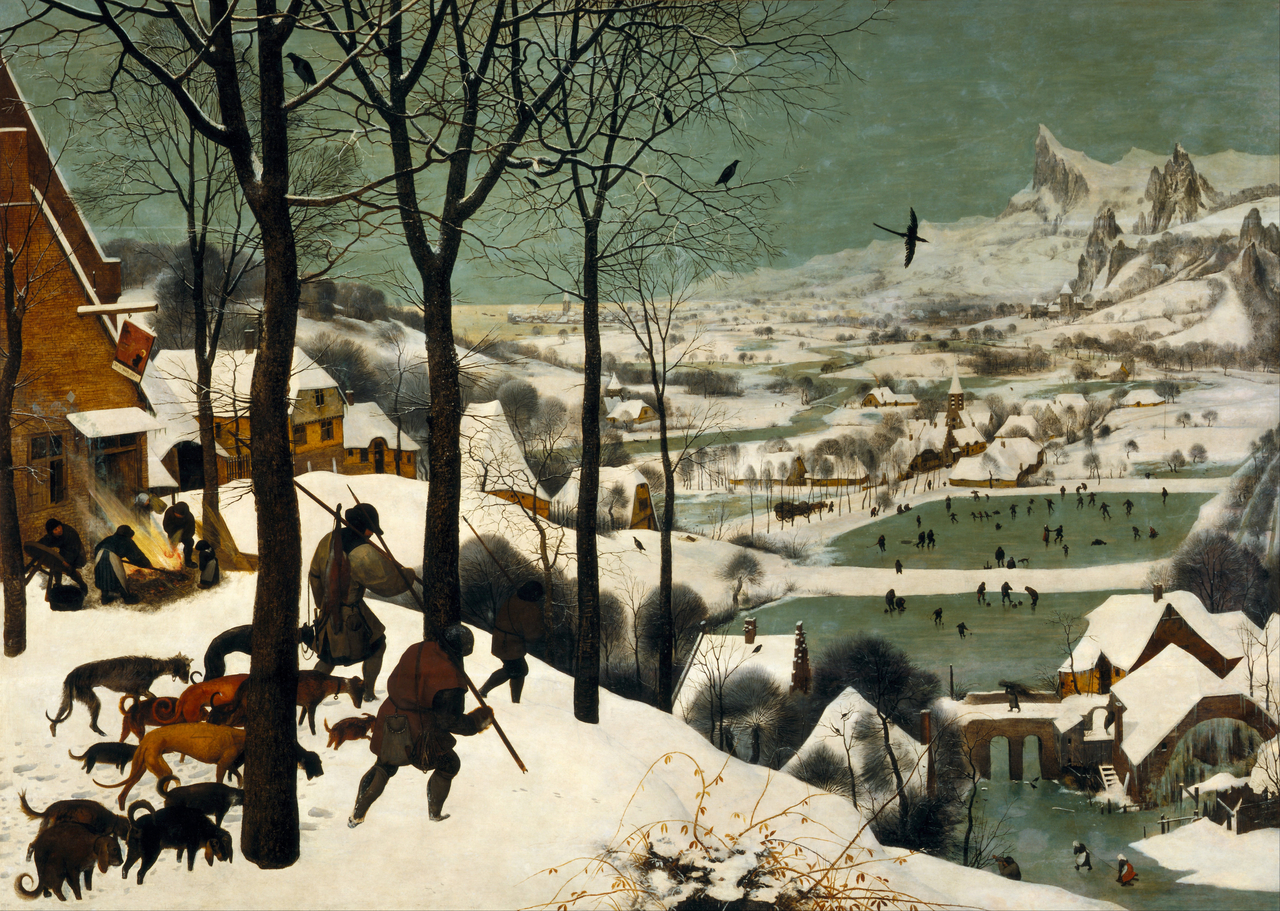
Bruegel died in 1569 for reasons that remain unknown. He was in his late 30s or early 40s.
Well into the late 19th century, Bruegel was understood as little more than a comic painter of peasants. It was only with the arrival of the more complex, more layered 20th century that he began to be seen anew — not as a painter of peasants, but as a painter of all humanity beneath the heavens. The world of his time was not a gentle one, and the paintings that grew from it, on closer inspection, are anything but simple.
References
E.H. Gombrich, "The Story of Art," Phaidon
Franits, Wayne, "Dutch Seventeenth-Century Genre Painting," Yale University Press
Grove: Wied, Alexander and Van Miegroet, Hans J., "Bruegel," Grove Art Online, Oxford University Press
yul@heraldcorp.com