Province launches first dedicated PRRS task force this year
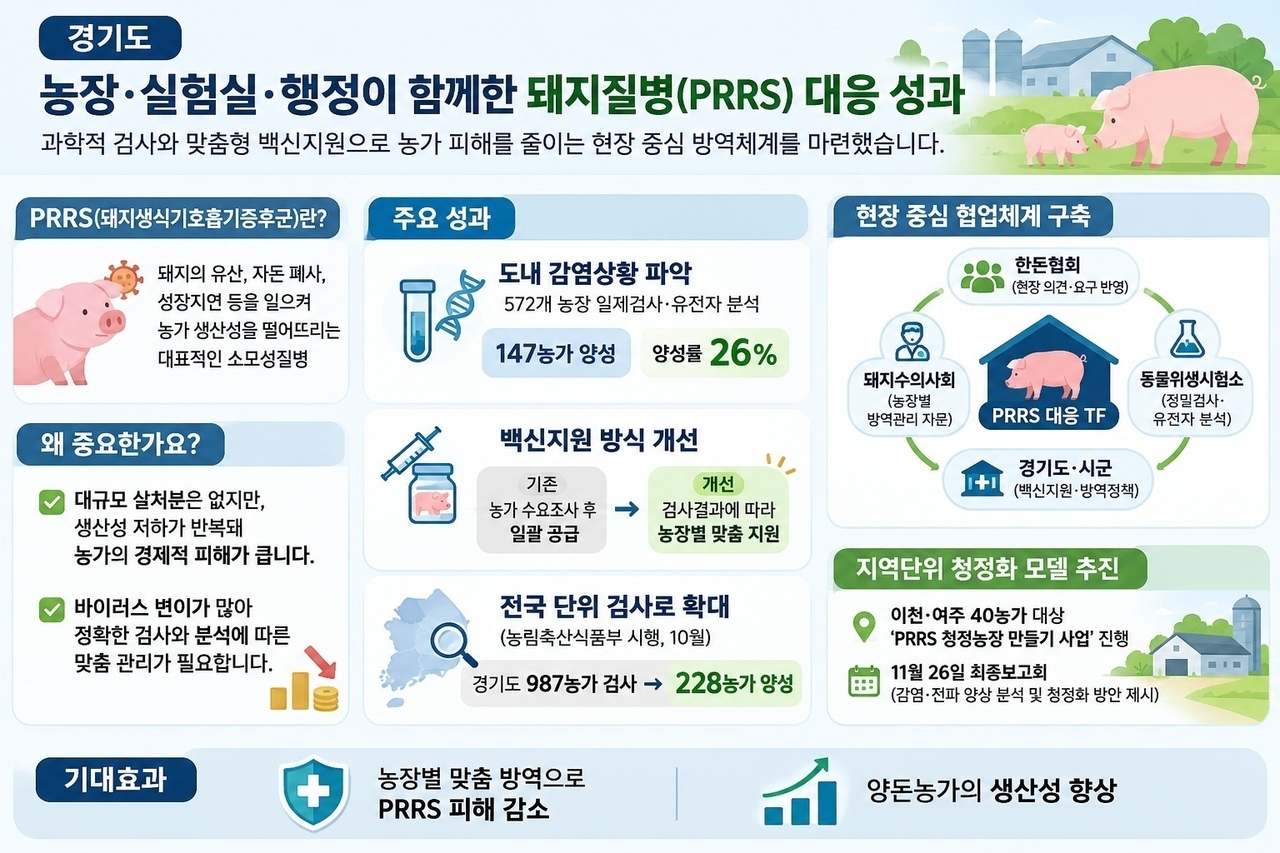
Gyeonggi Province announced Monday that it has established a tailored disease management system bringing together farms, testing institutions and government agencies to combat porcine reproductive and respiratory syndrome, or PRRS, through a dedicated task force launched for the first time this year.
PRRS is a major wasting disease in pigs that causes miscarriages, piglet deaths and stunted growth, significantly reducing farm productivity. The virus is particularly difficult to manage because it mutates frequently and infection patterns vary from farm to farm, making accurate testing and analysis essential.
Gyeonggi Province formed the PRRS Response Task Force in February and worked with the Korea Swine Association and the Korean Association of Swine Veterinarians to first assess infection conditions on individual farms, then apply testing and analysis results to biosecurity management and vaccine support.
The most significant achievement was mapping PRRS infection conditions across the province's pig farms through comprehensive testing and genetic analysis.
Using carcass samples collected during a province-wide African swine fever inspection in March and April, the province tested 572 pig farms and confirmed the PRRS virus at 147 of them, putting the positive rate at 26 percent. The detection rate had previously hovered around 3 percent under blood-based monitoring, but the use of carcass samples gave officials a far more accurate picture of actual infection conditions on farms.
The test results were also put to practical use in supporting farms. Previously, vaccines were purchased and distributed in bulk based on demand surveys from farmers. Starting this year, the province shifted to a four-step approach — precision testing, genetic analysis, sharing of results and targeted vaccine allocation — and supplied 368,980 doses of PRRS vaccine to 575 farms across 15 cities and counties.
The infection-mapping method Gyeonggi Province developed in the first half of the year was later expanded to a national scale. The Ministry of Agriculture, Food and Rural Affairs conducted a nationwide PRRS inspection in October in conjunction with its African swine fever survey. In Gyeonggi Province, 987 farms were tested and the virus was confirmed at 228 of them; genetic analysis of those cases is ongoing.
The province also held four task force meetings throughout the year and continuously shared test results and field information through specialized training sessions for biosecurity and diagnostic personnel, expert briefings on PRRS management, and seminars.
Alongside this, the province pursued a regional eradication model in partnership with Icheon, Yeoju, the Korea Swine Association and the Gyeonggi Province Swine Veterinarians Association. The initiative targets 40 farms in Icheon and Yeoju under a program to create PRRS-free farms, with Jeonbuk National University also participating in genetic analysis. Following an interim briefing in June, a final results presentation is scheduled for Nov. 26 to outline infection and transmission patterns in the region and propose a path toward eradication.
"The biggest achievement this year was connecting on-the-ground farm information and veterinary expertise with laboratory analysis data and government biosecurity policy," said Lee Eun-gyeong, head of Gyeonggi Province's Animal Disease Control and Hygiene Division. "We will continue to strengthen cooperation with the field and, based on scientific test results, provide farm-specific biosecurity management support to reduce damage caused by PRRS and improve the productivity of pig farms."
pjh@heraldcorp.com