Solo show 'Floating Islands' opens at Gladstone Seoul
11 new works unveiled, including large-scale multi-panel paintings
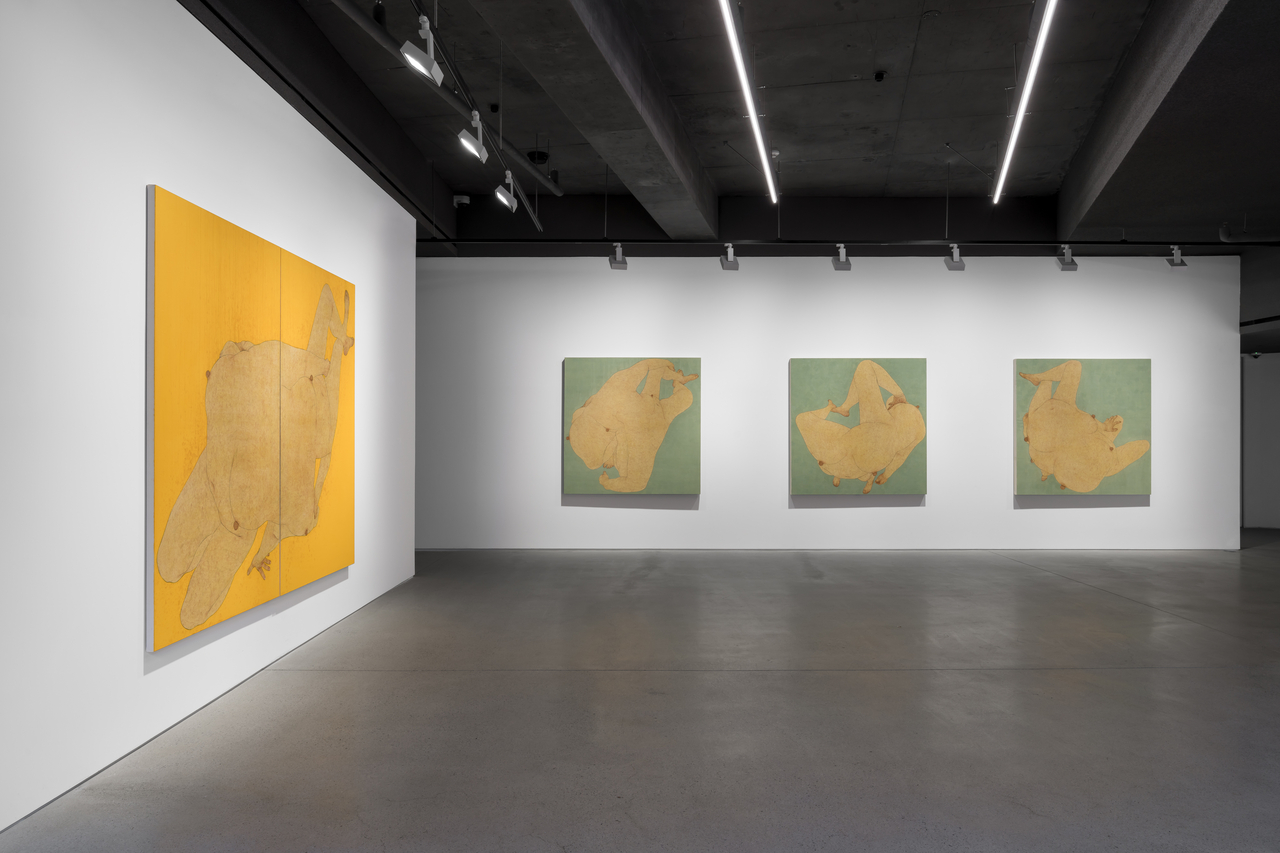
A faceless body, arms and legs tangled together. Fragments of a torso fuse into a single mass. Shapes rise above fields of color and hover like islands.
The solo exhibition "Floating Islands" by Baek Seung-ah, 47, now on view at Gladstone Seoul in Yongsan-gu, transforms the most familiar of subjects — the artist's own body — into an alien landscape. The show presents 11 new works.
Baek photographs her body from above, shooting hundreds of images. She then crops and rescales pictures of her arms, legs and torso taken from slightly different angles before reassembling them into a single composition.
"In earlier works, fragments of the body were often scattered across the canvas," Baek said. "More recently, they have begun to gather into denser, more unified masses. The body grows increasingly hard to recognize — strange, sometimes monstrous — like islands floating on a field of color."
The works bear little resemblance to conventional self-portraiture. Rather than identifying a figure through the face, the viewer must feel their way through a fragmented body. Familiar yet foreign, the body emerges as something at once personal and universal.
The "Self Configuration" series, which anchors the exhibition, is where this shift is most pronounced.
"Self Configuration: Red Madder Lake Island" (2026) is a large-scale painting measuring 240 centimeters wide by 480 centimeters tall. Composed of eight 120-centimeter square panels, each panel functions as an independent painting while simultaneously serving as a fragment of one vast form.
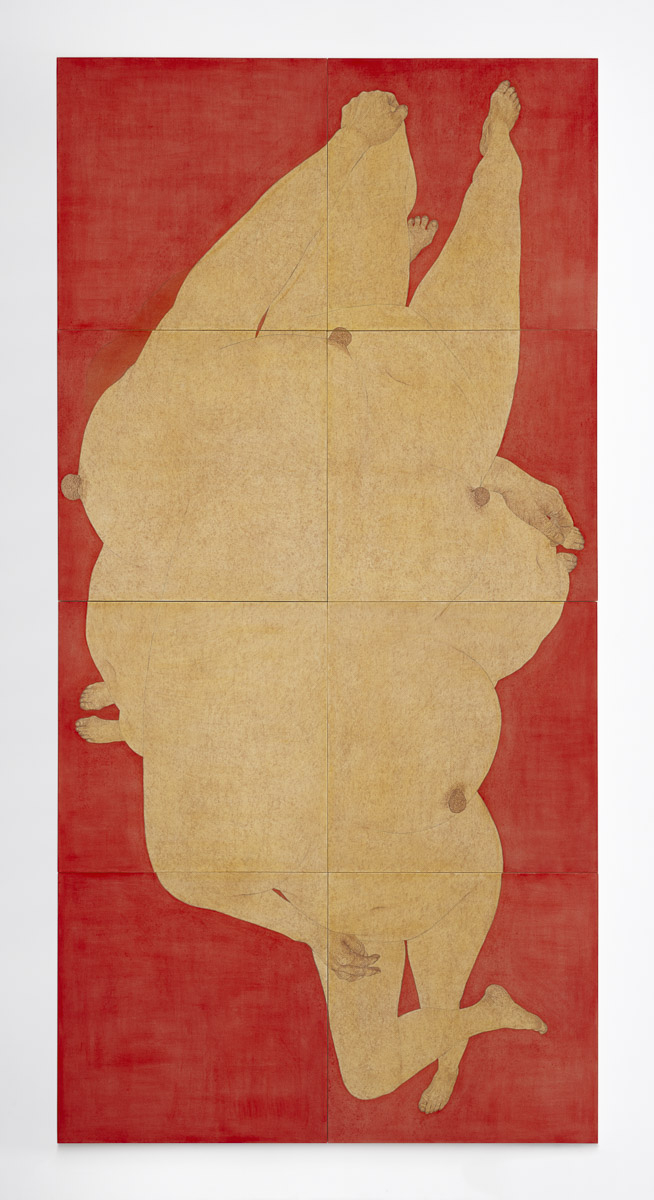
"Self Configuration: Cobalt Turquoise Island" (2026) is another large-scale work, linking six panels. The colors are not meant to evoke any specific natural landscape; rather, they are background hues chosen intuitively in response to the body's form.
This attentiveness to the body extends to Baek's materials. She begins with unprocessed cotton muslin, sketching in charcoal before applying thin layers of diluted pigment that seep into the fabric. The cloth is not treated as a flat surface to paint on but as an extension of skin itself — the pigment absorbed into the weave captures the subtle tones and textures of flesh, while the fabric's creases and folds register the passage of time.
This approach reflects Baek's own background. She studied Korean ink painting at Seoul National University before going on to study fashion design at Central Saint Martins in London. The unprocessed cotton muslin she encountered there has remained a constant in her painting practice ever since.
Korean ink painting is equally central to understanding her work.
Baek draws on the portrait techniques of the Joseon period and the "scattered-point perspective" of traditional East Asian landscape painting — a method of capturing views from multiple vantage points simultaneously rather than from a single fixed position.
The process of dismantling and reassembling parts of the body invites the viewer to see the self not as a fixed form but as a being in constant flux.
The exhibition runs through Jan. 9.
pink@heraldcorp.com