16 GWh supply agreement with Jupiter Power over three years
Cumulative supply reaches 27 GWh including prior contract
Prismatic LFP cells to be made at Indiana factory
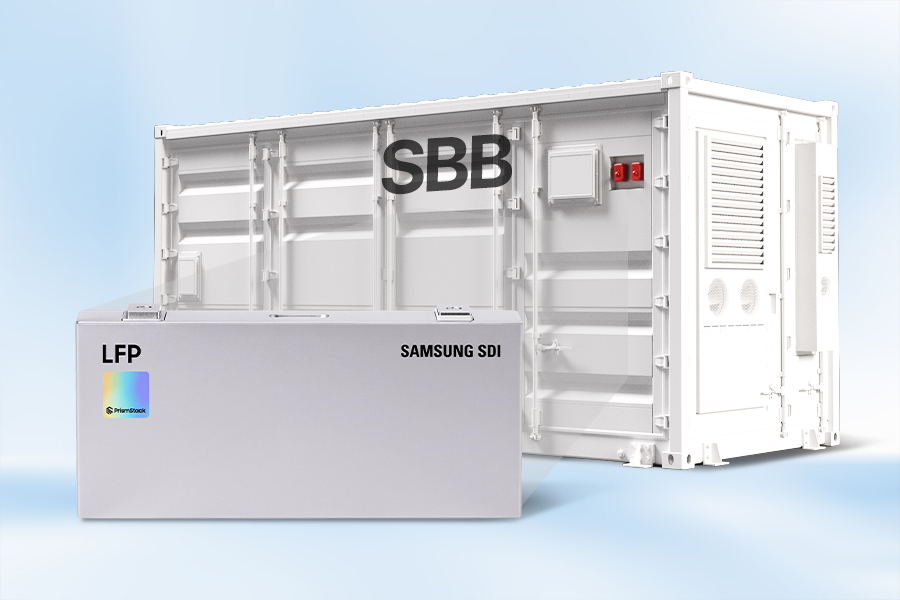
Samsung SDI has secured a large-scale lithium iron phosphate battery supply contract — estimated to be worth trillions of won — with a US energy storage system company affiliated with BlackRock, the world's largest asset manager. The deal extends Samsung SDI's order backlog beyond 2029, broadening its mid-to-long-term supply base in the US ESS market.
Samsung SDI announced Monday that its US subsidiary, Samsung SDI America, had signed a long-term supply agreement with Jupiter Power, a US ESS specialist.
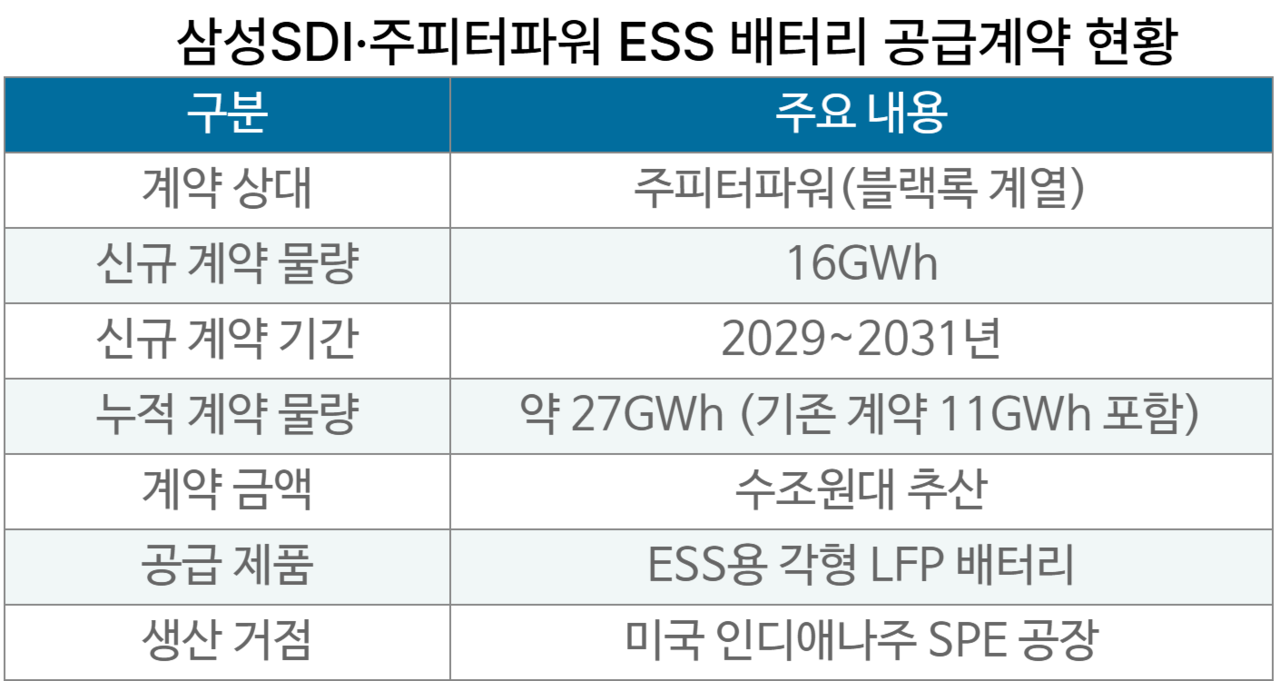
Under the contract, Samsung SDI will supply a total of 16 GWh of LFP batteries over three years from 2029 to 2031. The batteries will be used in large-scale ESS projects Jupiter Power is developing across the United States. The exact contract value was not disclosed, but it is estimated to reach the multi-trillion-won range.
Combined with a previously signed agreement between the two companies, the cumulative supply volume rises to approximately 27 GWh. Jupiter Power is an energy company owned by BlackRock that develops and operates large-scale ESS projects throughout the United States.
The latest order is significant in that it adds supply commitments beyond 2029 on top of Samsung SDI's existing backlog.
Samsung SDI had secured more than 60 GWh in ESS battery orders through October, centered on the US utility-scale market. That existing backlog alone is sufficient to keep its StarPlus Energy factory in the United States and its Ulsan production line running through 2028.
The batteries destined for Jupiter Power will be produced at the SPE factory in Indiana. SPE is a joint venture between Samsung SDI and global automaker Stellantis, and Samsung SDI began mass-producing prismatic LFP batteries for ESS applications there last month.
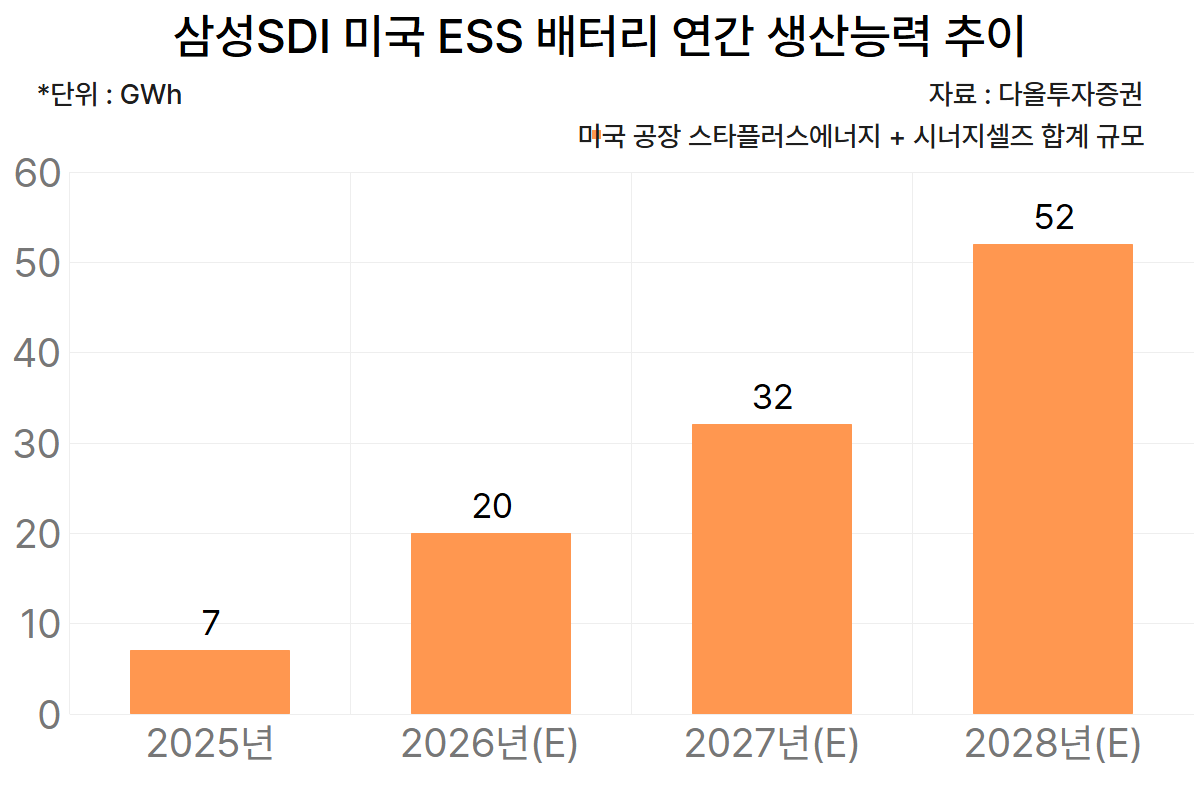
Production capacity is also expanding. The SPE plant is ramping up ESS battery output across multiple lines — Line 2, which previously made nickel-cobalt-aluminum batteries; Line 3, which has begun LFP production; and Line 4, which is scheduled to convert in the first half of next year. SPE's annual ESS battery production capacity is expected to grow from 20 GWh this year to 32 GWh next year.
Separately, Samsung SDI is converting its Synergy Cells factory in Indiana into an ESS battery production hub, targeting mass production in the second half of 2028 to early 2029.
As demand for electric vehicle batteries slows, ESS demand in the United States is rising on the back of grid-stabilization needs and growing investment in AI data centers. Samsung SDI has responded by converting some of its EV production lines to ESS use and expanding its product lineup from its existing NCA-based chemistry to include LFP.
LFP batteries offer lower raw material costs by eliminating nickel and cobalt, and carry advantages in cycle life and thermal stability. Samsung SDI is targeting the ESS market by applying its established prismatic cell structure to LFP chemistry, positioning itself as the only non-Chinese company producing prismatic batteries for ESS applications in North America.
Alongside expanding US production, Samsung SDI is accelerating efforts to build a China-independent supply chain for key materials.
Samsung SDI recently signed LFP cathode material supply agreements with domestic battery materials companies Posco Future M and L&F. The move aims to diversify procurement of LFP materials — which have historically relied heavily on China — to meet the supply chain requirements of its US customers.
US regulations in this area are also tightening. The United States plans to gradually raise the threshold for the direct cost ratio of non-Chinese components and materials eligible for ESS investment tax credits — from 55 percent this year to 75 percent by 2030. As a result, reducing dependence on Chinese materials, not just building local battery production capacity, is emerging as a key variable in winning orders.
The ESS business expansion is also contributing to Samsung SDI's earnings recovery. The company posted consolidated sales of 4.69 trillion won ($3.52 billion) in the third quarter, up 52.6 percent from a year earlier. Operating profit came in at 407.8 billion won, marking a return to the black and the highest level in 12 quarters since the third quarter of 2023. Growth in ESS and small battery sales drove the improvement.
Fabrice Hudry, vice president and head of the ESS team at Samsung SDI America, said the deal was "a recognition of the competitiveness and supply capabilities of our prismatic LFP batteries made in the United States," adding that the company would "continue to advance into the global ESS market on the strength of our differentiated prismatic battery technology and stable supply chain."
Andy Bowman, CEO of Jupiter Power, said "securing a stable supply of US-made equipment is central to our project planning and risk management strategy," and that the company would "strengthen supply chain competitiveness and deliver reliable power supply capabilities through Samsung SDI's LFP batteries produced in the United States."
kwater@heraldcorp.com