42 railway accidents recorded last year, half the 2022 figure
Land Ministry, Korail hold safety forum to review progress
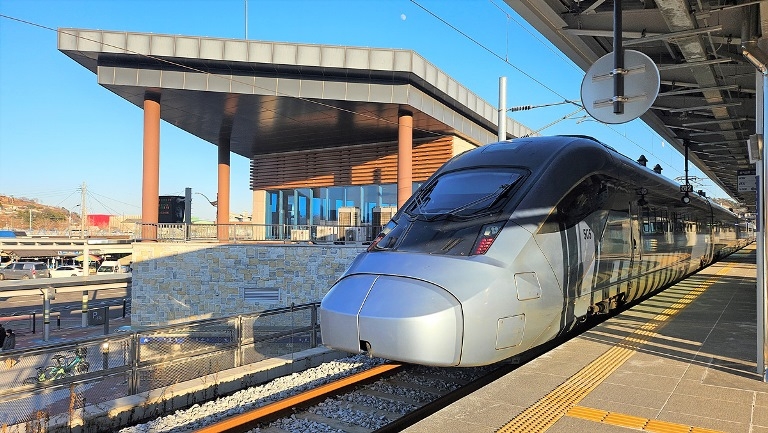
The government is moving to develop additional on-site safety management improvements after similar railway accidents continued to recur despite the overall number falling by half over four years. A comprehensive railway safety reinforcement plan is to be released before the end of the year.
According to the Ministry of Land, Infrastructure and Transport, railway accidents declined each year from 82 in 2022 to 68 in 2023, 46 in 2024 and 42 last year. Twenty-five incidents had been recorded through October this year.
The ministry said it has completed most recurrence-prevention measures following an analysis of 15 major railway accidents and service disruptions that occurred in the second half of this year, and plans to accelerate work on additional improvements.
On the rolling stock side, inspections of 11 train sets using the same power transmission system were completed after a KTX power transmission failure. To prevent KTX-Sancheon trains from making sudden emergency stops, the replacement cycle for a related electrical component — the multiple-unit relay — was shortened from 15 years to five. Ten air-pressure switches in the braking system were also replaced preemptively. Going forward, aging parts in the braking and electrical control systems will be replaced and maintenance procedures improved.
On the infrastructure side, following the Busan Station derailment, wooden rail ties in high-risk sections at 24 high-traffic stations were inspected and reinforced first. Wooden rail ties are timber supports that hold the rails in place and distribute the weight of passing trains. An additional 125 gauge-widening prevention devices were installed to stop the track gauge from spreading. All approximately 1.609 million wooden rail ties nationwide will be inspected by year's end, and about 16,000 deteriorated ties will be replaced.
Additional measures included lubricating 67 key operating components of track switches at Seoul Station, conducting a full inspection this month of all track switches of the same type as a faulty one, improving train stopping and departure procedures, and carrying out special safety inspections and training for drivers at 51 crew depots. Procedures were also clarified to require crews to immediately notify the control center and confirm the safety of surrounding tracks whenever an unintended "train roll" — a stationary train moving without intent — occurs.
Work is also accelerating on the Railway Shunting Operations Safety Reinforcement Plan announced in September. Korail completed development of rear-camera technology this month to change the work structure that currently requires workers to ride on the outside of freight cars. The railway operator plans to confirm which stations will adopt the system after field verification.
A wireless remote-control shunting system, already installed at three locations — the Jecheon marshalling yard (up-line), Yeongju and Goidong — will be expanded to eight stations by 2027, with introduction at Uiwang Station planned for 2028.
An AI-powered CCTV system that predicts worker hazards in advance will be piloted at Donghae Station in 2027. Hazards blocking movement paths and sightlines at 20 locations across three stations have been eliminated, and more than 100 lighting facilities will be upgraded by 2028 to improve nighttime work safety.
These developments were reviewed Monday at the fourth Railway Safety Forum held at Government Complex Sejong. Korail, Korea National Railway, the Korea Railroad Research Institute, the Korea Transportation Safety Authority and private-sector experts attended. Participants reviewed existing measures and discussed additional improvements.
"The fact that similar accidents keep recurring despite the various railway safety measures we have pursued means we need to fundamentally review how well existing measures are being carried out on the ground and how our safety management systems are structured," said Kim Tae-byeong, director general of the ministry's Railway Bureau. "We will develop a comprehensive railway safety reinforcement plan before year's end to strengthen vehicle and infrastructure management, reduce human error through advanced technology, and improve the effectiveness of accident prevention."
smh@heraldcorp.com