Share of new guarantees for low- and mid-credit borrowers falls from 47% to 30.4% in four years
Foundation draws fire for shifting support toward high-credit businesses
Applicants wait two weeks for in-person consultations despite 68 billion won headquarters
Small business owners at risk of falling through the cracks
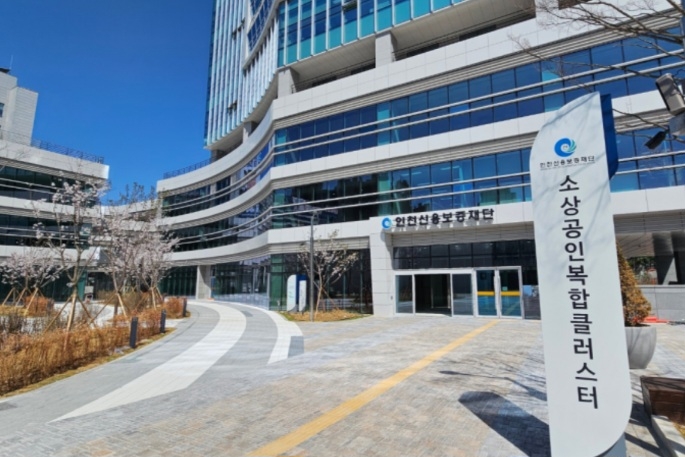
The Incheon Credit Guarantee Foundation, established to improve financial access for small businesses and self-employed entrepreneurs in Incheon, is drawing criticism for turning its back on the financially vulnerable — the very people it was created to serve.
Critics say the foundation's founding mission is being undermined as the share of new guarantees extended to low- and mid-credit small business owners shrinks year after year, with support increasingly concentrated on higher-credit applicants under the pretext of managing guarantee default risk.
The concerns deepened after it emerged that despite spending 68 billion won ($51 million) to build a large mixed-use complex, small business owners in urgent need of funds still cannot get timely in-person consultations — fueling calls to strengthen substantive financial support systems rather than expand facilities for appearances' sake.
At a 2026 administrative audit of the Incheon Credit Guarantee Foundation on Monday, Democratic Party of Korea lawmaker Cho Min-kyung, a member of the Incheon City Council's Industry and Economy Committee representing Yeonsu-gu District 4, raised pointed questions about the foundation's reduced guarantee support for financially vulnerable groups and the shortcomings of its small business consultation system.
According to data obtained by Cho, the share of new guarantee amounts extended to low- and mid-credit borrowers fell from 47.0% in 2022 to 30.4% as of September this year — a drop of 16.6 percentage points in just four years.
Meanwhile, about 70 percent of new guarantee amounts issued this year went to high-credit borrowers.
Critics say this runs counter to the foundation's core mandate of providing guarantees to small business owners who lack collateral or cannot clear the lending thresholds of mainstream financial institutions.
Cho also pushed back against using guarantee default rates as the sole justification for limiting support to lower-credit borrowers.
Data submitted by the foundation showed that businesses rated in credit grades 1 through 5 had an average net default rate of 5.0 percent, while those rated grade 6 or below posted a rate of 11.5 percent — more than double.
Cho argued, however, that if policy focuses solely on reducing financial risk, the most vulnerable small business owners will be repeatedly pushed out of the formal financial system, perpetuating a vicious cycle.
Cho called on the foundation to develop policy alternatives that manage risk while helping lower-credit businesses stabilize their operations — through tiered guarantee limits, phased support and post-guarantee management consulting.
Inconsistent guarantee eligibility standards across regional boundaries, which leave some businesses in a financial blind spot, also drew fire.
A representative case involved a small and medium-sized enterprise whose registered headquarters is in Gyeonggi Province but whose business activity and sales are largely generated in Incheon — a company told by both the Incheon Credit Guarantee Foundation and the Gyeonggi Credit Guarantee Foundation that it did not qualify for support from either.
The Incheon foundation cited the company's Gyeonggi-registered headquarters as grounds for ineligibility, while the Gyeonggi foundation pointed to the fact that most of its sales occur in Incheon.
The result is a situation where a business is denied financial support from any region because administrative registration takes precedence over where a company actually operates.
Cho said the two foundations should establish shared guarantee eligibility standards and an inter-agency referral system, and build a mechanism under which the first institution a business contacts takes responsibility for directing it to the appropriate agency.
The consultation process that small business owners must navigate before receiving support was also flagged as a problem.
The foundation completed construction of a small business mixed-use complex this year using about 68 billion won and operates eight branches across Incheon along with an outpost on Yeongjong Island. Yet complaints persist that access to in-person consultations remains inadequate.
According to a case presented by Cho, one business owner visited a branch without a prior appointment and was turned away, only to be told that the earliest available consultation slot was roughly two weeks away.
With 82 percent of the foundation's guarantee services delivered remotely this year, in-person consultations remain in effect a critical channel for small business owners who are not comfortable with digital services or who need funds urgently.
Cho said it calls the system's effectiveness into question when a foundation that runs mobile outreach units and a digital-access support program for underserved groups still cannot provide a consultation to a small business owner who walks through the door of a branch.
The utilization of the 68 billion won headquarters building was also singled out for scrutiny.
The foundation originally built the complex to create a one-stop support system offering financial services, education and management consulting under one roof.
Yet as recently as Aug. 24, the foundation was still actively recruiting public institutions to fill vacant spaces in the office and commercial wings of the complex.
Cho called on the foundation to publicly disclose the actual move-in status of institutions that had originally expressed interest, along with vacancy rates, annual facility operating costs, rental income and an objective assessment of how much small business owners' access to services has improved since the new headquarters opened.
"Small business owners do not care how big or impressive the foundation's building is," Cho said. "What matters is whether they can get the urgent funding they need. If small business owners cannot even get a single consultation despite a 68 billion won headquarters with branch offices, then who is that facility actually for?"
If a public guarantee institution established to protect the financially vulnerable prioritizes guarantee default risk and operational efficiency above all else and expands support mainly for high-credit borrowers, critics say it becomes indistinguishable from a private financial company.
Calls are growing for the Incheon Credit Guarantee Foundation to overhaul its guarantee screening standards and consultation systems so that it can function as a genuine financial safety net for cash-strapped small business owners — not just a showcase of expanded facilities.
gilbert@heraldcorp.com