District Mayor Ku Jae-yong holds press conference to disclose fiscal crisis
Own-source revenue falls 30% while fixed costs remain largely unchanged
District to pursue organizational restructuring and fiscal reform
Calls for changes to resident tax system and higher adjustment grant rates
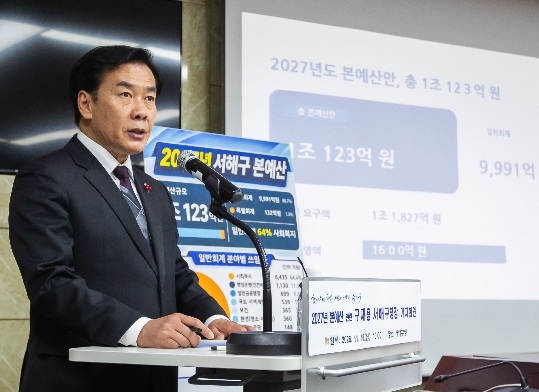
Incheon's Seohaegu district is facing a severe fiscal crisis following an administrative restructuring, leaving it unable to fully fund welfare programs, waste management, public facility operations and even civil servant salaries.
In drawing up its 2027 main budget, the district could not accommodate 160 billion won ($120 million) of the amounts requested by its departments.
As a result, a wide range of programs directly affecting residents' daily lives — including welfare services, sanitation administration, road and park maintenance, and local investment projects — have been scaled back or put on hold.
District Mayor Ku Jae-yong held a press conference Monday to disclose the fiscal situation, saying the district would work to overcome the crisis through internal fiscal reform and by securing support from the central government and Incheon city.
The 2027 main budget submitted to the district council totals 1.01 trillion won, of which the general account stands at 999.1 billion won. Departments had originally requested 1.18 trillion won, but a large number of projects could not be included due to insufficient revenue.
Particularly concerning is that the cuts extend beyond new projects and one-off event expenses to programs considered essential to residents' daily lives, raising fears of widespread disruption to public services.
Specifically, 12.3 billion won in district co-payment obligations for welfare programs — including the basic pension, the Angel Support Grant, disability activity support benefits and infant care subsidies — was left out of the budget. Funding for outsourced sanitation services was cut by about 17.9 billion won, and park, green space and street tree maintenance by about 9.1 billion won.
Budgets for community programs, including neighborhood association stipends and resident autonomy council operating costs, were also reduced. Major investment projects — road construction, school commute route improvements and the construction of a new public health center — could not be included either.
The crisis has also affected the district's own workforce. The budget had to be drawn up with 18.6 billion won in civil servant salaries and 12.2 billion won in pension contributions cut.
Root causes: falling revenue, fixed costs
Seohaegu identified the root causes of the fiscal crunch as a drop in revenue following the administrative restructuring and the fixed costs required to maintain existing administrative infrastructure.
Own-source revenue — comprising local taxes, non-tax revenue and grants — fell roughly 30 percent, from 461.4 billion won to 321.4 billion won.
By contrast, personnel costs fell only 16.6 percent compared with the 2026 main budget, public corporation and foundation operating expenses dropped just 15 percent, and waste disposal costs declined 9.3 percent. The district said the spending structure has not adjusted quickly enough to match the scale of the revenue decline, deepening the fiscal imbalance.
The district added that mandatory expenditures — including personnel costs and facility operating expenses — remain substantial, as it must continue maintaining existing roads, parks and public facilities inherited from the restructuring, compounding the fiscal pressure.
Own-source revenue accounts for just 32.17 percent of next year's general account. The district said much of the remainder consists of earmarked national and city government subsidies, leaving it with limited discretionary funds.
District Mayor Ku outlined three broad directions for fiscal normalization, starting with sweeping internal reform of the district's organizational and financial management systems.
The district plans to expand the activities of the fiscal stabilization TF formed shortly after its launch and commission a research project to improve the efficiency of its administrative and financial operations.
It will also review redundant and overlapping programs for consolidation, and consider organizational mergers and workforce redeployment.
Additional measures include improving the operational frameworks of public facilities and affiliated institutions, stepping up collection of overdue payments, and adjusting public facility usage fees to reflect market prices to boost self-generated revenue. The district said it would also consider selling district-owned assets and issuing local bonds if necessary.
Calls for emergency support from government, Incheon city
The district is also moving to formally request fiscal support from the central government and Incheon city.
Seohaegu said the additional fiscal burden created by the administrative restructuring cannot be resolved through the district's own efforts alone, and it will request emergency support to cover shortfalls in essential expenditures such as personnel costs and welfare co-payment obligations.
The district also plans to work with relevant agencies to promptly resolve outstanding fiscal settlement issues from before the split, and to gradually normalize delayed local projects by securing external funding through the special local allocation tax and special adjustment grants.
The district is also pursuing longer-term institutional reforms to strengthen its fiscal base.
It plans to ask the central government to reclassify the individual portion of the resident tax — currently a metropolitan city tax — as an autonomous district tax, and to raise the grant rate districts receive for collecting city taxes from the current 3 percent to 5 percent.
For Incheon city, the district intends to request that the adjustment grant rate be raised from the current 22.3 percent to 23 percent, and that the calculation method be revised to better reflect administrative boundary changes, demographic shifts and growing welfare demand.
"Since the administrative restructuring was planned in advance, the organizational and fiscal structure appropriate for a district of some 390,000 residents should have been put in place before the split — but preparation was insufficient," Ku said. "It is late, but we will now move to streamline our administrative and fiscal operations and undertake fundamental reform, however painful."
"The top priority in overcoming the fiscal crisis is protecting residents' daily lives and safety," Ku added. "As additional funding is secured, we will first address areas directly tied to residents' lives — welfare, the environment and public safety — and we will make every effort to secure the education expense budget that could not be included this time."
gilbert@heraldcorp.com