Top 4 insurers' property-damage payouts reach 4.09 trillion won in first half, up 1.6%
Excessive repairs, rental car collusion cited as 'insurance leakage'; auto insurance posts first deficit in 6 years
The number of property-damage auto insurance claims fell in the first half of this year, yet total payouts for parts and repair costs rose — a trend expected to weigh further on an auto insurance market that has already swung into the red.
According to the insurance industry, the four major non-life insurers — Samsung Fire, Hyundai Marine & Fire Insurance, KB Insurance and DB Insurance — paid out a combined 4.09 trillion won ($3.07 billion) in property-damage auto insurance claims in the first half of this year, up 65.2 billion won, or 1.6 percent, from 4.03 trillion won in the same period last year.
Property-damage claim counts fell from about 2.422 million in the first half of last year to about 2.358 million in the first half of this year, a drop of roughly 64,000, or 2.6 percent. With fewer accidents but a higher total payout, the average payout per claim climbed 72,000 won, or 4.4 percent, from 1.66 million won to 1.74 million won.
Property-damage payouts from the four insurers have grown every year. The combined figure stood at 6.41 trillion won in 2020, surpassed 7 trillion won in 2022, and reached 8.28 trillion won last year — crossing the 8 trillion won threshold for the first time. Over the same period, the average payout per claim rose from 1.28 million won to 1.62 million won.
Breaking down last year's payouts by category, parts costs were the largest component at 3.76 trillion won, or 43.4 percent of the total, followed by repair labor at 3.44 trillion won (39.7 percent) and rental car fees at 721.1 billion won (8.3 percent). Compared with 2020, parts costs rose 43.1 percent and rental car fees climbed 30.9 percent.
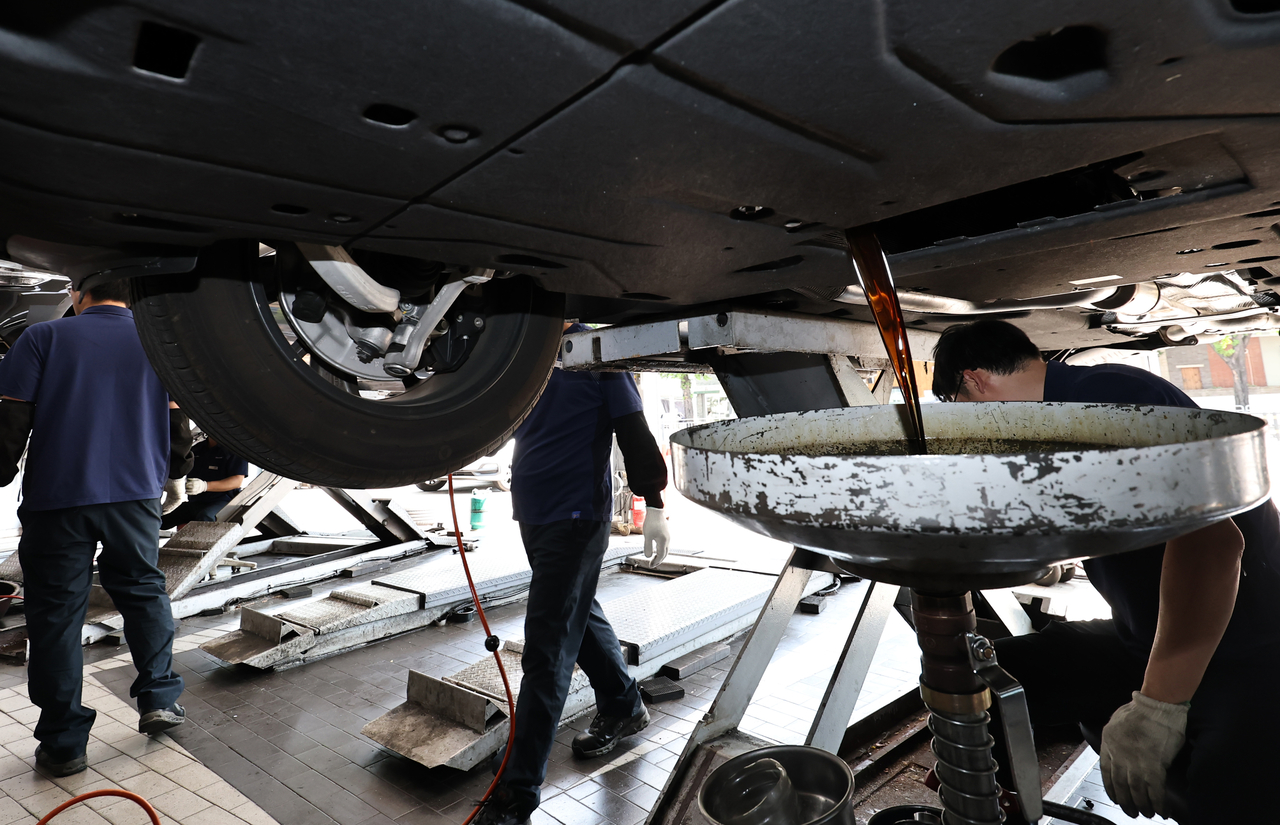
The industry attributes the rising payouts largely to excessive and inflated billing by some repair shops, as well as collusion with rental car companies. Common practices include replacing entire components — such as bumpers — for minor damage that could simply be repaired, and deliberately extending repair times to rack up more rental car days.
The rise in property-damage payouts is expected to push up the loss ratio for auto insurance. The four major insurers' auto insurance operations had already fallen into the red in the first half of this year, and the industry-wide auto insurance deficit came to 184.8 billion won. The combined ratio hit 101.9 percent, exceeding the breakeven point of 100 percent — the first time auto insurance has posted a loss in six years.
Medical and personal injury costs are also rising, which could add further pressure on the loss ratio. The four major insurers' cumulative loss ratio for January through September stood at 84.7 percent, down 0.8 percentage points from the same period last year. But the industry cautions against complacency, as deficits typically widen in the second half of the year.
Several variables could push the loss ratio higher still. Increased vehicle traffic during the autumn leisure season and winter cold snaps and heavy snowfall add seasonal pressure, while parts costs, repair service fees and labor costs continue to rise. Auto insurance premiums were raised 1.3 to 1.4 percent this year and a so-called "eight-week rule" limiting long-term treatment for minor-injury patients was introduced, but industry observers say these measures fall short of offsetting the seasonal and structural forces driving up the loss ratio.
"If the insurance deficit persists, it could translate into higher premiums and greater burdens for consumers," an industry official said. "The current irrational structure of insurance leakage must be reformed to normalize the market."
won@heraldcorp.com