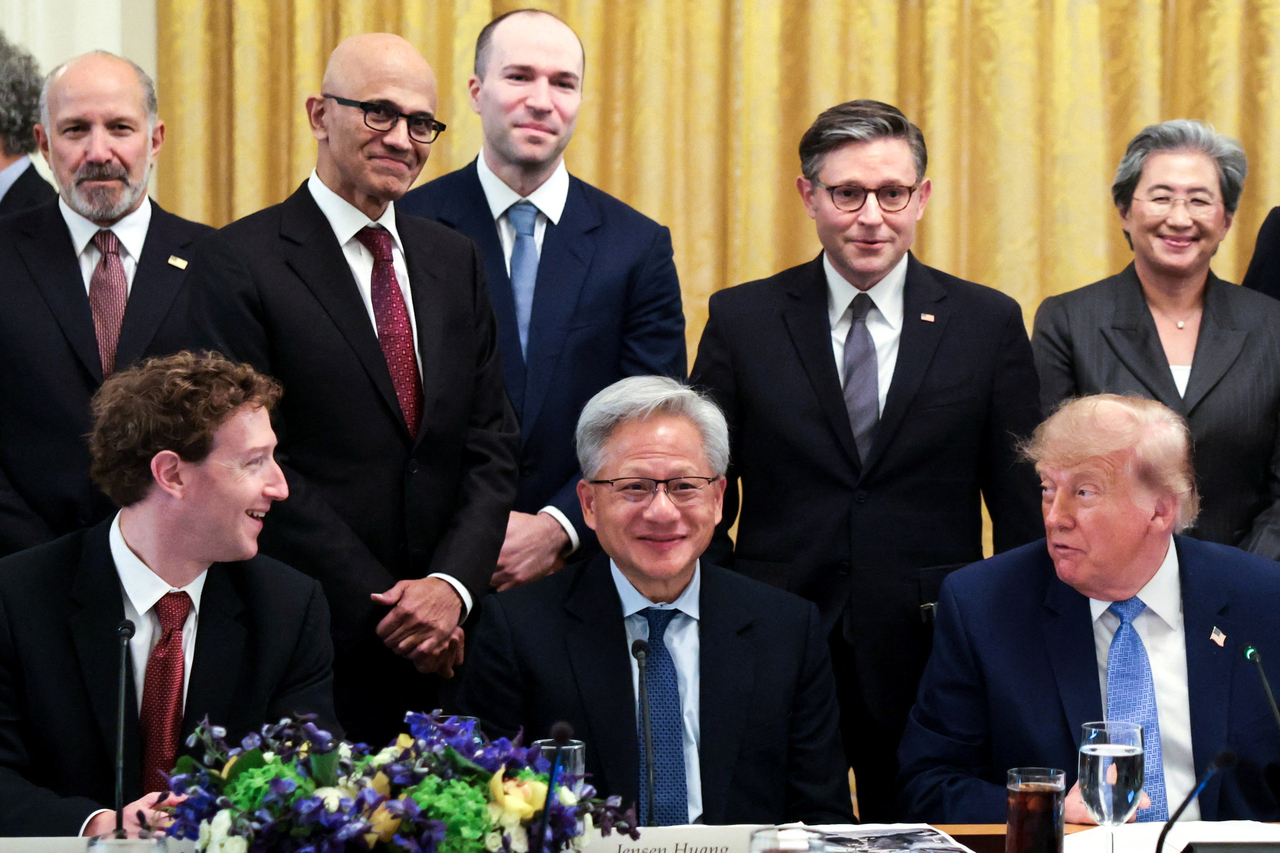
The abrupt departure of former Nvidia CEO Jensen Huang amid a series of scandals has cast doubt over the $500 billion AI industry financing initiative he championed, with analysts warning the effort could lose some of its ambition.
Reuters reported Monday (local time) that while Nvidia's AI financing push is expected to continue after Huang's exit, the company's appetite for risk is likely to diminish. Experts said investment in AI startups and neo-cloud providers — specialized cloud companies that lease out AI computing resources — could pull back as a result.
Nvidia announced the program in August, partnering with major global financial institutions to help customers finance the construction of large-scale AI infrastructure, including data centers, to support purchases of its chips. Apollo Global Management, BlackRock, Blackstone, Brookfield Asset Management, Goldman Sachs and KKR are among the financial firms that agreed to participate.
Reuters said the initiative is expected to continue under Chief Financial Officer Colette Kress, who is serving as interim CEO. However, it may be temporarily paused early on as the company reviews its operational direction.
Brian Colello, an analyst at Morningstar, said the leadership change "adds uncertainty" to Nvidia and described the future of the $500 billion financing initiative as difficult to gauge.
Citing anonymous sources, Reuters said Nvidia's financial partners are still in discussions about ways to fund AI companies. Sikandar Rashid, global head of AI infrastructure at Brookfield Asset Management, said in an email that the firm "values the relationship between our two teams greatly and looks forward to continuing to work together."
Still, analysts said the initiative is unlikely to operate in the same way it did before Huang's departure.
Erica Speer, an analyst at JPMorgan, wrote in a report that while existing commitments are not expected to change, new deals "could take longer to close or require greater compensation as investors seek more certainty around Nvidia's role."
With the Federal Reserve expected to raise its benchmark interest rate next month, a rising rate environment — combined with potential pushback from the incoming US Congress on data center construction — could cause investor interest in Nvidia and its partners to cool sharply.
Experts said the financing initiative could shift toward financially stronger hyperscalers — large-scale cloud service providers — as lenders and credit investors grow more cautious about risk.
Huang had envisioned a structure that used Nvidia chips as collateral while limiting guarantees. As doubts mount over the AI financing initiative, lenders may begin demanding customer contracts or financial guarantees from recipient companies as backing.
Joseph Moore, an analyst at Morgan Stanley, wrote in a report that the $500 billion third-party capital pool Nvidia assembled is "more likely to accrue to better-capitalized companies, i.e., the large hyperscalers." Moore added that while neo-cloud companies are still expected to account for roughly 25 percent of Nvidia's sales, the share going to more established firms will grow.
kate01@heraldcorp.com