Share of annuity recipients rises from 3.3% to 16.5% in five years, but 82% of those choosing annuity set payout period at 10 years or less
Adoption rate at firms with fewer than 5 workers stands at 10.6%, versus 92.1% at firms with 300 or more
National Assembly Research Service urges protection of accrued benefits and support for small businesses ahead of mandatory external reserve requirement
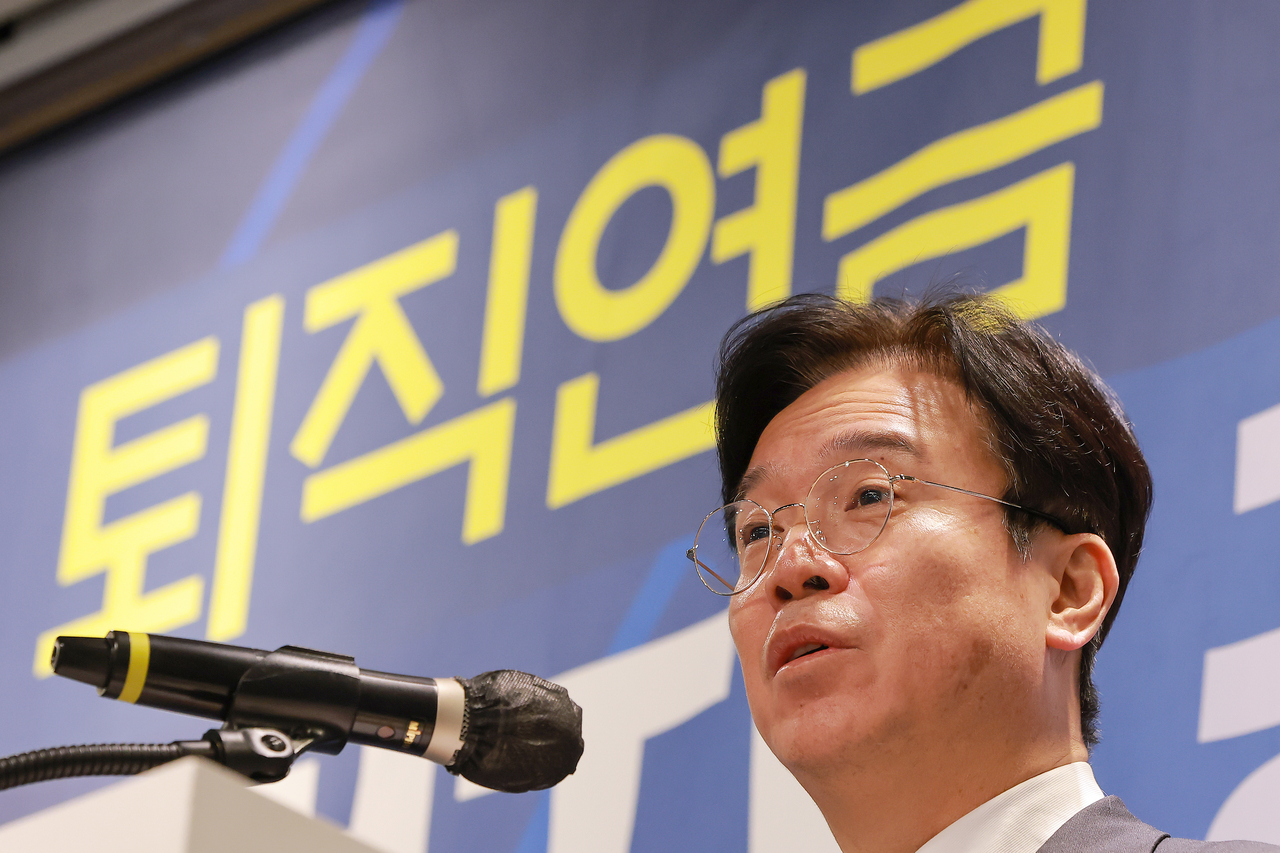
South Korea's retirement pension reserves have reached 501 trillion won ($375 billion), yet more than eight in 10 accounts that received retirement benefits last year chose a lump-sum payout. Even among those who opted for an annuity, about 82 percent set the payout period at 10 years or less.
The government plans to require external reserves for retirement benefits on a phased basis starting in 2028, and the National Assembly Research Service said authorities must establish clear rules on protecting benefits already accrued and put in place mechanisms to encourage annuity uptake.
Annuity uptake rising, but 15 trillion won withdrawn from IRP accounts before age 55
Retirement pension reserves stood at a preliminary 501 trillion won at the end of last year, up 70 trillion won, or 16.1 percent, from the previous year, according to a report published Tuesday by the National Assembly Research Service titled "The Paradox of 500 Trillion Won in Retirement Pensions: Why It Still Fails to Function as a Pension."
The annual return last year was 6.47 percent, the highest since records began. The five-year average return was 2.86 percent and the 10-year average was 2.31 percent, with about 75 percent of reserves still held in principal-guaranteed products.
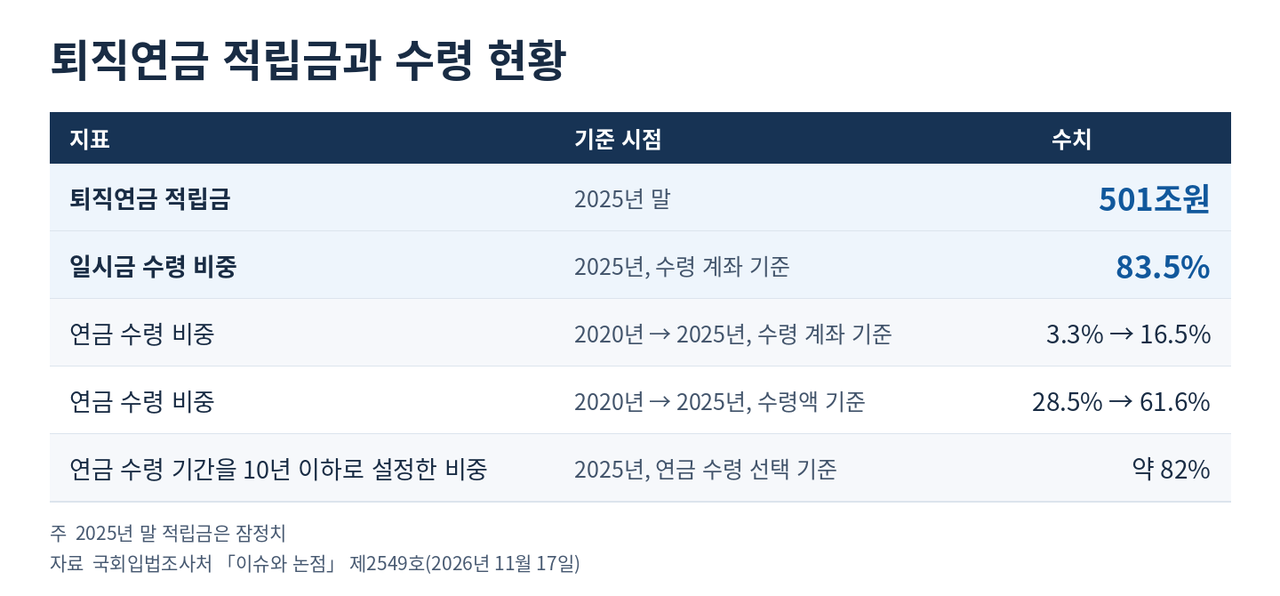
The share of retirement benefit accounts choosing an annuity rose from 3.3 percent in 2020 to 16.5 percent last year. Measured by amount received, the annuity share climbed from 28.5 percent to 61.6 percent over the same period. By value, annuity payouts now account for more than half of all retirement benefits, but by account count, lump-sum withdrawals still represent 83.5 percent.
Keeping retirement benefits intact until the annuity payout stage remains a separate challenge.
According to government data, of the roughly 18 trillion won in retirement benefits drawn early in 2024, 15 trillion won — 83.3 percent — left the system through early termination of individual retirement pension (IRP) accounts before the holder reached 55, the age at which annuity payments become available. Early withdrawals while still employed accounted for 3 trillion won, or 16.7 percent.
The research service said the government should develop separate measures for post-retirement IRP terminations and mid-employment early withdrawals, and should also reconsider the exemptions from mandatory IRP transfers that currently apply to retirees aged 55 and older and to those receiving small payouts of 3 million won or less.
Adoption rate at sub-5-worker firms just 10.6%; protection of pre-mandate accruals emerges as key issue
The gap in retirement pension adoption varies sharply by workplace size.
The overall adoption rate across all workplaces in 2024 was 26.5 percent, a figure that has hovered in the 26 to 27 percent range for the past decade. The rate was 92.1 percent at firms with 300 or more employees, but fell to 23.2 percent at firms with fewer than 30 workers and was limited to 10.6 percent at firms with fewer than five.
Workplaces without a retirement pension scheme are not required to hold statutory severance pay in external reserves, meaning workers can struggle to collect their benefits if the employer's finances deteriorate or the business collapses. Retirement pay accounted for 822.9 billion won of unpaid wages last year, representing 41.1 percent of the total.
Subject to legislative amendment, the government plans to mandate external reserves for firms with 100 or more employees in 2028, firms with 10 to 99 employees in 2029, and firms with fewer than 10 employees in 2030, applying the requirement to benefits accrued from the date of implementation onward. Next year's budget includes 6 billion won for matching support for early adopters and 6.2 billion won in interest-rate subsidies for new participants.
The research service said transitional provisions must clearly specify how retirement benefits accrued before the mandate takes effect will be protected and how companies will be expected to fund existing severance pay obligations.
The government also plans to introduce a fund-type structure — in which a trustee corporation manages reserves — for defined-contribution and IRP schemes, running it alongside the existing contract-based model.
The research service said the law should explicitly set out trustees' duty to prioritize the interests of plan members, their liability for damages, and board composition requirements including independent directors and member-nominated directors. Han In-sang, a legislative research officer, said workers employed for less than a year, very short-hour workers, and those in special-employment or platform arrangements are difficult to cover through workplace-level mandates alone, and that separate measures to extend coverage to them are needed.
fact0514@heraldcorp.com