Korea-US strategic investment firm set for 20-year run; first overseas bond issue targeted for January
Kreiss-Tompkins cautious on LNG development, stresses resident benefits and economic viability
South Korea's $350 billion investment commitment to the United States is expected to proceed regardless of a Democratic candidate's victory in the Alaska gubernatorial race and mounting calls for the removal of Commerce Secretary Howard Lutnick, who spearheaded the investment drive within the Trump administration, according to officials familiar with the matter.
The investment vehicle established under the Korea-US agreement is already up and running, and preparations for overseas bond issuances to raise funds are underway. Still, observers note that the shift in the US congressional balance of power could affect the pace at which individual investment projects are selected and executed.
According to the Ministry of Economy and Finance and related ministries, the Korea-US Strategic Investment Corporation — the body overseeing the $350 billion investment program — has a statutory lifespan of 20 years. The institutional framework was designed to allow long-term management and financing of investment projects even through changes in administration or congressional composition.
The $350 billion commitment stems from last year's Korea-US tariff negotiations. Under the agreement, South Korea agreed to invest $200 billion in cash in US strategic industries — including semiconductors, energy, pharmaceuticals and AI — in exchange for lower reciprocal tariff rates, with the remaining $150 billion to be channeled into the US shipbuilding sector through private-sector loans and guarantees.
Fundraising efforts are now gaining momentum. The Korea-US Strategic Investment Corporation is conducting a roadshow this month in major financial centers including New York, Washington, London and Luxembourg to attract overseas investors. The roadshow is groundwork for raising part of the up to $20 billion in annual investment funds through overseas bond issuances.
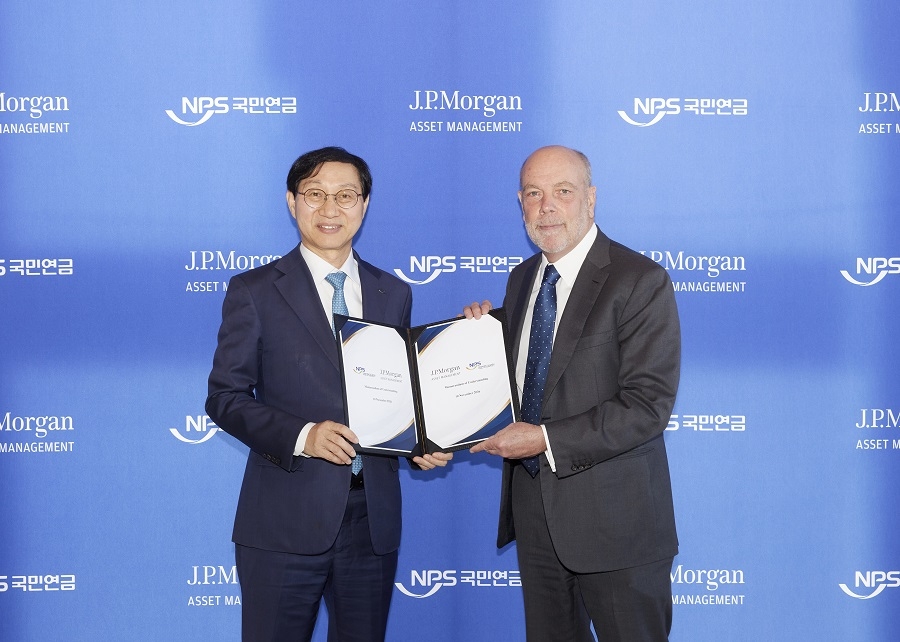
Preparations for the corporation's first overseas bond issue since its establishment are also underway. A foreign-currency bond issuance team has been assembled, led by personnel with experience from Korea Land and Housing Corporation's finance division, and a kickoff meeting was held Oct. 26. Underwriters, including JPMorgan, have already been selected.
The corporation is targeting January for its inaugural overseas bond issue of between $1 billion and $2 billion. The initial tranche is expected to be denominated entirely in US dollars. The plan calls for expanding annual issuances to as much as $7 billion over time, with bonds denominated in dollars and euros to be issued across major financial markets in the United States, Europe, the Middle East and Asia — diversifying both funding currencies and the investor base.
"Despite the Democratic candidate's win in the Alaska governor's race and the talk of Lutnick's removal, it appears that what Korea and the US have agreed to will inevitably be carried out," said an official with close knowledge of the investment program.
The key question now is how to secure the commercial viability of individual investment projects and translate commitments into actual execution.
The government plans to wrap up the selection of a specialized advisory firm to support commercial reviews of US investment projects this month. The chosen firm will handle practical work including financial modeling and technical assessments. After the selection, South Korea intends to request detailed materials from the US side on the Alaska LNG development and nuclear power plant construction projects, and to negotiate business plans and investment terms.
The Alaska LNG project involves transporting natural gas produced in the state's north through a roughly 1,300-kilometer pipeline to the south, where it would be liquefied and exported. Questions about the project's economic viability have persisted, centered on the high cost of building the pipeline and the price competitiveness of the resulting LNG. Japan's government commissioned energy consultancy Wood Mackenzie last year to assess the project, and has been in talks with the US side focused primarily on purchasing future LNG output rather than making direct investments.
The domestic political environment in the United States is another factor to weigh as individual projects move forward. The election of Democratic candidate Jonathan Kreiss-Tompkins as Alaska's governor has drawn attention to how state-level consultations over energy development will unfold. Kreiss-Tompkins is not opposed to energy development as such, but is said to hold the position that a project's economic merits and benefits to local residents must both be weighed. Meanwhile, pressure on Commerce Secretary Lutnick — who has led the US investment negotiations — is growing not only from Democrats but also from Republicans and within the administration itself, amid allegations that he turned a blind eye to claims that Jensen Huang, former Nvidia CEO, was involved in Chinese espionage, as well as controversy over his pursuit of personal interests.
oskymoon@heraldcorp.com