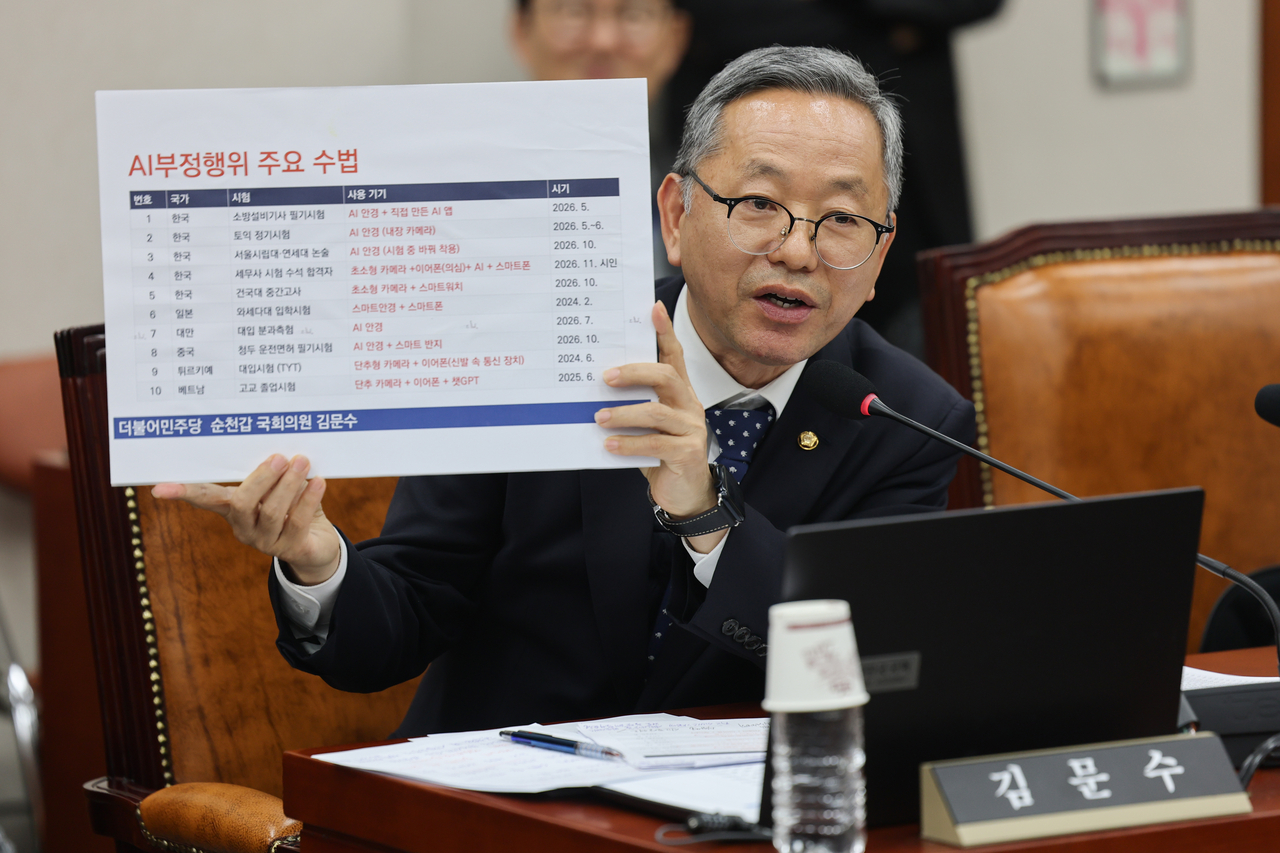
Kim Moon-su, the lawmaker chairing the Democratic Party of Korea's special committee on education, said Tuesday that when it comes to countering AI-assisted cheating on exams, "the last appeal I can make is that test takers have no choice but to monitor one another."
Kim made the remarks during an appearance on CBS Radio's "Park Sung-tae's News Show," prefacing the suggestion with the admission that "countermeasures are honestly quite hard to come by."
Kim's use of the word "monitor" appeared to carry the meaning of "supervise and keep watch."
"They are competitors, so of course they are focused on the exam — but that is one such method," Kim added. "In fact, the test takers sitting nearby are in the best position to notice. So, for example, they could file a report."
Kim also suggested that proctors "mark down any suspicious individuals and then immediately investigate and examine them once the exam is over." Proctors face real constraints, Kim said, noting that "as we can see from cases of infringement on teachers' authority, teachers can actually get sued by students, so they may not be able to handle this part well — that concern has come up a lot."
Kim pointed to structural limitations as well. "Right now only two proctors are assigned to each exam room, and only about one specialist capable of detecting AI cheating is deployed per room, so having to resolve all of this with the naked eye is the biggest problem," he said. "There are risks of human rights violations — someone could claim they were disrupted, that they did nothing wrong but were repeatedly targeted and could file a lawsuit. There are also technical limits: what do you do about a student who arrives one minute before the exam starts and needs to be checked?"
Kim went on to say the Ministry of Education should "actively respond at the ministry level to legal liability risks, take out something like liability insurance, and later have the ministry itself take responsibility for providing lawyers directly." He added that "there should also be some kind of commendation or promotion system for proctors who properly catch violations, to encourage active enforcement."
Kim said that under current rules, a student caught cheating on the College Scholastic Ability Test faces only a two-year ban — covering the year of the offense and the following year. He said he is preparing legislation to extend that ban to five years, 10 years, or even a lifetime, noting that "retaking the exam two or three times is common, so a three-year ban is not enough."
Kim said he is also preparing a tougher bill that would share the records of exam cheaters across institutions — similar to how information on sex offenders is shared — to bar them from sitting for exams at other organizations or schools entirely.
"Someone who actually cheats, or even entertains the thought of cheating, is essentially a person who has nearly given up on their own life," Kim said. "I think we need to treat it as a very serious crime and come down hard on it."
yul@heraldcorp.com