Philadelphia Semiconductor Index falls 5.28%; Nvidia, Micron slide in tandem
Jensen Huang resignation fallout compounds US chip export restrictions
Kospi clings to 5,100 line; bargain buying eyed
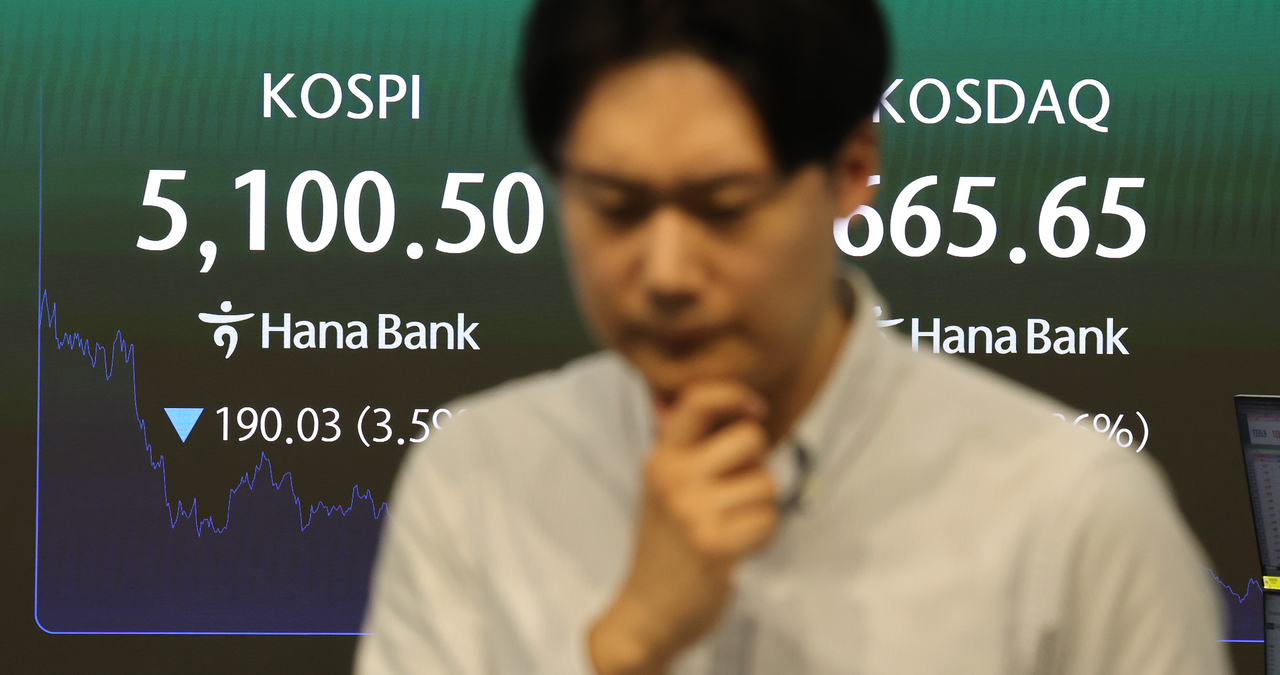
The Kospi is expected to face continued headwinds Tuesday as a sharp selloff in US semiconductor stocks ripples through Asian markets. Volatility has persisted in the wake of former Nvidia CEO Jensen Huang's resignation, and investors are watching closely whether the benchmark index can hold the psychologically significant 5,100 level.
On Monday, the Kospi closed down 190.03 points, or 3.59 percent, at 5,100.50 — its third consecutive losing session since Thursday.
The index opened higher, gaining 14.87 points, or 0.28 percent, to 5,305.40, but reversed course during trading and at one point fell as low as 5,069.83, a decline of 4.17 percent.
At the close of the regular session, foreign investors posted net selling of 1.38 trillion won ($1.04 billion) on the Kospi market, extending their selling streak to a second straight session. Institutional investors were also net sellers at 459.8 billion won, while retail investors were net buyers at 1.35 trillion won.
Analysts attributed the selloff to mounting concern over AI industry investment following news of Huang's extramarital affair and subsequent resignation, compounded by caution ahead of Nvidia's earnings release, Anthropic's listing and the publication of Federal Open Market Committee minutes.
South Korea's two semiconductor giants bore the brunt of the decline. Samsung Electronics fell 4.47 percent to close at 196,800 won, while SK hynix tumbled 7.89 percent to 1.12 million won.
Overnight on Wall Street, all three major indexes closed lower. The Dow Jones Industrial Average fell 1.41 percent, while the S&P 500 and the Nasdaq Composite dropped 1.92 percent and 2.49 percent, respectively.
Nvidia fell 4.12 percent, extending its recent decline. Rivals AMD and Broadcom dropped 5.58 percent and 3.92 percent, respectively, after reports that new US export restrictions could affect the supply of advanced AI chips to countries beyond China.
On Monday (local time), the US Commerce Department's Bureau of Industry and Security, acting on instructions from the Treasury Department and the National Security Council, moved to block the provision of computing power to Chinese entities without US authorization. The measure requires US approval for any company in China or other countries of national security concern to receive computing performance from US-made "superintelligence" — the Donald Trump administration's term for AI — chips and servers, regardless of where those chips and servers are physically located.
In addition, prior authorization will be required to export advanced chips to Southeast Asian countries including Singapore, Malaysia, Thailand and Indonesia, as well as Brazil.
Memory chip suppliers also took heavy losses. Micron fell 7.62 percent, SK hynix's American depositary receipts dropped 7.29 percent, and SanDisk slid 8.58 percent. The Philadelphia Semiconductor Index fell 5.28 percent.
CoreWeave, a US neo-cloud provider that has recently raised credit risk concerns, tumbled 6.12 percent. Nebius and Iren fell 7.55 percent and 9.80 percent, respectively.
The MSCI Korea ETF, a gauge of foreign investor sentiment toward South Korean equities, fell 4.36 percent. The KOSPI 200 overnight futures index also weakened 1.76 percent.
With the Kospi having fallen for three consecutive sessions and retreating to the 5,100 line, attention is turning to whether bargain hunters will step in Tuesday.
As of 8:27 a.m. in premarket trading, Samsung Electronics was down 3.0 percent from the previous close at 190,900 won, while SK hynix was off 2.8 percent at 1.09 million won.
Han Ji-young, a researcher at Kiwoom Securities, said the market has struggled to absorb the uncertainty stemming from Huang's resignation, which emerged as a new risk factor last week. Han added that domestic stocks would open lower Tuesday due to the sharp drop in US AI shares on fears of a contraction in the AI investment ecosystem and weakening demand, but that Monday's steep index decline had already priced in much of the AI-related negative news, so the market could recover some of its losses during the session.

yuni@heraldcorp.com