67 products added this year
AI, semiconductor sector leads with 20 items
SMEs account for 94% of certified firms
4 companies upgraded to higher rating
48 overseas buyers visit Korea
More than 300 export consultations held
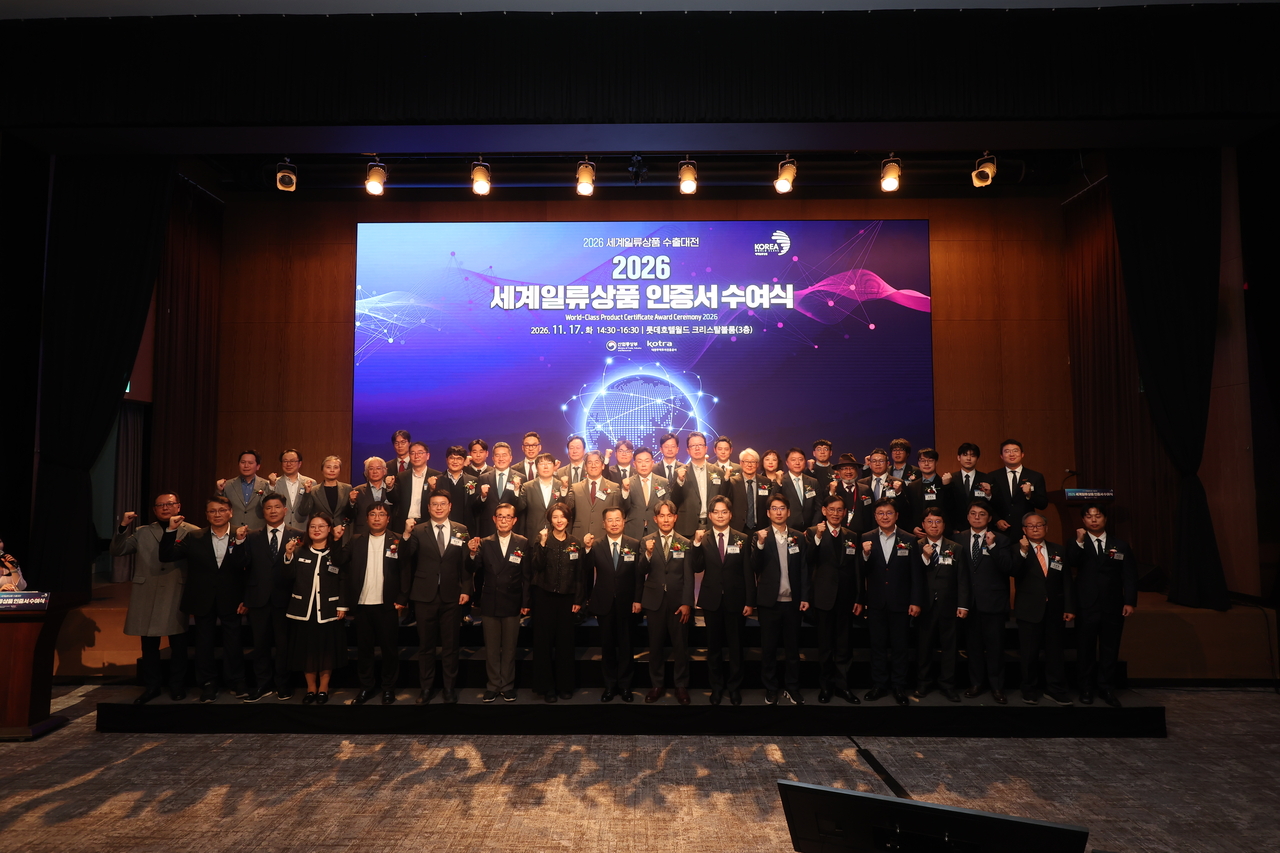
The number of South Korean companies certified as producers of world-class products has reached 1,100, after 75 firms — concentrated in advanced industries such as AI and semiconductors — were newly designated this year, broadening the base of companies expected to drive future exports.
South Korea's Ministry of Trade, Industry and Resources and the Korea Trade-Investment Promotion Agency (KOTRA) held the 2026 World-Class Product Export Festival at Lotte Hotel World in Songpa-gu, Seoul, on Tuesday, presenting world-class product certificates to the 75 newly selected companies.
The event was organized to support Korean companies' entry into overseas markets during Mid-sized Enterprise Week. Alongside the certificate ceremony, the program included export consultation sessions with overseas buyers, a forum on strategies for entering future industries and alternative markets, and a recruitment fair for attracting overseas talent.
The world-class product regime identifies domestic products and companies that have secured global competitiveness — or show strong potential to do so — and provides export support.
Products ranked fifth or higher in global market share with at least a 5 percent share are designated "current world-class products," while those deemed likely to meet that threshold within seven years are classified as "next-generation world-class products."
This year's newly selected cohort comprises 75 companies across 67 product categories. The current world-class product designation covers 23 categories from 28 companies, while the next-generation designation covers 44 categories from 47 companies.
Four companies previously classified under the next-generation category were upgraded to current world-class product status.
As of this month, 1,100 domestic companies hold active world-class product certification. The total number of certified product categories stands at 989 — 645 current world-class products and 344 next-generation world-class products.
The 75 newly selected companies this year represent a decrease of 13 from the 88 added last year. However, new categories in advanced industries and consumer goods have made the overall selection more diverse.
By sector, AI- and semiconductor-related products led with 20 items. Established industries such as petrochemicals and shipbuilding accounted for 19 newly selected categories, while consumer goods including cosmetics and lifestyle products contributed 10.
Small and medium-sized enterprises dominate the certified pool. Of the 79 companies receiving certificates — including newly selected firms and those upgraded in rating — five were large corporations, 20 were mid-sized enterprises and 54 were small and medium-sized enterprises (SMEs), meaning SMEs and mid-sized firms together account for about 94 percent of the total.
An export consultation fair was also held at the event to help newly certified companies translate their designation into actual overseas market entry.
A total of 48 overseas buyers and 134 domestic companies participated, conducting more than 300 export consultations. KOTRA had been running online pre-consultations since May to assess the potential for deals between participating companies and overseas buyers.
Particular effort was made to invite buyers from emerging markets in Southeast Asia, the Middle East and Africa, beyond South Korea's traditional major export destinations.
Notable participants included Thailand's CP Group, a major retail conglomerate, and Indonesia's Soho Global — companies with established local distribution networks that could support Korean firms' market entry.
Buyers from the so-called Global South — encompassing ASEAN, the Middle East and Africa — made up 58 percent of all overseas participants, up 15 percentage points from last year.
The forum on future industries and alternative market entry strategies provided information to support export market diversification, with discussions covering high-growth industries and pathways into Southeast and South Asian markets.
Key agenda items included the government's seven SEED projects, physical AI combining robotics and AI, and the AI transformation of manufacturing.
The seven SEED projects are a government initiative to foster sectors with strong medium- to long-term growth potential, including nuclear fusion, small modular nuclear power plants, renewable energy, quantum technology, space, biotech and advanced supply chains.
A program to help companies recruit overseas talent was also on offer. Thirteen small but strong domestic and mid-sized companies participated alongside about 300 foreign students seeking employment, holding recruitment consultations.
On-site advisory sessions addressed companies' export challenges across a range of areas, including ESG management, overseas mergers and acquisitions, and reshoring support.
KOTRA plans to help certified companies leverage overseas marketing support and preferential export financing to break into new markets.
"With this latest round of selections, 1,100 companies now carry the world-class product designation, and we are particularly pleased to welcome new product categories such as consumer goods," KOTRA President Kang Kyung-sung said. "We will do our utmost to diversify export markets and expand results so these companies can serve as the driving force behind a $1 trillion export era."
Meanwhile, export-import trend data released by the Ministry of Trade, Industry and Resources on Nov. 1 showed South Korea's cumulative exports from January through October reached $930 billion, up 60.6 percent from the same period last year. The government said roughly $70 billion remains before the annual $1 trillion export target is reached, and expects the milestone to be achieved this month.
kwater@heraldcorp.com