Han Sang-woo posts video on YouTube channel
'Pattern identical to fraudsters in private education'
'A person interested only in using scores, not pursuing a path'
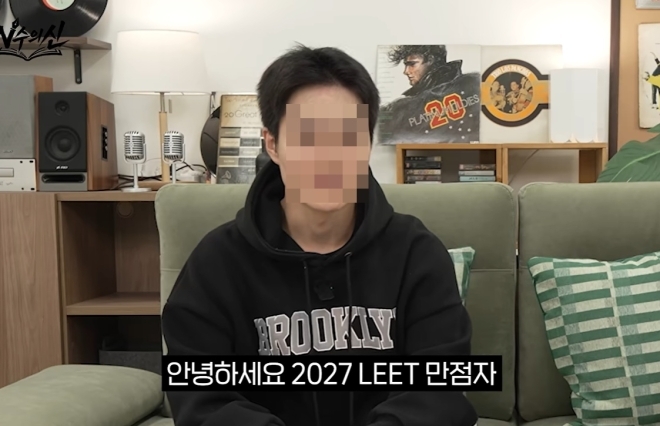
Controversy surrounding Lee, a Seoul National University dental school student reported to have scored a perfect mark on this year's Law School Admission Test, known by its Korean acronym LEET, is growing amid claims by a math instructor who says he is "certain" Lee cheated.
Lee has said the allegations will be addressed through a live-streamed session on Thursday, in which Lee will solve the Korean language section of the College Scholastic Ability Test, known as the Suneung, under third-party observation.
Math instructor Han Sang-woo posted a video titled "A story about Lee, the LEET perfect-scorer" on his YouTube channel "Suhakaneun Ddangwoo" on Monday.
In the video, Han explained "why I was suspicious and what I saw that made me certain from the outset" regarding Lee.
"There are a lot of fraudsters in the private education industry," Han said. "Some have been caught and disgraced, and some are still active — but the pattern is identical to everyone who has been caught so far."
Han also said that anyone who has genuinely studied "must have something to show for it — specific talk about the traces of studying and the methods used, but Lee had none of that." He added that the study techniques Lee describes, such as a "blank-page method" and "learning concepts in reverse through past exam questions," are "honestly things even a middle schooler knows — extremely basic."
Han then said Lee places greater emphasis on lifestyle habits — "dopamine detox," exercise and diet — than on actual study methods, including in Lee's book "Brain Axel," and argued this was problematic. "These things are not unimportant," Han said, "but grades involve many variables, and there is an order of priority."
"What these people have in common is that their track record does not add up," Han said, pointing to what he found suspicious: that Lee, despite near-perfect Suneung scores, chose Seoul National University's dental school over a medical school; then suddenly sat the LEET; and after scoring perfectly, said the goal was to "contribute to society" rather than pursue a legal career. Han also noted that Lee later published a study-method book written with AI and joined a hagwon called "OO Talent" under the title of "brain coach." "This is the track record of someone with no interest in the paths their scores could open, only in using those scores," Han said.
Han also said, "Everyone I have seen fitting this pattern turned out to be a fraudster. Those who are genuine either show no suspicious circumstances or prove themselves when they arise." He said he was "certain" based on his "big data on fakes."
On the proposed live-streamed Suneung Korean section as a verification method, Han said he "welcomed it at first — I even applied to observe, since the verification was to take place on a stage set by a third party." However, he added, "the Suneung Korean section cannot serve as verification. I am at least certain that there was cheating on the LEET."
Han argued that offering to verify through a live Suneung broadcast "is already a diversion — muddying the waters by shifting attention elsewhere." He said the verification "has become meaningless," adding that "the very act of so thoroughly demanding to be verified is either a way of saying 'my method won't be caught,' or simply stalling for time."
Referring to marks on the LEET exam paper Lee made public that appeared to show answers written in shifted positions, Han said, "Questions 25 through 29 are five items — you cannot shift answers when writing them on the exam paper itself rather than the answer sheet." He added that he would "like to make a bet on whether it is even possible to verify further by bringing in a LEET instructor."
Meanwhile, speculation has emerged online that Lee chose Thursday — the day of this year's Suneung — for the public verification because it coincides with the date the previous year's exam papers would be destroyed after the one-year retention period expires.
Under the exam paper management guidelines based on Article 9 of the current College Scholastic Ability Test Management Regulations, used exam paper envelopes must be sealed in boxes and kept in a manner that allows for post-exam verification. Stored exam papers and listening evaluation CDs must be preserved for one year from the test date at a location designated by the superintendent of education, after which they are to be destroyed.
jshan@heraldcorp.com