The Presidential Committee on National AI Strategy said Tuesday that Ha Jung-woo, its standing vice chairman, visited Daejeon to meet with industry, academic and research officials at the National AI for Science Center, Daejeon Tips Town and KAIST.
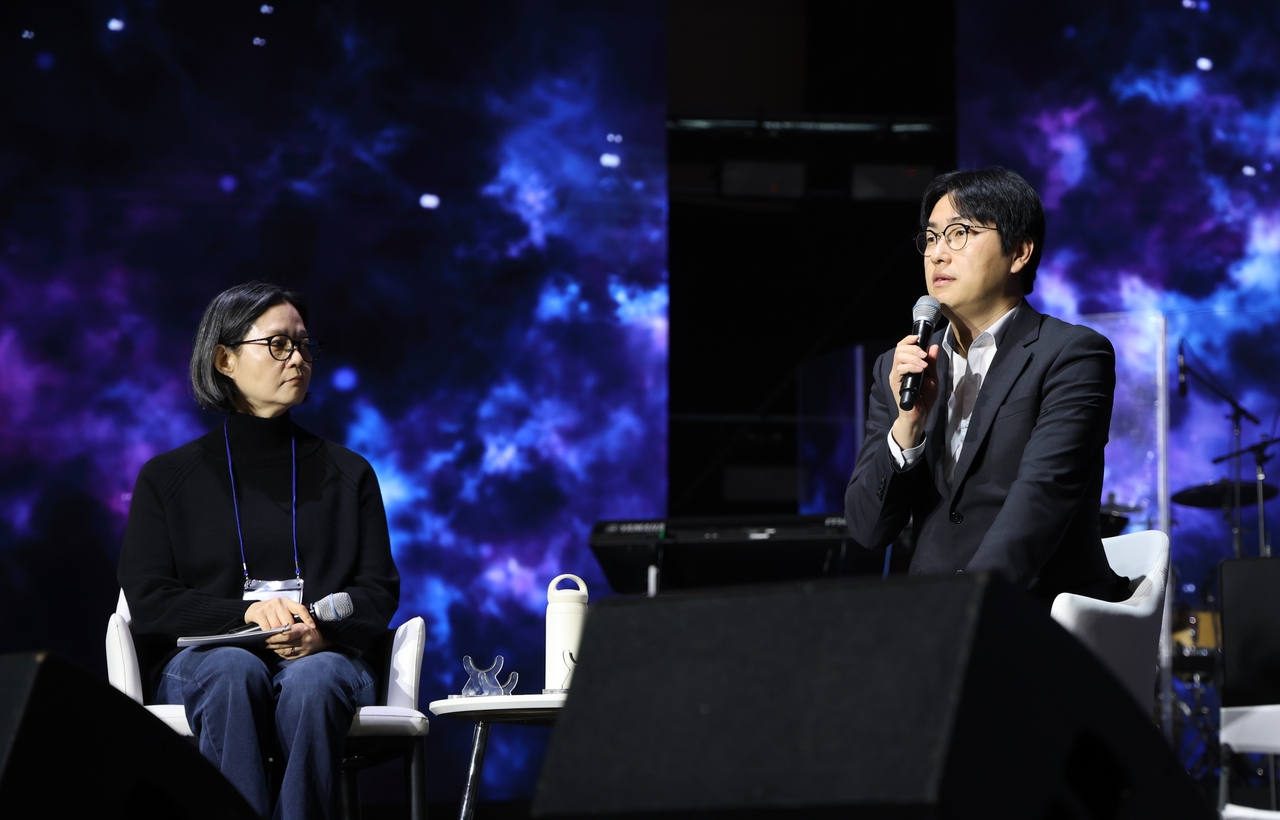
Ha attended an AI talk concert at Innovate Korea 2026, held at the Ryu Keun-chul Sports Complex at KAIST.
The talk concert, moderated by KAIST Professor Yoon Yun-jin, brought together Ha, KAIST AI College Dean Yoon Kuk-jin, LG CNS AI Center Director Jin Yo-han and Korea Research Foundation Chairman Hong Won-hwa. The panelists exchanged views on South Korea's push to become one of the world's top three AI powers, corporate survival strategies in the AI era, and the future of AI talent.
Earlier, Ha received a briefing from KAIST Professor Jang Young-jae of the Department of Industrial and Systems Engineering — also chief executive of Daim Research — on KAIROS, an AI-powered unmanned factory platform developed by KAIST, and toured the AI-driven manufacturing site.
KAIROS is a next-generation unmanned factory operating system that uses AI to integrate and control a range of robots, including logistics, collaborative and humanoid robots. The system — from the robots and controllers to wireless charging and operating software — was built entirely on domestic technology.
Ha also held a field meeting with representatives of AI startups and investment institutions at Daejeon Tips Town, located within Chungnam National University.
Daejeon Tips Town is an open startup space established in 2021. It currently houses about 30 organizations in total, including 26 startup companies and several investment institutions.
Participants shared on-the-ground perspectives on the challenges AI startups face as they grow, including attracting investment, commercializing technology and entering new markets, and discussed ways to strengthen the regional AI startup ecosystem.
Ha also visited the National AI for Science Center, housed within the Institute for Basic Science, where he reviewed the center's operations and key initiatives with Director Yu Yong-gyun and other officials.
NAIS was established in May within the National Research Council of Science and Technology to promote "AI Native R&D" — the integration of AI across the entire research and development process.
The center's core functions include developing autonomous AI scientists, building and operating autonomous laboratories, and creating an online and offline hub for science AI research collaboration.
Participants shared updates on these initiatives and discussed the center's role in strengthening South Korea's science and technology competitiveness, along with on-site challenges and potential improvements.
"We will continue engaging with AI innovation sites — research institutions, universities and companies — to sharpen the execution of the national AI strategy and pursue field-driven policy development and support so that South Korea can rise to become one of the world's top three AI powers," the committee said.
Ha visited Gangwon Province in October to examine AI applications in healthcare and transportation, review talent development efforts and inspect plans for large-scale AI data center construction. A subsequent visit to Daegu and North Gyeongsang Province focused on the progress of AI transformation in the region's key industries, including secondary batteries, mobility and robots.
sjpark@heraldcorp.com