Noh Man-seok testifies at trial of former Prosecutor General Shim Woo-jung... 'Opinions divided on type of appeal'
'Staff conveyed preference for ordinary appeal... chief never gave unlawful or improper orders'
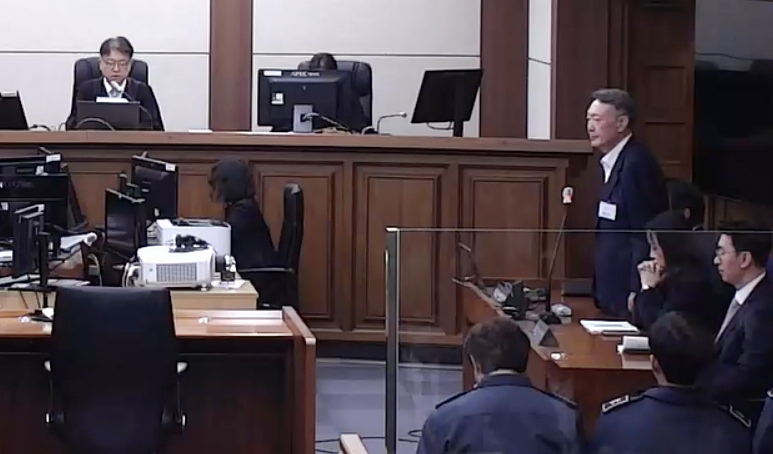
Noh Man-seok, former deputy prosecutor general at the Supreme Prosecutors' Office, said Tuesday that while prosecutors were dissatisfied with a court ruling last year lifting former President Yoon Suk Yeol's detention, most officials at the time accepted it as a legitimate court decision.
Noh made the remarks while testifying at the trial of former Prosecutor General Shim Woo-jung and Jeon Mu-gon, former head of the Supreme Prosecutors' Office's planning and coordination division. The hearing was held Tuesday before the Seoul Central District Court's Criminal Division 38-3, presided over by judges Choi Young-gak, Jang Seong-jin and Jeong Su-yeong.
Shim was indicted on charges including abuse of authority for allegedly waiving an immediate appeal after a court granted Yoon's request to lift his detention. Yoon had been indicted in custody in March last year on charges including leading an insurrection.
At the time, Noh served as head of the narcotics and organized crime division, one of the senior staff positions at the Supreme Prosecutors' Office.
He said that at a senior prosecutors' meeting held the day the court issued its ruling, "most people seemed to feel the court's decision should be accepted, even though there was general dissatisfaction with it." He added, however, that "there were differing views on whether to file an immediate appeal or an ordinary appeal."
Noh said the staff subsequently conveyed to Shim their preference for filing an ordinary appeal, adding, "The prosecutor general said he understood the staff's view, and I don't know what happened after that."
Shim's defense said that on March 7 last year, the decision on an ordinary appeal was to be coordinated with the special investigation unit handling the emergency martial law case, but that unit also concluded an ordinary appeal risked being dismissed on procedural grounds and opted to contest the matter on the merits instead.
The defense said that after Cheon Dae-yeop, then head of the National Court Administration and a Supreme Court justice, remarked in the National Assembly that an immediate appeal was still possible, opinions at the senior staff meeting became divided — at which point Shim said he would take personal responsibility for the final decision.
"That account is probably correct," Noh said. "In the end, since it was the prosecutor general's call to make, the staff said they would follow whatever decision he reached."
Noh said there were also those who agreed with Shim's position of forgoing an immediate appeal, and added, "In all the time I worked under him, I never once thought the prosecutor general gave an unlawful or improper order."
Under the Code of Criminal Procedure, appeals against court rulings take two forms: immediate appeals and ordinary appeals. An immediate appeal must be filed within seven days and automatically suspends the execution of the ruling upon filing. An ordinary appeal, by contrast, requires a separate ruling from either the original court or the appellate court to suspend execution.
For that reason, public opinion at the time ran strongly in favor of prosecutors filing an immediate appeal to prevent Yoon's release.
Prosecutors, however, decided against filing an immediate appeal just one day after the court's ruling to lift the detention — on March 8 last year — and released Yoon.
Cheon appeared before the National Assembly's Legislation and Judiciary Committee on March 12 of the same month and said the deadline for an immediate appeal had not yet passed, adding that he believed "it is necessary to seek a higher court's judgment." Prosecutors nonetheless did not reverse their decision.
mokiya@heraldcorp.com