Trump, Xi and Putin to meet Thursday for first-ever trilateral talks on nuclear arms, Iran war
US-China summit to tackle tariffs, rare earths and semiconductor curbs
Trump says he may meet Kim Jong-un; first US-North Korea contact in over 7 years possible
South Korean President Lee Jae Myung also attending; Korea-China summit in focus
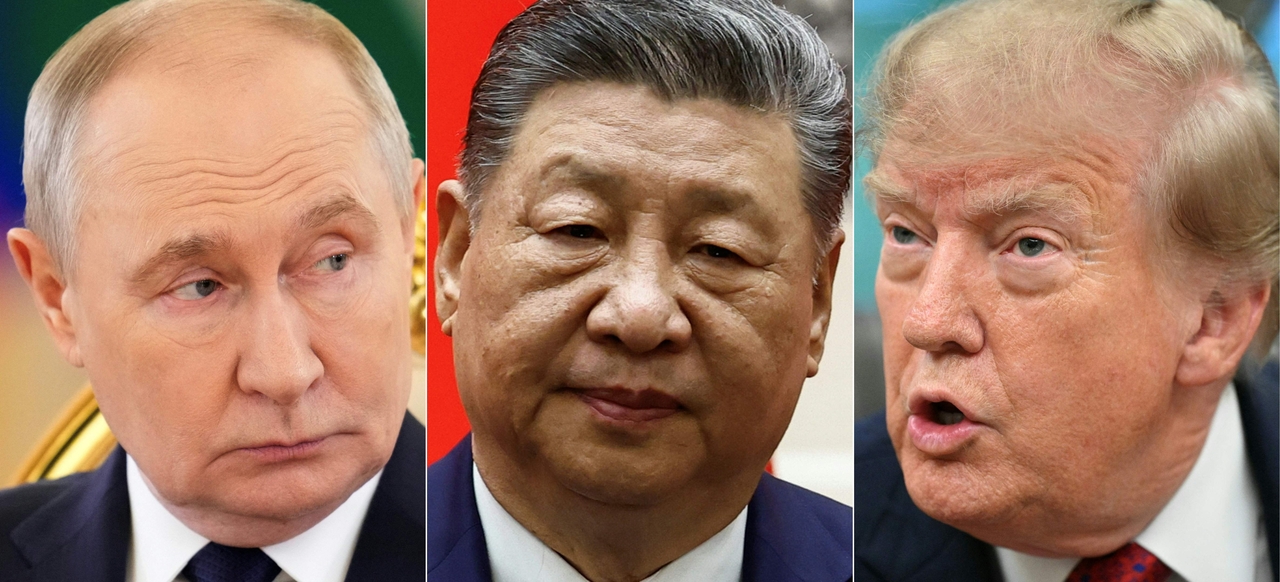
The Asia-Pacific Economic Cooperation summit opened Wednesday in Shenzhen, Guangdong Province, China, marking the first time the leaders of the United States, China and Russia have gathered in the same room. With Donald Trump, Xi Jinping and Vladimir Putin set to discuss nuclear disarmament and international security, the meeting has drawn intense global attention over what shifts it may produce in the world order. The gathering of major powers to address key international issues directly has even prompted comparisons to the 1945 Yalta Conference — with some observers raising the prospect of a "second Yalta."
The 33rd APEC Leaders' Meeting, which opened Wednesday, runs through Thursday. The centerpiece of the summit is the first-ever US-China-Russia trilateral leaders' meeting scheduled for Thursday. The White House announced the session, and the Kremlin and China's Ministry of Foreign Affairs subsequently confirmed it.
China's Ministry of Foreign Affairs said the gathering of the three leaders for the first time carries landmark significance for world peace and stability.
No specific agenda has been made public, but nuclear disarmament and international security issues — including the war involving Iran — are expected to dominate the talks. Trump has long expressed interest in nuclear arms reduction negotiations involving the United States, China and Russia together.
Earlier on Nov. 8, Trump said in connection with the trilateral summit that the leaders would discuss "many things, including denuclearization," adding, "We are trying to end the Iran war."
Attention is also focused on whether the talks will produce movement toward a new arms control framework to replace the lapsed US-Russia nuclear reduction treaty.
New START, the last nuclear arms reduction treaty between the United States and Russia, expired last February, leaving the two countries — the world's largest nuclear powers — without any binding agreement limiting their strategic nuclear arsenals.
Trump has envisioned a new nuclear arms reduction framework that goes beyond the existing bilateral US-Russia arrangement to include China.
China, however, has remained reluctant to join trilateral nuclear disarmament talks, citing its far smaller nuclear arsenal compared with those of the United States and Russia. China's Ministry of Foreign Affairs has said demanding China's participation in trilateral nuclear disarmament negotiations at this stage is unrealistic.
The three countries' diverging positions on the war in Ukraine add another layer of uncertainty. Russia wants the question of ending the Ukraine war on the agenda, while the United States has said it does not plan to discuss that issue at the trilateral meeting.
China also holds that the Ukraine war should be resolved with European countries at the table. Analysts therefore expect the meeting to serve more as a starting point for future negotiations than a forum for concrete agreements.
The "second Yalta" comparison has gained traction precisely because major powers are convening to discuss international security and the global order among themselves.
At the 1945 Yalta Conference, the leaders of the United States, Britain and the Soviet Union mapped out the basic framework of the postwar international order. The parallel being drawn now is that the leaders of the United States, China and Russia are again consulting on major security issues without the direct participation of other nations.
Russia, however, has pushed back against the comparison. Kremlin spokesperson Dmitry Peskov acknowledged the significance of the meeting but said no group of countries can impose its vision of the international order on others.
The bilateral summit between Trump and Xi, set to take place ahead of the trilateral meeting, is drawing its own scrutiny.
The two leaders are expected to discuss core bilateral issues including tariffs, rare earth export controls, and restrictions on advanced semiconductors and AI technology. The meeting comes roughly two months after their Washington summit in September and marks their third encounter this year.
The United States and China agreed in October last year to pause their trade war, but the two countries remain at odds over tariffs, rare earth supply and US agricultural purchases.
With the trade truce set to expire Jan. 10 next year, a key question is how much of the existing agreement each side has fulfilled and whether they can reach additional accords.
The United States insists China must follow through on its pledge to increase agricultural purchases, while China argues it can only commit to further buying once the US delivers on its promise to lower tariffs.
Tensions over advanced semiconductors also loom over the summit. After the United States tightened export controls restricting China's access to advanced AI chips, Beijing pushed back, calling the measures an attempt to suppress the development of its technology industry.
Taiwan remains another sensitive flashpoint. China has designated the Taiwan issue a "red line" in US-China relations and opposes US arms sales to the island, making the two leaders' messaging on the subject closely watched.
The possibility of contact between the US and North Korean leaders is also drawing attention at this APEC gathering.
Before departing on his Asia trip Monday, Trump said he expected to meet Xi and Putin in China and added that he might also meet North Korean leader Kim Jong-un.
On the possibility of Kim visiting China, Trump said, "Kim Jong-un can come. That's up to President Xi."
If a meeting between the two leaders takes place, it would be the first since their encounter at Panmunjom in June 2019 — a gap of roughly seven years and five months.
North Korea has not announced any plans for Kim to visit China or hold a summit with Trump. The White House has also consistently maintained that no US-North Korea summit is planned.
Chinese Foreign Ministry spokesperson Guo Jiakun said Tuesday he had "no information on this matter" when asked about the possibility of a US-North Korea summit.
Whether North Korea's nuclear program will come up at the US-China-Russia summit is also a point of interest. Given Trump's stated interest in resuming dialogue with Pyongyang, there is speculation he may ask Xi and Putin for their cooperation on the issue.
South Korean President Lee Jae Myung arrived in Shenzhen on Wednesday to join the APEC schedule.
Lee is attending the APEC CEO Summit and a leaders' welcome dinner before joining the plenary session chaired by Xi on Thursday morning.
Whether Lee and Xi will hold a bilateral summit on the sidelines of APEC is also drawing attention. If the two leaders meet, it would be their third summit — following meetings in Gyeongju last November and in Beijing in January.
Should the meeting take place, economic cooperation expansion and the situation on the Korean Peninsula are expected to be the main topics.
A summit between Xi and Japanese Prime Minister Sanae Takaichi, by contrast, appears to have fallen through, amid ongoing friction between the two countries over Takaichi's remarks about Japan's potential involvement in a Taiwan contingency.
The official APEC Leaders' Meeting schedule began Wednesday, with the plenary session attended by leaders of all member economies set for Thursday morning.
The plenary, chaired by Xi, will focus on building an Asia-Pacific community and promoting shared prosperity, with discussions centered on regional economic cooperation.
China is expected to push openness, innovation and cooperation as its core themes, emphasizing the need to uphold the multilateral trading system and advance regional economic integration.
Leaders are expected to discuss expanding free trade, stabilizing supply chains, and cooperating on AI and the digital economy, with plans to adopt the "APEC Shenzhen Leaders' Declaration" outlining the future direction of Asia-Pacific economic cooperation.
Xi will deliver a keynote address at the opening of the APEC CEO Summit on Wednesday and host a welcome dinner for leaders and representatives of member economies in the evening.
This is the third time China has hosted an APEC summit — after Shanghai in 2001 and Beijing in 2014 — and the first in 12 years.
Shenzhen, the venue for this year's meeting, is a symbol of China's reform and opening-up era and a hub for high-technology industries. China is using the summit to project its commitment to free trade and regional economic integration while also asserting its standing as a major power on the diplomatic stage.
sjy@heraldcorp.com