- Korea Research Institute of Chemical Technology, Kolmar Korea to jointly develop AI-based skin impact prediction technology
- Analysis to cover individual ingredients and mixtures, with potential to transform cosmetics development
It may soon be possible to predict the likelihood of skin side effects from cosmetics using AI — without applying the products to skin at all.
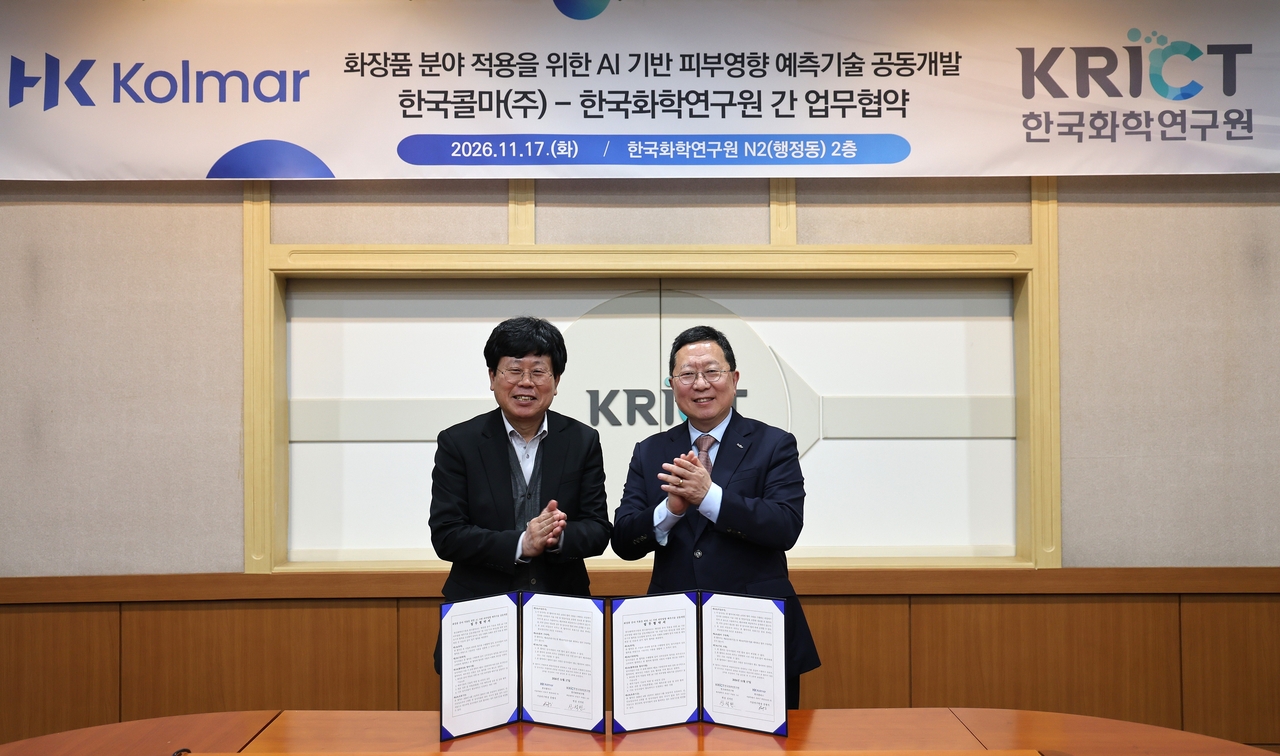
The Korea Research Institute of Chemical Technology announced Wednesday that it will jointly develop AI-based skin impact prediction technology for cosmetics with Kolmar Korea.
The two organizations signed an MOU at the institute's Daejeon campus on Tuesday, with Korea Research Institute of Chemical Technology President Shin Seok-min and Kolmar Holdings Chief Research Officer Moon Byeong-seok in attendance.
The agreement is aimed at applying the institute's AI-based toxicity prediction technology to real-world cosmetics research and development.
Cosmetics blend a wide range of chemical and natural ingredients. Even when the safety of individual components has been confirmed, predicting how a combination of ingredients will affect the skin remains a significant challenge. Accurately assessing skin sensitization and absorption characteristics is considered a core task in developing safe cosmetics.
The institute plans to build a cosmetics-specific AI model by drawing on its accumulated technology for predicting the toxicity of single substances and mixtures.
The core of the effort is technology that predicts the skin sensitization potential and absorption rates of cosmetic ingredients and mixtures before use. The AI analyzes the properties of individual components and their combinations to forecast potential skin effects, supporting researchers in reviewing safety from the earliest stages of product design.
Kolmar Korea will provide actual ingredient and formulation data gathered during the development of cosmetic raw materials and finished products. That data will be used to verify the accuracy of the AI prediction model and its applicability in industrial settings.
The two organizations had earlier tested the technology's feasibility by running Kolmar Korea's lip mask product ingredients and the institute's own naturally derived raw materials through its skin sensitization prediction model.
The joint research will focus on developing prediction models for representative cosmetic ingredients and mixtures, followed by validation using actual product formulations.
The institute believes the AI toxicity prediction technology could extend beyond cosmetics to safety assessments of a broad range of chemical products, including household chemicals, disinfectants and mold removers.
The collaboration is particularly significant in that it applies AI core technology developed by a government-funded research institute directly to private-sector product development. Once fully validated, the technology could screen for potentially hazardous ingredients in the early stages of cosmetics development and inform safety-conscious product design.
"This agreement will serve as an opportunity to apply the AI-based toxicity prediction technology we have built up to actual cosmetics research and development," Shin said. "We will work to ensure that AI core technology in the chemical field spreads into industry and contributes to the safety and quality of life of the public."
nbgkoo@heraldcorp.com