Ruling party, Defense Ministry agree on basic plan for unified National Armed Forces Academy
Main campus and graduate school to be built at Daejeon's Jaunidae; branch campuses for each service
'1+2+1' system to take effect from 2029 academic year; separate recruitment by service to continue
Defense Minister Kang: 'Train elite officers loyal to the people, ready to lead future warfare'
The Democratic Party of Korea and the government have drawn up a basic plan to establish a unified National Armed Forces Academy that would merge the Army, Navy and Air Force academies. The core of the plan is to build a main campus at Jaunidae in Daejeon while operating separate regional campuses for each service branch. Cadets would receive integrated education in their first and fourth years, with branch-specific professional training in their second and third years.
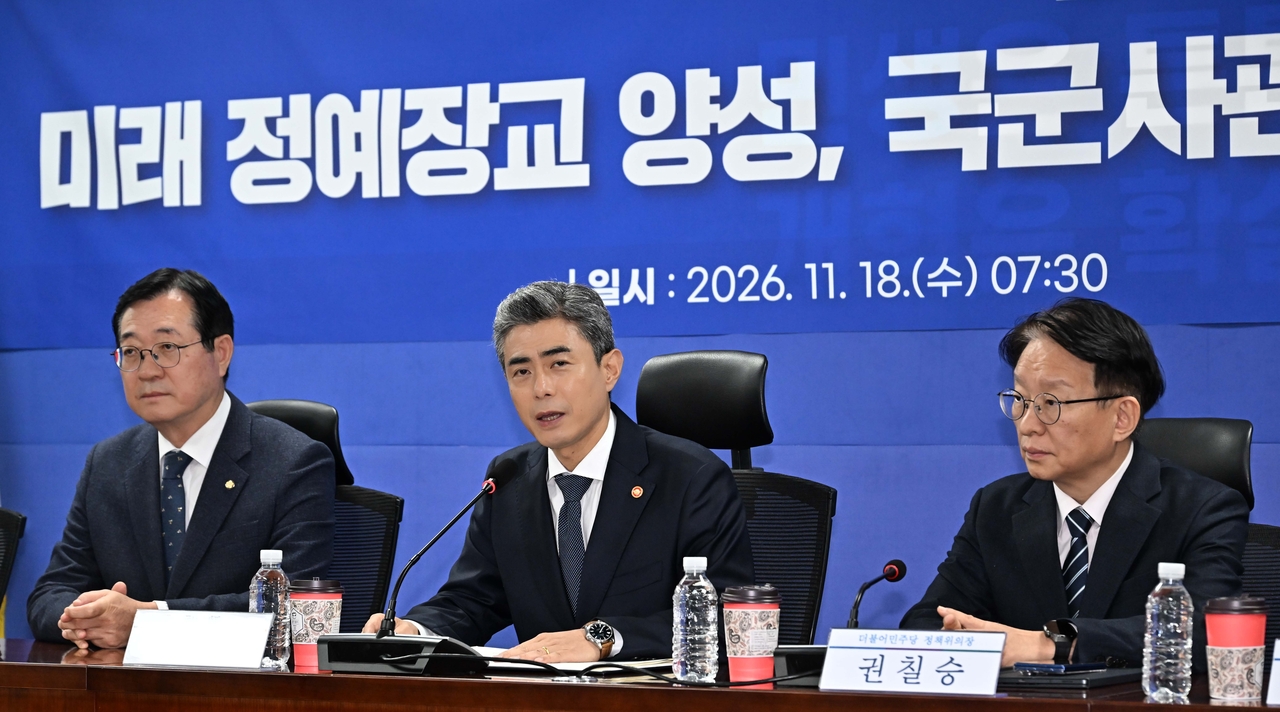
The Democratic Party and South Korea's Ministry of National Defense held a ruling party-government consultative meeting at the National Assembly on Wednesday morning under the theme "Training Elite Future Officers: Consultative Meeting on Establishing the National Armed Forces Academy," where they discussed a revised version of the basic plan. Attendees from the party included Policy Committee Chairman Kwon Chil-seung, National Assembly Defense Committee Chairman Jin Seong-jun, and lawmakers Kim Byung-joo, Min Hong-chul and Park Seon-won, while Defense Minister Kang Shin-cheol represented the government.
Rep. Kim Byung-joo briefed reporters immediately after the meeting, saying the plan sets out to train elite officers capable of leading victories in future warfare, with the main campus at Jaunidae in Daejeon to provide integrated education and a graduate school to offer master's-level programs in science, technology and strategy.
"We will establish regional campuses for each service branch to strengthen branch-specific characteristics and joint operational capabilities," Kim said. "The Army Academy will relocate to the Chungcheong region, while the Naval Academy and Air Force Academy will remain at their current locations and function as undergraduate colleges for their respective services."
The key revision to the original plan is a shift from a purely integrated education model to one that combines integrated and branch-specific training. The Defense Ministry had initially pursued a fully integrated curriculum at Jaunidae in Daejeon, but adjusted to a "1+2+1" system that balances joint education with specialized training for each service, taking into account the distinct characteristics and expertise of each branch.
Under the revised system, cadets will receive integrated education at the main campus during their first year upon enrollment and again in their fourth year before graduation. Second- and third-year instruction and summer military training will be conducted under the leadership of each respective service. The Navy's curriculum will also include specialized training tailored to Marine Corps operations such as amphibious warfare.
The new education system is set to apply to incoming students from the 2029 academic year. To minimize confusion for applicants and their families, cadet recruitment will continue to be conducted separately by each service branch, as it is now. The plan also calls for keeping the relocation of existing units stationed at Jaunidae in Daejeon — where the main campus and graduate school will be built — to a minimum.
"The goal of establishing the National Armed Forces Academy is solely to train elite officers who are loyal to the Constitution and the people, and who can lead victories in future warfare on the basis of advanced science and technology and a deep understanding of humanity," Defense Minister Kang Shin-cheol said. "We will continue to refine the details going forward, starting with today's discussions."
thanks@heraldcorp.com