Non-performing loans up 32% in nine months
Corporate sector surges 44%
All four banks exceed 1 trillion won
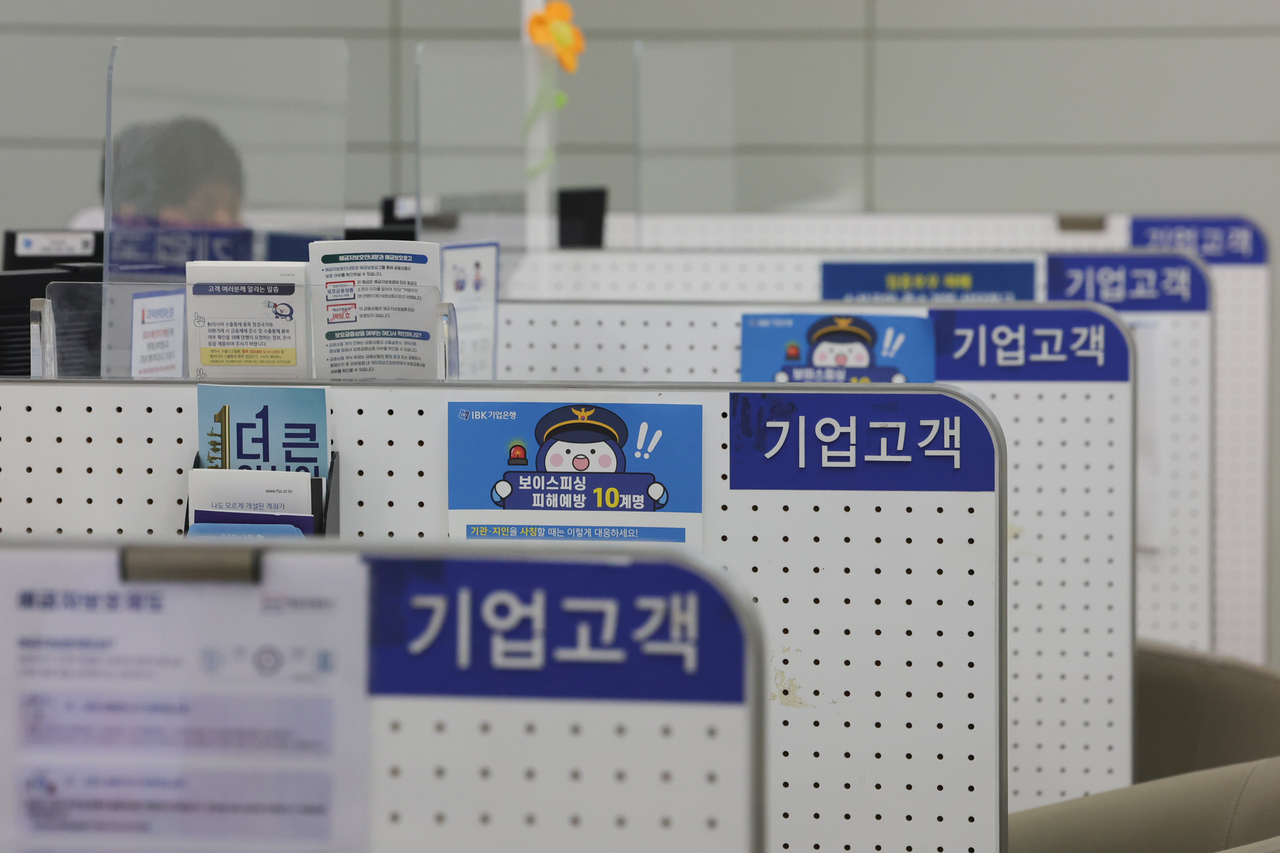
Non-performing loans at South Korea's four major commercial banks swelled by more than 1.2 trillion won ($899 million) this year, pushing the total past 5 trillion won. More than 90 percent of the increase came from corporate lending, underscoring mounting credit stress in the business sector.
According to Financial Supervisory Service electronic disclosures released Wednesday, the combined non-performing loan balance at KB Kookmin Bank, Shinhan Bank, Hana Bank and Woori Bank stood at 5.09 trillion won as of the end of September, up 32.2 percent from 3.85 trillion won at the end of last year.
Non-performing loans refer to credit extended to borrowers whose repayment capacity has deteriorated or who are behind on principal and interest payments, making it difficult for lenders to recognize interest income in the normal course of business. They are sometimes called "hollow loans" in the industry.
The four banks' non-performing loans have risen consistently, climbing from 2.28 trillion won at the end of 2022 to 2.75 trillion won at the end of 2023 and 3.18 trillion won at the end of 2024. After reaching 3.85 trillion won at the close of last year, the total crossed the 5 trillion won threshold in the third quarter of this year.
Bad loans have also grown far faster than overall lending. Total loans at the four banks rose 3.3 percent from the end of last year, while non-performing loans jumped 32.2 percent over the same period. As a result, the ratio of non-performing loans to total loans climbed from 0.26 percent to 0.33 percent.
By segment, corporate loans drove the sharpest deterioration. Corporate non-performing loans surged 44.0 percent, from 2.62 trillion won at the end of last year to 3.78 trillion won at the end of the third quarter. Household non-performing loans, by contrast, edged up just 7.0 percent, from 1.22 trillion won to 1.31 trillion won over the same period. Corporate lending accounted for 93.1 percent of the 1.24 trillion won total increase in non-performing loans.
Among the four banks, Hana Bank carried the largest non-performing loan balance at 1.65 trillion won, a 51.6 percent increase from the end of last year. Corporate non-performing loans at the bank nearly doubled, jumping 90.9 percent from 693 billion won to 1.32 trillion won.
Woori Bank's non-performing loans rose 49.3 percent, from 819.4 billion won to 1.22 trillion won. Shinhan Bank posted 1.1 trillion won, up 17.1 percent, while KB Kookmin Bank recorded 1.11 trillion won, up 11.4 percent. All four banks now carry non-performing loan balances exceeding 1 trillion won.
Hana Bank had the highest non-performing loan ratio at 0.43 percent, followed by Woori Bank at 0.35 percent, Shinhan Bank at 0.28 percent and KB Kookmin Bank at 0.26 percent. All four banks saw their ratios rise from the end of last year.
Industry analysts attribute the corporate lending deterioration in part to uneven recovery across sectors. While some industries such as semiconductors have performed well, sluggish improvement in steel and petrochemicals has increased the debt-servicing burden on a number of companies.
Meanwhile, the delinquency rate on won-denominated loans at domestic banks fell 0.10 percentage point from the previous month to 0.59 percent at the end of September, though it remained 0.07 percentage point above the level a year earlier, according to the Financial Supervisory Service. The delinquency rate on large corporate loans rose to 0.33 percent, up 0.21 percentage point from a year earlier — the highest September reading in seven years.

rim@heraldcorp.com