Nowon-Dobong-Gangbuk vs. Mapo-Yongsan-Seongdong 84㎡ price gap widens: 935m won → 1.23b won
Extra cash for debt-free couple on 100m won income: 330m won → 830m won
Mortgage cap cut by over 200m won as price gap expands

The amount of cash needed to trade up from an outer Seoul apartment to the Han River belt has grown by about 500 million won ($373,000) in just 16 months since the government tightened lending rules, an analysis shows. A widening gap in apartment prices combined with a shrinking mortgage ceiling has raised the bar for moving into more sought-after neighborhoods.
An analysis of median sale prices by district registered on the Ministry of Land, Infrastructure and Transport's actual transaction price system shows that the median transaction price for 84-square-meter apartments — the standard "national unit" size — in Nowon, Dobong and Gangbuk-gu edged down from 750 million won in May last year, just before the government clamped down on lending with its June 27 measures, to 735 million won in September this year. Over the same period, the median price for the same unit size in Mapo, Yongsan and Seongdong-gu rose 275 million won, from 1.69 billion won to 1.96 billion won.
The median price gap between the two areas widened by 290 million won — from 935 million won to 1.23 billion won — significantly increasing the amount needed to make the move from the outer districts to the Han River belt.
The actual cash burden is even heavier. In May last year, mortgage limits were determined by a borrower's income and repayment capacity, but subsequent government measures capping total loan amounts and applying tiered limits by property price have reduced how much buyers can borrow outright.
Under the June 27 lending rules announced last year, the government capped mortgages for home purchases in the greater Seoul area and regulated zones at 600 million won, effective the following day. From July 1, the third phase of the stress-based debt service ratio took effect, raising the stress rate applied to variable-rate mortgages from banks in the greater Seoul area from 1.2 percent to 1.5 percent.
In October last year, the government's Oct. 15 measures further cut mortgage limits to 400 million won for homes priced between 1.5 billion and 2.5 billion won, and to 200 million won for homes above 2.5 billion won. The stress rate for mortgages in the greater Seoul area and regulated zones was also raised to 3.0 percent.
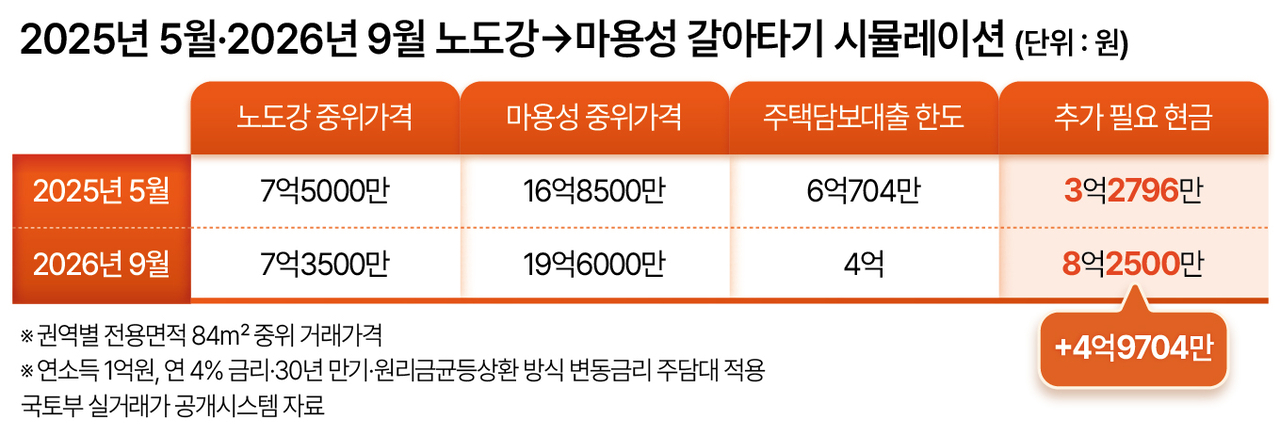
Factoring in these regulatory changes, the actual financing burden is considerably larger. A simulation modeled a debt-free couple with an annual income of 100 million won selling their existing home and buying a new one — in May last year before the lending curbs and again in September this year — using the median transaction price for 84-square-meter units in each area, with a variable-rate mortgage at 4 percent annual interest, a 30-year term and equal principal-and-interest repayments.
As a result, the additional cash required to sell an existing apartment in the Nowon-Dobong-Gangbuk area and move to the Mapo-Yongsan-Seongdong area rose from 327.96 million won in May last year to 825 million won in September this year, an increase of about 497.04 million won. Transaction costs such as acquisition tax and brokerage fees were excluded. While the median price gap between the two areas widened by 290 million won, the available mortgage shrank by more than 200 million won — from about 607.04 million won in May last year to 400 million won in September this year.

Market watchers say the tiered mortgage caps tied to property prices could increasingly restrict residential mobility. The median price for 84-square-meter apartments in the three Gangnam-area districts — Gangnam, Seocho and Songpa-gu — rose 29.5 million won from 2.47 billion won in May last year to 2.5 billion won in September this year. If prices continue climbing past 2.5 billion won, more apartments in those areas would fall under the tighter 200 million won mortgage cap rather than the 400 million won limit, leaving prospective movers with even less borrowing power.
Yang Ji-young, a senior adviser at Shinhan Premier Pathfinder, said tighter lending rules have made it harder to trade up even as home prices have risen. "The wait-and-see mood is strengthening and more people are choosing to stay put in their current homes," Yang said, adding that market shifts could emerge in Gangnam as tax reform details are finalized, while outer districts may respond to future moves in interest rates.

shy@heraldcorp.com