Keynote address at 2026 IIAS World Congress in Seoul
'Economic growth has compounded social problems — government intervention alone cannot solve them'
'We should appeal to self-interest, the capitalist way'
SK Group research shows incentivized firms created three times more social value
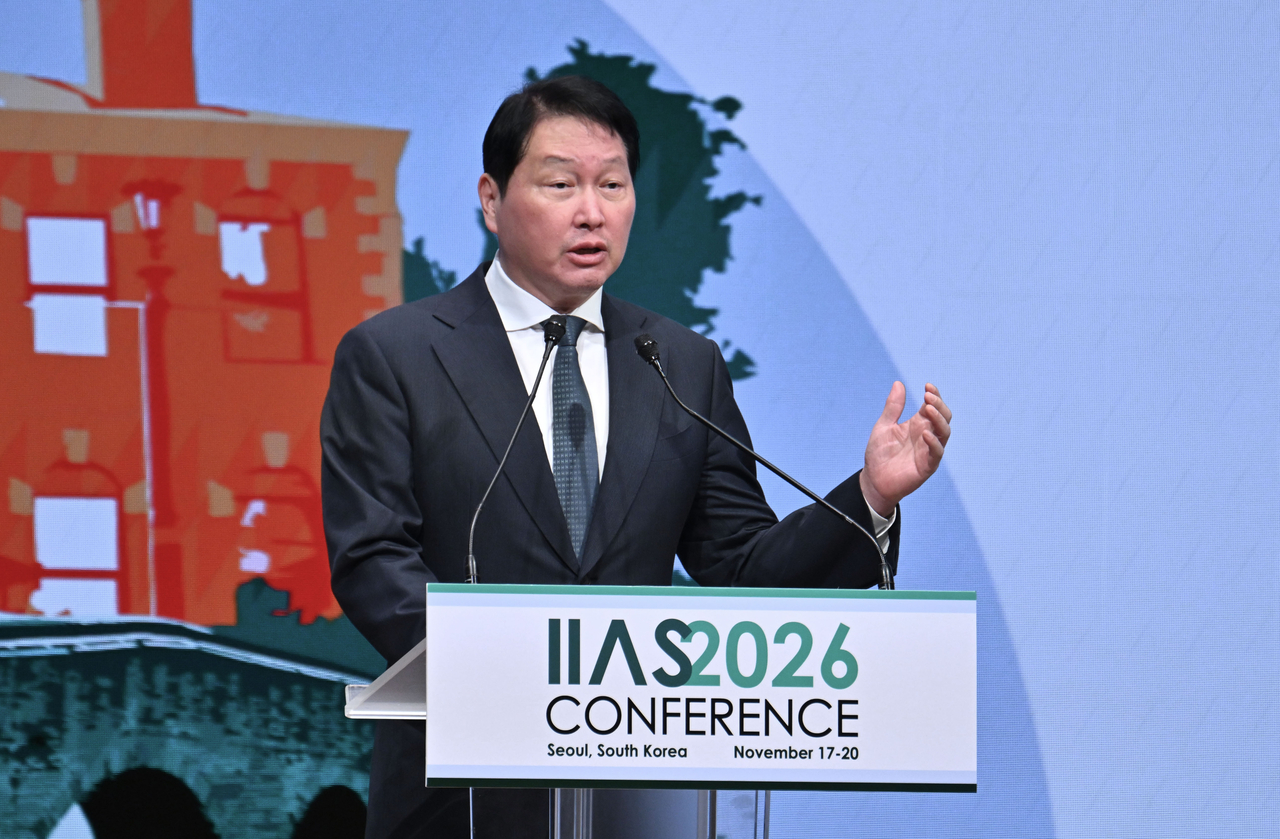
Korea Chamber of Commerce and Industry Chairman Chey Tae-won proposed Wednesday that entities solving social problems should receive cash-based incentives, and said advances in AI have made it possible to both generate and measure social value with far greater precision.
Chey delivered the keynote address at the opening ceremony of the 2026 International Institute of Administrative Sciences World Congress in Seoul, held at the Korea Chamber of Commerce and Industry's international conference hall under the theme "Growth for Society: Collaborative Governance, Social Innovation and Social Value." The event opened with remarks from IIAS President Srinivas Boruganty, followed by congratulatory speeches from National Assembly Speaker Jo Jeong-sik, Interior and Safety Minister Yun Ho-jung and Korea Development Institute for Economy and Society Chairman Lee Han-ju.
Chey introduced the concept of a "social progress credit" — a performance-based financing model in which the social value created by an individual or group is measured in monetary terms and rewarded with cash incentives proportional to that output. He argued the approach could draw more participants into solving social problems.
Noting that social problems have accumulated alongside economic growth, Chey said, "Until now, we have relied on altruistic people — such as those in NGOs — to address social issues, yet the cost burden on society has not decreased."
"The question then became: why not tackle social problems by appealing to self-interest, the capitalist way?" he said. "If we provide incentives that encourage more people to participate in solving social problems, participation will inevitably increase."
Chey also shared findings from SK Group's decade-long experiments in measuring social value. An analysis of 468 companies that participated in the social progress credit program over the past 10 years found that firms receiving incentives created on average about three times more social value than those that did not, and posted average sales 34 percent higher. Employment and production multiplier effects were also up to twice as high compared with conventional approaches. Seoul, Jeju and North Jeolla Province have incorporated performance-based social compensation into local ordinances, signaling the model's spread to regional governments.
Chey said applying AI to social problem-solving could maximize efficiency. "Ten years ago, measuring social value was so difficult that we had to visit each company individually, but now we can receive results far more quickly," he said. "This also allows us to measure outcomes after the fact rather than providing support upfront, enabling much more effective allocation of resources."
He argued that scaling up this performance-reward model could generate broad economic benefits, including new jobs. "If we measure social value in economic terms, we can build sustainable capitalism in the social sector and create entirely new occupations that have never existed before," Chey said.
He added that SK Group had persuaded multiple local governments to adopt the methodology over its 10-year experiment, and that many governments were already using it to address social problems more quickly. "However, this is not a problem that one person or one sector can solve alone — more people need to get involved," he said.
klee@heraldcorp.com