Exports and investment boom on AI spending surge
Current account surplus seen hitting $601.3 billion next year
Semiconductor dependence raises growth volatility concerns
The Korea Development Institute (KDI) raised its South Korean GDP growth forecast for this year to 3.8% from 3.2%, reflecting a semiconductor export boom and strong capital investment fueled by surging global AI infrastructure spending.
The state-run research institute also lifted its growth outlook for next year to 3.9% from 2.2%. However, it warned that South Korea's growing dependence on semiconductors could significantly amplify growth volatility depending on the trajectory of global AI investment.
KDI presented the revised GDP growth forecast of 3.8% — up 0.6 percentage points from its August projection — in its second-half 2026 economic outlook released Wednesday. The figure marks the institute's second consecutive upward revision, following an earlier adjustment from 2.5% in February to 3.2% in August. KDI also raised its growth forecast for next year by 1.7 percentage points to 3.9%.
The 2026 forecast of 3.8% falls below the IMF's projection of 3.9% but exceeds those of the OECD (3.7%), the National Assembly Budget Office (3.5%) and the Bank of Korea (3.3%). The 2027 forecast of 3.9% comfortably surpasses existing projections from the IMF (3.3%), the Bank of Korea (2.9%) and the OECD (2.6%).
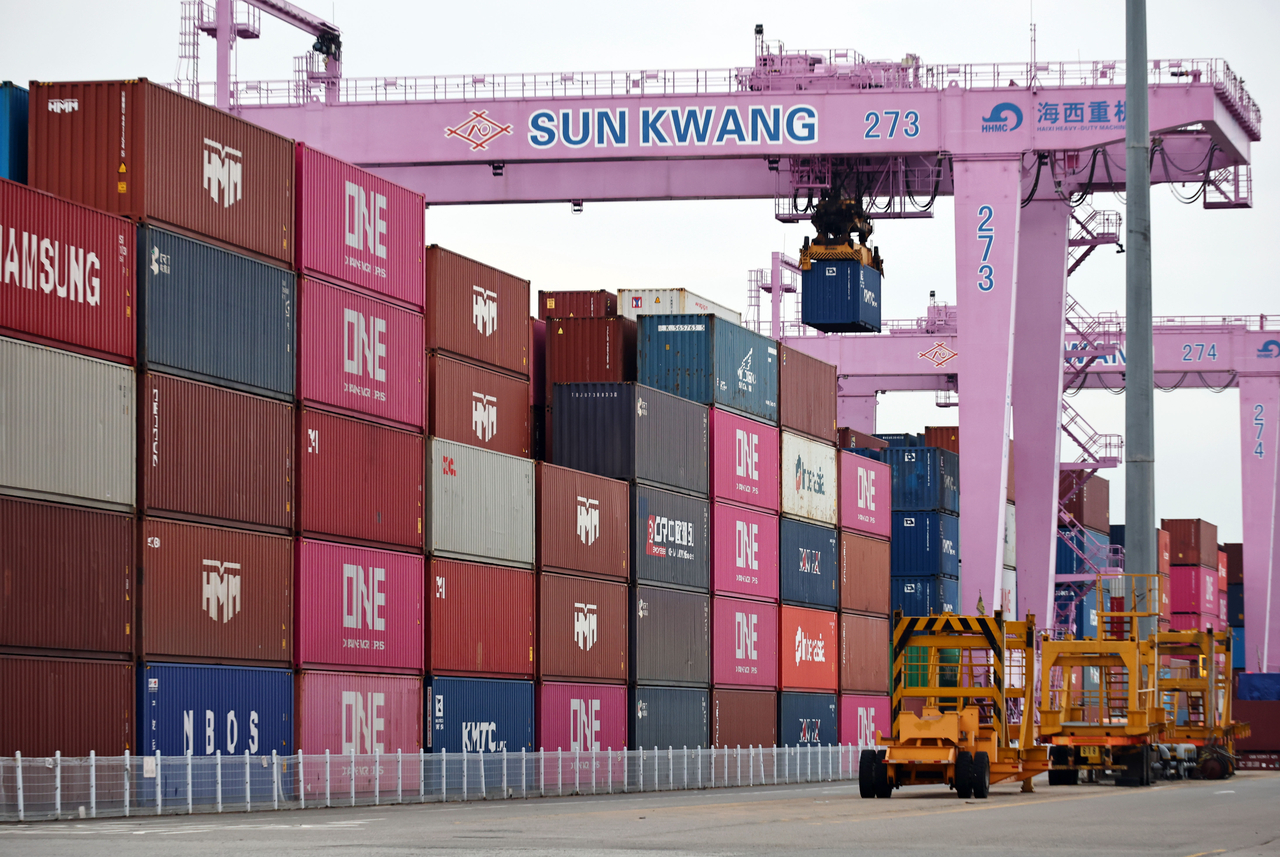
The primary driver behind the upward revisions is the semiconductor boom. KDI said large-scale AI infrastructure investment by major economies has kept exports of semiconductors and related products on a strong growth trajectory, while also supporting robust capital spending.
KDI projected total export volume to grow 10.3% this year compared with last year, with capital investment rising 8.7%. Private consumption growth, however, is expected to remain modest at 1.8%, while construction investment is forecast to hold roughly flat with last year's level.
For next year, KDI projected both total export volume and capital investment to each grow 8.1%. Demand for semiconductors and AI infrastructure-related products will remain elevated, the institute said, while domestic investment expansion will also boost production capacity.
Strong exports and improving terms of trade are expected to sustain a large current account surplus. KDI estimated the surplus at $516.2 billion this year, rising to $601.3 billion next year, underpinned by robust external demand for semiconductors and other AI infrastructure-related goods.
Private consumption and construction investment are also expected to improve next year. The private consumption growth rate is forecast to rise from 1.8% this year to 2.4% next year, as stable international oil prices allow the income gains from the semiconductor boom to gradually filter through to households.
Construction investment is projected to grow 2.5% next year, recovering from its current slump on the back of non-residential building activity — including semiconductor factories — and related plant construction.
KDI cautioned, however, that private consumption is improving more slowly than the broader economy. The income gains from the semiconductor boom have had limited spillover effects, and persistently high inflation continues to constrain household spending capacity.
Employment conditions are expected to improve gradually. The number of employed workers is forecast to rise by 120,000 this year compared with last year, with the increase widening to 200,000 next year. KDI noted, however, that employment among youth in their 20s remains weak.
Consumer price inflation is projected to ease from 2.7% this year to 2.4% next year. Core inflation, however, is expected to come in at 2.5% next year, as demand-side price pressures build alongside improving private consumption, even as international oil prices fall.
Given the delayed return to price stability, KDI recommended that monetary policy maintain its tightening stance. On fiscal policy, the institute said spending expansion should be managed flexibly in line with economic and price conditions to avoid adding to inflationary pressures.
KDI identified growing semiconductor dependence and the resulting amplification of growth volatility as a key downside risk to the South Korean economy going forward.
According to KDI, the share of value added by the computer, electronics and optical equipment manufacturing sector — which includes semiconductors — in nominal GDP surged from an average of 7.5% between 2022 and 2025 to 20.7% in the first half of this year. As a result, swings in that sector's output are expected to have a significantly larger impact on overall GDP growth next year.
KDI warned that a rapid contraction in global AI infrastructure investment — whether from delays or cutbacks in US data center construction or a deterioration in borrowing conditions for major firms — could cause South Korea's growth rate to fall sharply. Conversely, improved profitability among leading AI companies or faster-than-expected expansion of domestic semiconductor production capacity could push growth above its forecast, it said.
KDI also flagged the risk that escalating tensions in the Middle East could disrupt energy supply, raising production costs for businesses and delaying a recovery in household consumption. It further noted that if high stock market volatility persists into next year, it could weigh on private consumption.
y2k@heraldcorp.com