First test bed opens Wednesday at Jeonju campus with 10 billion won investment; 8 more sites to follow next year with 24 billion won
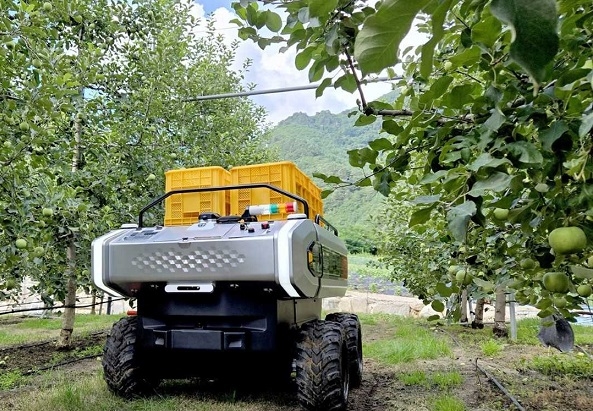
The government is building "physical AI test beds" — integrated training facilities that combine AI and robotics to simulate the full production chain from crop cultivation and harvesting to product packaging and logistics.
A total of 10 billion won ($7.47 million) will be invested this year to set up hands-on training facilities at four Korea Polytechnics campuses nationwide, with 24 billion won earmarked for eight additional sites next year. The initiative aims to help small and medium-sized enterprises in regional areas that lack the resources to adopt AI on their own, while training the skilled workers those industries need.
The Ministry of Employment and Labor and the Korea Polytechnics Foundation held an opening ceremony Wednesday for the first physical AI test bed at the New Technology Education Center in Jeonju, North Jeolla Province. About 100 people attended, including Korea Polytechnics Chairman Lee Cheol-su, officials from the Labor Ministry, North Jeolla Province and Jeonju city, and representatives from local businesses.
Physical AI refers to technology in which artificial intelligence is integrated with physical devices such as robots and machinery to perceive the surrounding environment, make decisions and carry out real-world tasks. Unlike conventional AI, which focuses on data analysis and information processing, physical AI operates directly on industrial floors — in manufacturing plants, farms and logistics warehouses.
The government is using the 10 billion won this year to build physical AI test beds at four Korea Polytechnics campuses — in Jeonju, Seongnam, Changwon and Cheongju — each linked to the growth industries of its region. Jeonju specializes in smart farming, Seongnam in biotech, and Changwon in manufacturing and logistics.
The Jeonju test bed, which opened Wednesday, connects three zones — smart farm, manufacturing and logistics — into a single integrated production process.
In the smart farm zone, vision AI learns to monitor crop growth and supports cultivation. At the harvesting stage, robots collect crops from the smart farm; in the manufacturing zone, AI inspects, sorts and automatically packages the products. Autonomous mobile robots and humanoid robots then handle loading and shipping in the logistics zone.
The entire sequence — from crop production to final dispatch — is managed through a digital-twin-based integrated control platform, replicating what the industry calls a "farm-to-table" workflow. Trainees can observe the equipment in operation and learn how AI makes decisions and executes tasks on an actual production floor.
The test bed is open not only to Korea Polytechnics students but also to local small and medium-sized enterprises, universities and vocational training institutions. Workers from regional companies can learn AI technology in an environment that closely mirrors real production processes, while businesses can assess which technologies are applicable to their own operations.
The broader goal is to accelerate AI transformation among regional small and medium-sized enterprises while producing technicians capable of installing, operating and maintaining robots on the factory floor.
The Jeonju test bed is also tied to the agri-biotech sector, which has been designated as a key growth engine for North Jeolla Province. The plan is to use AI to bridge the region's core industries of agriculture and manufacturing, raise their competitiveness, and channel the trained workforce into jobs at local companies.
The government plans to expand the physical AI test bed program next year. It will invest 24 billion won to add eight more facilities, creating a nationwide network of physical AI training hubs. Combined with the four sites being built this year, the network will reach 12 locations across the country by the end of next year.
A Ministry of Employment and Labor official said the government plans to invest 24 billion won next year to install eight additional test beds and establish a nationwide network of physical AI training hubs. "Building the facilities well is important, but what matters just as much is making sure they are actually used in ways that benefit local businesses," the official said, adding that the government and Korea Polytechnics would work together to ensure the test beds become genuine regional anchors for AI transformation among small and medium-sized enterprises.
Korea Polytechnics Chairman Lee Cheol-su said physical AI is a technology that comes to life on the factory floor, the farm and in the warehouse. "You need technicians who can install, repair and teach robots — only then does AI transformation truly take root on the ground," Lee said. "Korea Polytechnics will be the closest place to the field where those people are trained."
fact0514@heraldcorp.com