Ministry of Statistics releases 2026 Social Survey results
Rural satisfaction at 67.4% outpaces urban 54.3%; green space scores highest at 64.2%
Fine dust anxiety falls from 67.4% to 59.6% but remains top environmental concern
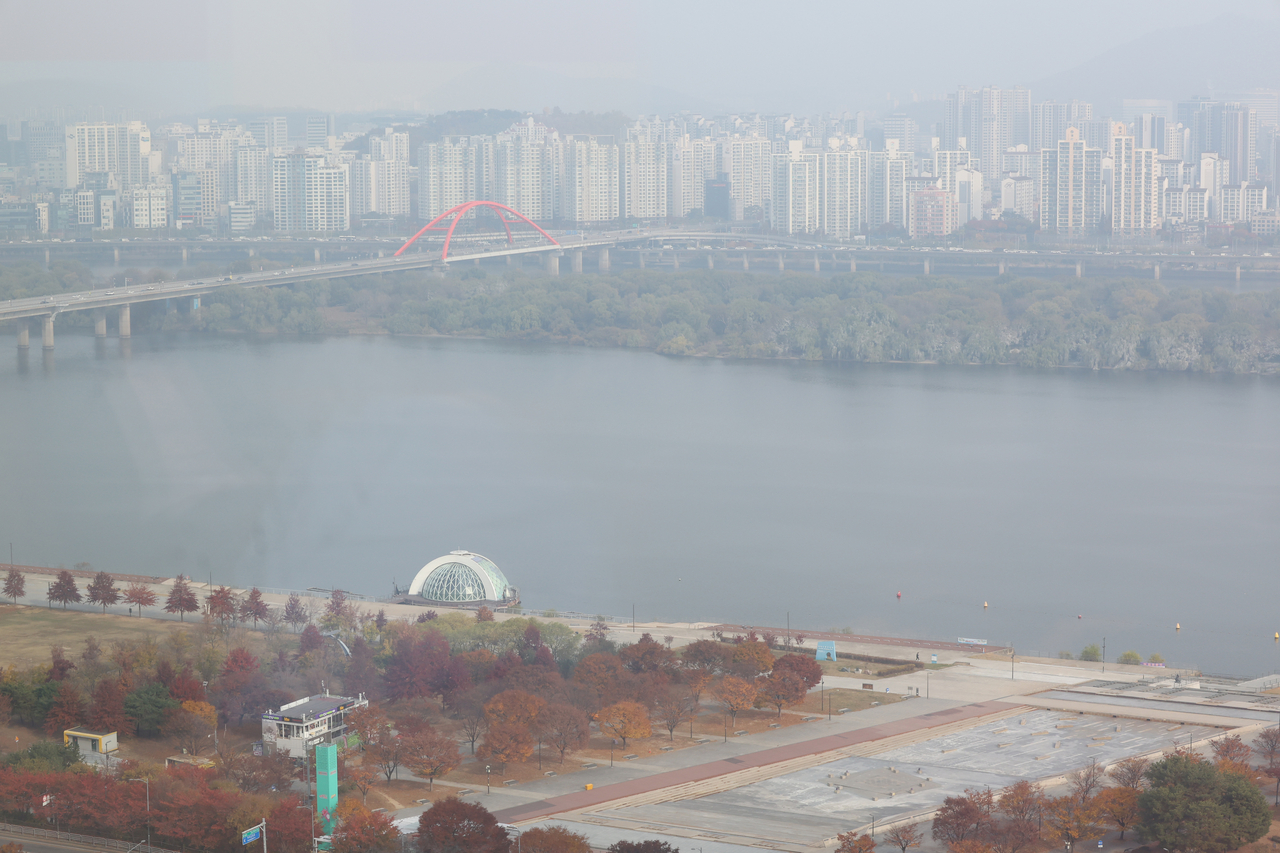
More than half of South Koreans gave a positive rating to the living environment in their area, according to a government survey released Wednesday.
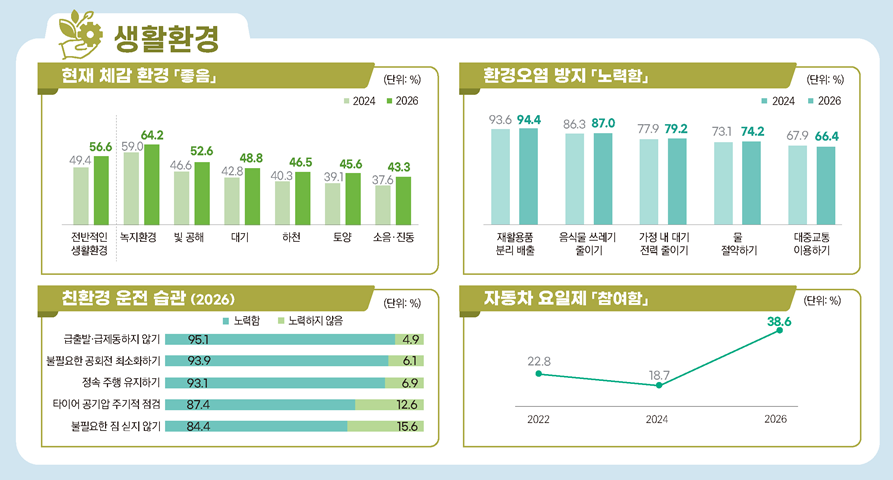
The Ministry of Statistics' "2026 Social Survey" found that 56.6 percent of residents aged 13 and older rated their overall local living environment as good — up 7.2 percentage points from 49.4 percent in 2024. Satisfaction improved across all categories, including air quality, waterways and green spaces, though nearly six in 10 people still said they felt anxious about fine dust. Positive assessments were higher in rural areas than in cities, and fewer than half of respondents said they were willing to pay additional costs for environmental protection.
Among those who rated their environment positively, 15.9 percent said it was "very good" and 40.7 percent said it was "somewhat good." The share rating their environment as poor fell to 5.2 percent, down 2.1 percentage points from 7.3 percent two years ago.
The gap between urban and rural areas was pronounced. Positive ratings for the living environment in rural and fishing communities reached 67.4 percent, outpacing the urban figure of 54.3 percent by 13.1 percentage points. The share rating their environment as poor stood at 5.6 percent in cities and 3.7 percent in rural areas.
Satisfaction rose across all individual subcategories as well.
Green spaces — including parks and street trees — drew the highest satisfaction, with positive ratings climbing 5.2 percentage points to 64.2 percent from 59.0 percent in 2024. Satisfaction with light pollution from streetlights and neon signs rose 6.0 percentage points to 52.6 percent. Air quality satisfaction increased 6.0 percentage points to 48.8 percent from 42.8 percent, while satisfaction with waterway environments rose 6.2 percentage points to 46.5 percent. Satisfaction with soil contamination from waste improved 6.5 percentage points to 45.6 percent.
Positive ratings for noise and vibration also climbed 5.7 percentage points to 43.3 percent, though this subcategory still recorded the lowest score among all items surveyed, pointing to continued room for improvement.
Rural areas outscored cities on most individual environmental measures.
Positive ratings for green spaces reached 74.3 percent in rural areas, compared with 62.0 percent in cities — a gap of 12.3 percentage points. For air quality, the rural figure was 65.0 percent against 45.4 percent in cities, a difference of 19.6 percentage points. Rural residents also rated noise and vibration more favorably at 56.8 percent, versus 40.5 percent for urban residents, a gap of 16.3 percentage points. Satisfaction with light pollution environments stood at 66.2 percent in rural areas and 49.6 percent in cities.
The share of people who believed their living environment had improved over time also grew.
Some 42.5 percent of respondents said their living environment had improved compared with five years ago, up 5.9 percentage points from the 2024 survey. Looking ahead, 46.1 percent expected conditions to improve over the next five years, while 10.8 percent anticipated a deterioration.
Despite the broader improvement in perceptions, anxiety about environmental pollution remained elevated.
Fine dust was the environmental issue that worried people most. Some 59.6 percent of respondents said they felt anxious about fine dust — down 7.8 percentage points from 67.4 percent in 2024, but still close to six in 10 people. Of those, 18.8 percent said they were "very anxious" and 40.7 percent said they were "somewhat anxious." Only 14.1 percent said they were not anxious.
Anxiety was particularly high among people in their 30s, 40s and 50s. Those in their 30s recorded the highest rate at 64.6 percent, followed closely by those in their 40s at 64.4 percent and those in their 50s at 64.3 percent. By contrast, only 44.1 percent of respondents aged 13 to 19 expressed anxiety about fine dust.
Women reported fine dust anxiety at 63.0 percent, 6.9 percentage points higher than men at 56.1 percent. Urban residents expressed more anxiety at 60.7 percent, compared with 54.2 percent among rural residents.
Climate change ranked second among environmental concerns after fine dust.
Anxiety about climate change — including heat waves and flooding — fell 7.0 percentage points to 46.2 percent from 53.2 percent in 2024. Concern about hazardous chemicals dropped 7.5 percentage points to 34.4 percent from 41.9 percent, while anxiety about radiation fell 13.6 percentage points to 33.9 percent from 47.5 percent. Worry about pesticides and chemical fertilizers declined to 30.9 percent from 36.9 percent, and anxiety about tap water fell to 19.7 percent from 26.3 percent.
While anxiety eased across all environmental categories surveyed, concern about fine dust and climate change remained comparatively high.
Views on bearing the cost of environmental protection were mixed. The share of respondents willing to pay additional taxes or levies for environmental protection slipped 0.5 percentage points to 49.7 percent from 50.2 percent in 2024 — falling just short of a majority even as overall environmental anxiety declined.
fact0514@heraldcorp.com