Ministry of Statistics releases 2026 social survey results
74.6% cite good job as top reason for studying; high schoolers at 76.5%
School life satisfaction falls from 57.3% to 55.5%; peer relations score highest at 71.7%
57% of households feel burdened by education costs; 71.7% cite out-of-school expenses as biggest strain
Three in four middle and high school students in South Korea study primarily to secure a good job, while fewer than one in five say they study because they genuinely enjoy learning, according to a government survey released Wednesday. The share of students satisfied with their school life also declined from two years ago.
Although the proportion of households reporting that children's education costs strain the family budget fell slightly, it still exceeded half. Academic competition for employment and the financial burden of education costs remain defining features of the country's education landscape.
According to the 2026 Social Survey results released Wednesday by the Ministry of Statistics, 74.6% of middle and high school students said they study "to get a good job or career" — the highest share among all listed motivations.
By school level, high schoolers recorded 76.5%, outpacing middle schoolers at 72.5% by 4.0 percentage points. The gap suggests that students increasingly connect academic effort to future employment as they approach the job market.
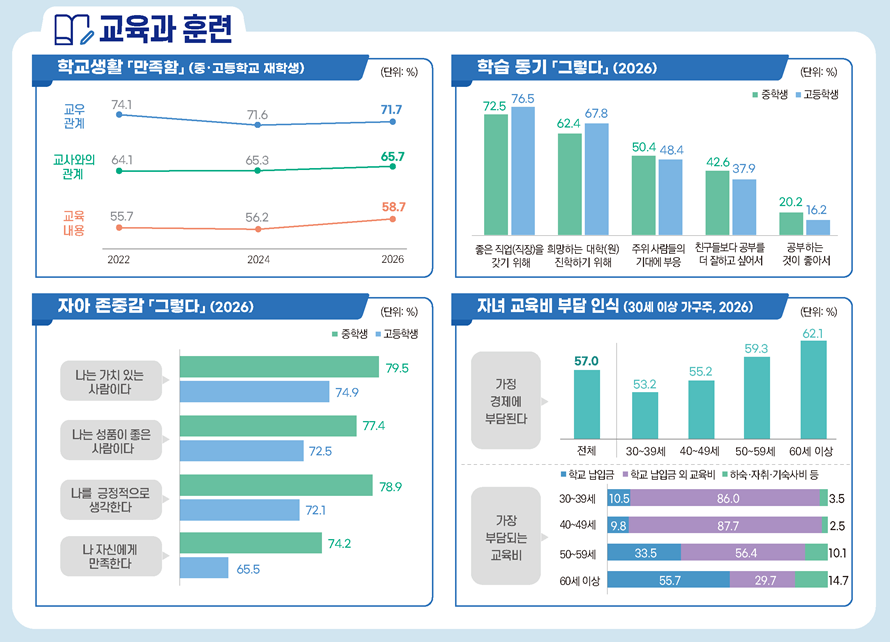
The second most common motivation was getting into a desired university or graduate school, cited by 65.3% of respondents — 67.8% among high schoolers and 62.4% among middle schoolers.
Then came "to meet the expectations of parents, teachers and those around me" at 49.4%, followed by "to do better academically than other students" at 40.0%.
By contrast, "because I enjoy studying" was limited to 18.1%. The figure was lower among high schoolers at 16.2% than among middle schoolers at 20.2%.
The gap between those who study to land a good job (74.6%) and those who study out of genuine interest (18.1%) stood at 56.5 percentage points. However, because the survey asked about each motivation separately, the two responses are not mutually exclusive.
Students' satisfaction with school life fell compared with two years ago.
The share of middle and high school students who said they were satisfied with school life overall was 55.5%, down 1.8 percentage points from 57.3% in 2024. The share reporting dissatisfaction rose 1.6 percentage points over the same period, from 5.9% to 7.5%.
Among specific aspects of school life, peer relationships drew the highest satisfaction at 71.7%, followed by relationships with teachers (65.7%), curriculum content (58.7%), school facilities (56.4%), the surrounding school environment (54.3%) and teaching methods (52.2%).
Students expressed relatively high satisfaction with their relationships with peers and teachers, while satisfaction with teaching methods and the surrounding school environment ranked comparatively low.
The tendency to link academic study to future employment was also reflected in students' expectations of higher education.
Among students who said they hoped to pursue a university degree or higher, 58.5% cited "to get a good job" as their reason — the highest share. "To develop my abilities and talents" came second at 31.9%. The results point to a strong perception of higher education as a path to employment.
The burden of children's education costs on household finances remained significant.
Among heads of household aged 30 or older with school-age children, 57.0% said education costs were a financial strain — down 3.9 percentage points from 2024, but still close to six in 10.
Particularly among those who felt burdened, 71.7% identified out-of-school education expenses as their biggest cost, compared with 22.0% for school tuition and fees and 6.3% for boarding, rent or dormitory costs.
The share citing out-of-school education expenses as the heaviest burden reached 86.0% among heads of household in their 30s and 87.7% among those in their 40s — age groups most likely to have children in primary or secondary school, where spending on private education outside the classroom weighs particularly heavily.
Among heads of household aged 60 or older who reported feeling burdened by education costs, however, 55.7% pointed to school tuition and fees as their biggest expense, likely reflecting the cost of university or graduate school enrollment for their children.
fact0514@heraldcorp.com