Ministry of Statistics releases 2026 Social Survey results
Share viewing society as safe rises 8.9 percentage points in two years to 37.8%
61.0% say personal data leaks unsafe; 42.1% flag cybersecurity concerns
Crime tops list of social anxieties at 22.4%; 42.1% of women fear walking alone at night
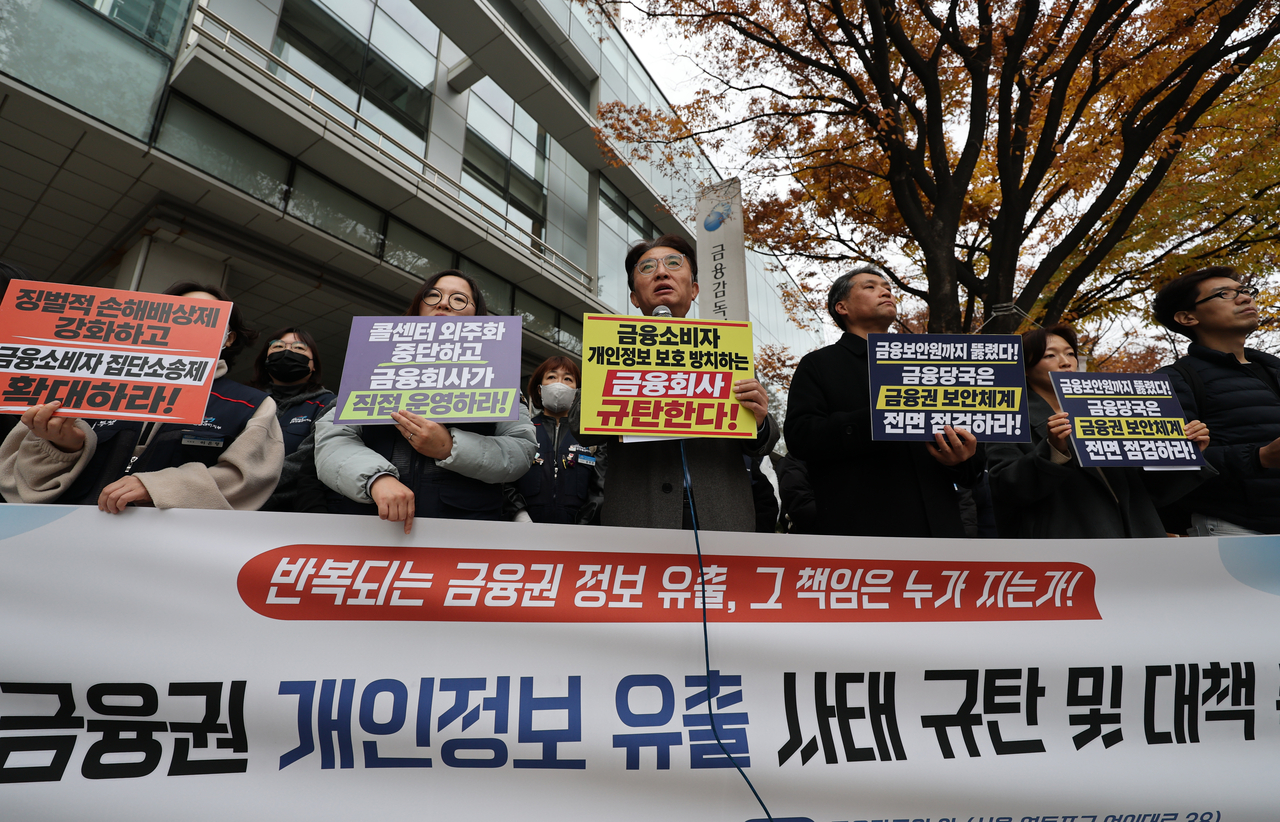
The share of Koreans who consider their society safe has grown significantly over the past two years, but anxiety over digital security — including personal data leaks and hacking — remains high, a new government survey shows. While the proportion viewing society as broadly safe has nearly tripled over the past decade, six in 10 people still say they feel unsafe about personal data protection.
According to the 2026 Social Survey released Wednesday by the Ministry of Statistics, 37.8% of Koreans aged 13 and older said they consider society generally safe, up 8.9 percentage points from 28.9% in 2024.
The share of respondents viewing society as safe climbed steadily from 13.2% in 2016 to 20.5% in 2018, 31.8% in 2020 and 33.3% in 2022, before dipping to 28.9% in 2024. This year's reading of 37.8% marks the highest level recorded since the survey began tracking the figure in 2016, representing a 24.6-percentage-point increase from a decade ago.
Conversely, the share of respondents who said society is unsafe fell 6.8 percentage points to 18.8% this year from 25.6% in 2024. Another 43.3% said conditions were average.
Despite the overall improvement in safety perceptions, assessments varied sharply by type of risk.
Food security drew the highest share of "safe" responses at 51.4%, followed closely by food hygiene at 51.0%. National security came in at 49.0%, structural and facility safety at 47.0%, and natural disasters at 45.5%.
Sentiment was far more negative on personal data protection and cybersecurity.
Some 61.0% of respondents said they feel unsafe about personal data leaks — 22.0% said "not safe at all" and 39.0% said "relatively unsafe." Only 13.1% said they feel safe from data breaches.
On computer viruses and hacking, 42.1% said they feel unsafe, compared with 23.4% who said they feel safe — a gap of 18.7 percentage points favoring negative assessments.
Concern about crime was also pronounced. Some 39.5% of respondents said they feel unsafe regarding crimes such as kidnapping, murder, robbery and sexual violence, outpacing the 26.6% who said they feel safe by 12.9 percentage points.
Anxiety over emerging infectious diseases also ran high, with 34.6% saying they feel unsafe — above the 27.0% who said they feel safe.
The results suggest that even as overall safety perceptions have improved, anxieties about specific risks — including personal data leaks, cybersecurity and crime — persist.
The share of Koreans who believe society has become safer than in the past also grew.
Some 34.9% said society is safer now than five years ago, up 13.0 percentage points from 21.9% in the 2024 survey. Looking ahead, 34.7% said they expect society to be safer five years from now, up 11.8 percentage points from 22.9% two years ago.
However, 24.0% said they expect society to become more dangerous over the next five years. By age group, respondents in their 50s were most optimistic, with 42.2% expecting greater safety, while those in their 30s were most pessimistic, with 25.6% anticipating greater danger.
Crime was identified as the single biggest threat to social safety.
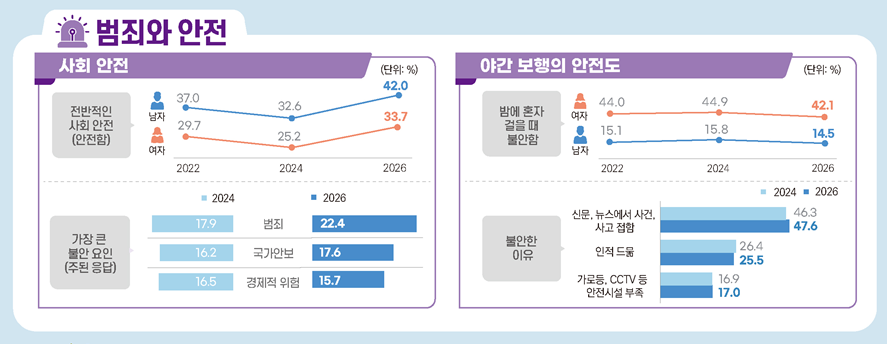
Some 22.4% of respondents named crime as their top source of anxiety, up 4.5 percentage points from 17.9% in 2024. National security rose 1.4 percentage points to 17.6%, and human-caused disasters climbed 1.5 percentage points to 9.5%.
Economic risk fell slightly, with 15.7% naming it as their top concern, down 0.8 percentage points from 16.5%. Environmental pollution dropped from 10.0% to 6.8%, and emerging diseases fell from 7.9% to 6.2%.
Men and women differed in their top anxieties. Among men, national security ranked highest at 19.4%, followed by crime at 17.4% and economic risk at 17.3%. Among women, crime topped the list at 27.4% — a full 10.0 percentage points higher than among men.
Perceptions of nighttime safety improved overall, but a significant gender gap persisted.
Some 71.6% of respondents said they feel safe walking alone at night, up 2.1 percentage points from 69.5% in 2024 and 12.5 percentage points higher than the 59.1% recorded in 2016.
Among women, however, 42.1% said they feel unsafe walking alone at night — about 2.9 times the 14.5% figure among men. That means more than four in 10 women feel anxious about walking alone after dark.
The most commonly cited reason for nighttime anxiety was exposure to crime and accident reports in the news, at 47.6%. That was followed by a lack of foot traffic (25.5%), insufficient safety infrastructure such as streetlights and closed-circuit television cameras (17.0%), and inadequate policing (6.8%).
Assessments of public order compliance also improved broadly. Queuing was rated the most well-observed norm at 82.8%, followed by yielding priority seats on public transit (69.8%) and pedestrian order (67.1%).
Positive assessments of compliance with no-smoking zones held steady at 54.2%, unchanged from two years ago. Keeping quiet in public spaces scored 58.8%, driver traffic compliance 58.7%, and maintaining clean street environments 57.6%.
fact0514@heraldcorp.com