Main campus and graduate school at Jajundae in Daejeon; Army academy to relocate to Chungcheong region; Navy and Air Force academies to stay put
New system takes effect for 2029 entering class; cadet survey results to inform only curriculum and facilities
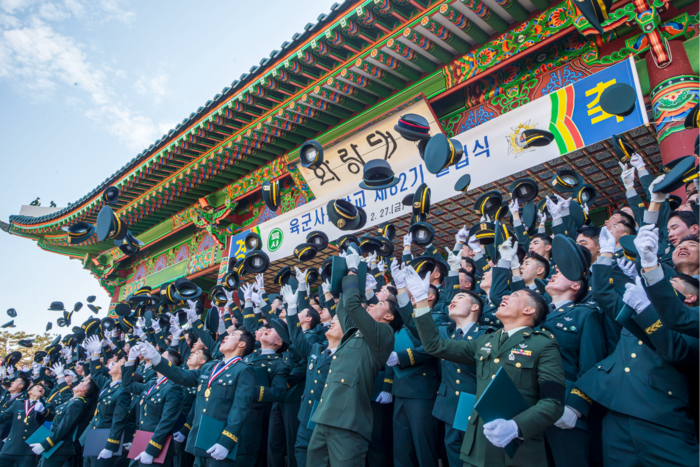
South Korea's Ministry of National Defense has revised its plan to consolidate all three military service academies at Jajundae in Daejeon, just four months after announcing the original proposal. Under the updated "network-type" model, a unified main campus and graduate school will be established at Jajundae, while branch campuses for each service handle service-specific training. The Navy and Air Force academies will remain at their current locations, and only the Army academy will relocate to the Chungcheong region. The names Korea Army Academy, Korea Naval Academy and Korea Air Force Academy will be retired — replaced by a single institution called the Korea Military Academy.
A Defense Ministry official announced the revised plan Wednesday, saying the school would be called the Korea Military Academy and that the individual service academy names would no longer be used. "The broad outline is finalized," the official said. "The network-type structure and the establishment of a graduate school have been decided."
The education framework will shift from the existing "2+2" model — in which first- and second-year cadets receive joint instruction and third- and fourth-year cadets train separately by service — to a "1+2+1" structure. Under the new arrangement, first-year cadets will receive integrated instruction immediately upon enrollment, and fourth-year cadets will again come together for joint training before graduation. Degree coursework in the second and third years, as well as summer military training for all years, will be led by the individual services. The official said the change was intended to strengthen the integrative effect that had been diluted by the shift away from full consolidation.
Cadets will be recruited by service branch under the Korea Military Academy name. After completing the first-year integrated program, they will have an opportunity to switch branches based on aptitude and preference. The official said nothing had been finalized but indicated the ministry was considering a ceiling of around 10 percent for such transfers. Marine Corps cadets will be selected separately; currently, about 20 of the roughly 170 cadets per year at the Naval Academy are commissioned as Marine officers.
The Army's branch campus is being considered for relocation to the Chungcheong region, taking into account educational conditions, proximity to the graduate school and the movement of administrative agencies. The Navy and Air Force branch campuses will remain in place. The official cited the Navy's need for ocean access and the Air Force's need for runways and fighter jets as reasons for keeping those academies where they are. Asked why the Army academy specifically needed to move, the official said there was "nothing additional to explain at this time."
When asked whether the Army academy's relocation amounted to a deliberate weakening of its standing, the official said the ministry's top priority was "training officers who can win in future warfare" and that no specific political considerations were involved. Candidate sites for the new campus and plans for the current Taereung site have not yet been determined.
The total project cost is estimated at approximately 1.5 trillion won ($1.12 billion), covering the establishment of the Korea Military Academy, the Army academy's relocation, the creation of the graduate school and the transfer of some units. The figure was produced by facilities specialists rather than a research consultancy. The official said that if a special accounts framework were used, "not a single won from the general budget may need to be spent."
The timeline is contingent on the enactment of legislation establishing the Korea Military Academy. A preparatory body would be formed in 2027, with the school formally established in 2028. The first class would enroll in March 2029 at the current Taereung site and complete the first-year integrated program there; Army cadets would also remain at Taereung for their second and third years. Construction of new facilities and the Army academy's relocation are targeted for completion by 2032, three years ahead of the previous 2035 target. Admissions guidelines will be published by April 2027 in accordance with advance-notice requirements for university entrance systems.
A graduate school — a long-standing goal — will be established alongside the unified main campus, offering master's and doctoral programs in advanced science, technology and convergence fields. Officers commissioned through non-academy pathways — including ROTC, officer candidate school and the Third Military Academy — who are selected for long-term service, numbering roughly 1,500 to 1,700 annually, will complete the same one-year graduate program as academy graduates. Asked whether bypassing the graduate school would disadvantage officers in promotions or assignments, the official said it would not.
The academy's president will be appointed from among education specialists, serving a two-year term renewable once for a maximum of four years. The current average tenure of an active-duty lieutenant general serving as academy superintendent is about 1.1 years. Retired four-star generals and former defense ministers have been mentioned as potential candidates. Civilian professors will be reclassified as special-category civil servants on par with educational civil servants, and their share of the faculty will be raised to 50 percent.
Asked why the revised plan was released before the results of a cadet survey had been incorporated, the Defense Ministry official said, "I do not think rationality is automatically produced simply because members' opinions are reflected as they are." The survey results will be made public Thursday, and the ministry said they would inform only specific details such as curriculum and facilities. Cadets currently enrolled will not be subject to the new system; transitional provisions will be included in the supplementary clauses of the legislation.
rimsclub@heraldcorp.com